

|
Getting your Trinity Audio player ready...
|
✓ Medically reviewed by Dr. Ashutosh Shah, Plastic, Reconstructive & Cosmetic Surgeon (M.Ch., DNB)
Written by Dr. Ashutosh A Shah, M.B.B.S., M.S., M.Ch., D.N.B., Board Certified Plastic and Reconstructive Surgeon, Elegance Clinic, Surat. Reg. no. [REG NO]. 22+ years in reconstructive and laser surgery.
Medically reviewed by Dr. Ashutosh A Shah · Published 21 September 2026 · Last reviewed 21 September 2026
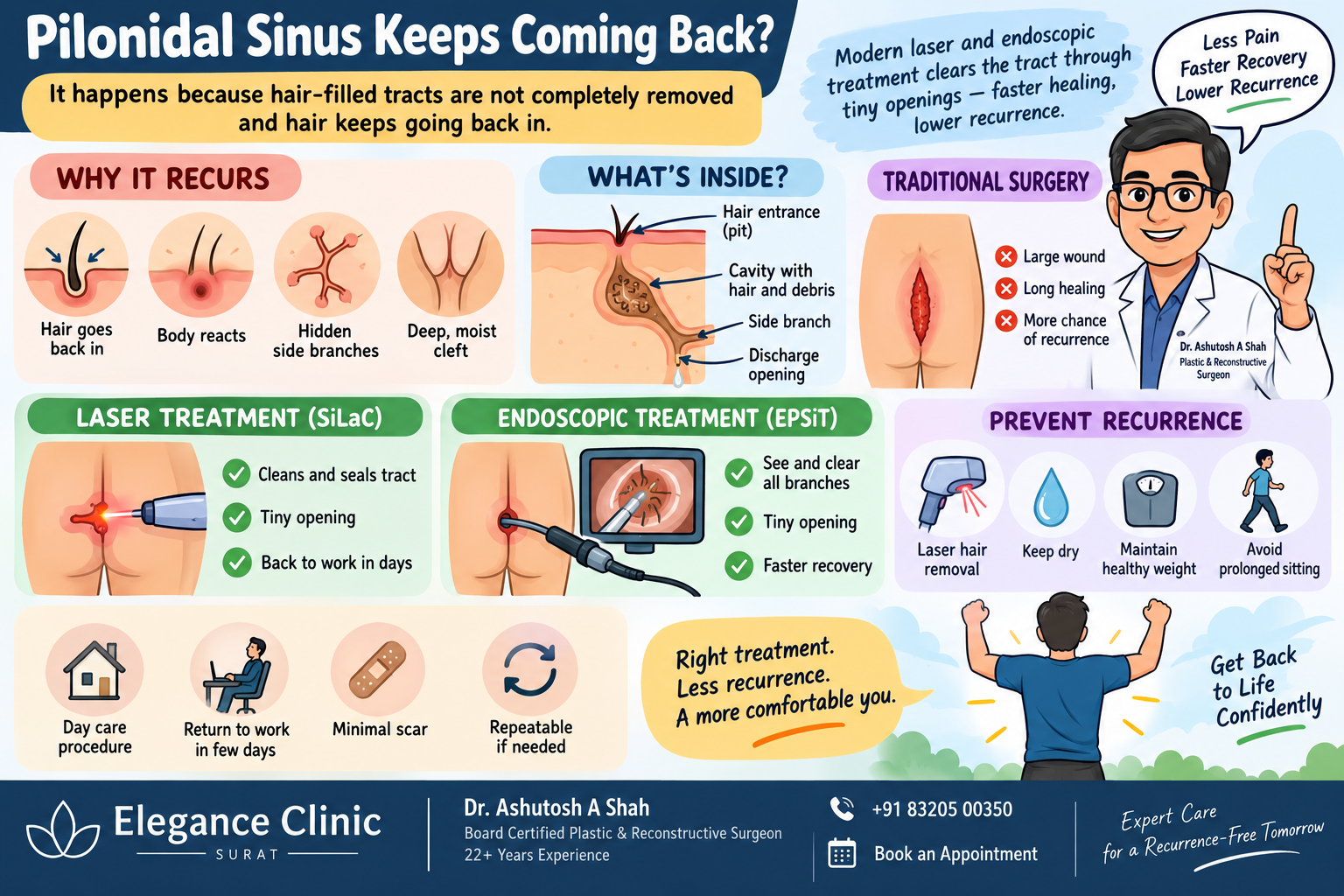
Pilonidal sinus recurs because the hair-filled tract and its side branches are not completely cleared, and hair keeps being driven back into the skin. Laser ablation and endoscopic treatment remove the tract through tiny openings instead of a wide excision, so healing takes days rather than weeks and recurrence falls.
Almost nobody researching pilonidal sinus is doing it for the first time. The typical patient has already had one operation, spent weeks with an open wound that needed daily packing, gone back to work, and then felt the same swelling and discharge return a few months later.
That is not bad luck and it is usually not a bad surgeon. It is what happens when a disease driven by hair and a deep skin fold is treated with a large midline wound in the one place on the body least able to heal a large midline wound. This post explains the mechanism of recurrence, what recurrent pilonidal sinus laser treatment and endoscopic treatment actually do differently, how the options compare, recovery, cost, and the prevention step most patients are never told about.
Why does pilonidal sinus keep coming back (pilonidal sinus baar-baar kyun hota hai)?
Pilonidal sinus recurs for two reasons working together: some part of the tract system was left behind, and the conditions that created it in the first place were never changed. Loose hair, a deep natal cleft, friction, moisture and prolonged sitting are all still there after the operation.
The disease is not a cyst you remove once. It is an ongoing process:
- Hair keeps being driven in. Loose hairs from the back and scalp collect in the natal cleft and are worked point-first into the skin by sitting and movement.
- The body reacts to hair as a foreign body. That reaction creates a cavity, which discharges through an opening, which becomes a chronic sinus.
- Midline wounds heal badly here. The natal cleft is moist, warm, under constant tension and repeatedly stretched every time you sit or stand. A midline scar is the single strongest predictor of the wound breaking down again.
- Side branches get missed. Most sinuses are not one straight tunnel. They branch, and a branch that is not found is a recurrence waiting to happen.
So a treatment that only removes tissue, without addressing the branches and without changing the hair and friction environment, is solving half the problem. The NHS guidance on pilonidal sinus describes the same disease mechanism and the same tendency to recur.
What is actually inside a pilonidal sinus?
A pilonidal sinus has three parts: one or more small midline pits where hair enters, a subcutaneous cavity containing hair, debris and granulation tissue, and one or more secondary openings, usually off to one side, where it discharges. Any treatment that does not deal with all three parts leaves disease behind.
Understanding the anatomy explains almost every treatment decision:
- The midline pits. Tiny, easy to miss, and the entry point for every future hair. Leave a pit and you have left the doorway open.
- The cavity. Lined with inflamed granulation tissue and packed with loose hair. It has to be emptied and its lining destroyed, not just drained.
- The side branches. The part surgeons cannot see with a blind instrument. This is precisely where endoscopic visualisation changes the game.
- The secondary opening. Usually lateral to the midline, and often the only thing the patient notices.
An important exception. If the area is acutely red, hot, severely painful and swelling by the day, possibly with fever, that is a pilonidal abscess. It needs urgent drainage first, not a planned laser procedure. Definitive treatment comes after the infection has settled.
Why does wide open excision have such a high recurrence rate?
Wide excision removes the disease, but it replaces it with a large open wound sitting directly in the midline of the natal cleft. That wound takes weeks to months to heal by secondary intention, needs regular packing, and the scar it leaves is in the worst possible position to withstand the tension and moisture of the area.
The three traditional approaches each fail differently:
- Excision left open to heal by secondary intention. Reliable clearance, but the healing time is measured in weeks to months of daily dressings, and the patient’s working life is badly disrupted.
- Excision with midline primary closure. Fast in theory, but this has the highest recurrence and wound breakdown of the common options, because the suture line sits exactly where the tension and moisture are worst.
- Off-midline flap procedures such as the Limberg flap, Karydakis procedure and Bascom cleft lift. These genuinely work: they move the scar off the midline and flatten the cleft, and they have the lowest recurrence of the open techniques. The trade-off is a much larger operation and a bigger scar.
Published recurrence figures vary widely between techniques, centres and how long patients were followed, so treat any single headline percentage with caution. The consistent finding across the literature is the direction, not the exact number: midline closure does worst, flattening the cleft and moving the scar off the midline does best, and leaving the wound open works but costs the patient weeks.
What is laser pilonidal sinus treatment (SiLaC)?
SiLaC, or sinus laser assisted closure, is a minimally invasive procedure in which the cavity is cleaned out through the existing openings, then a thin radial laser fibre is passed along the tract. The laser destroys the tract’s lining circumferentially, so the tunnel collapses and seals instead of being cut out.
What the procedure involves:
- The cavity is curetted and brushed clean of hair, debris and granulation tissue through the existing openings.
- The midline pits are excised with tiny punch incisions, closing the doorway that lets new hair in.
- A radial-emitting laser fibre is introduced and withdrawn slowly along the tract, delivering energy to the whole circumference of the lining.
- The tract shrinks and seals. There is no large open wound and usually no packing.
The appeal is obvious to anyone who has lived through an open excision: it is a day-care procedure, the openings are millimetres rather than centimetres, pain is modest, and most people return to desk work within days. It is also repeatable, which matters, because if it does not work the first time you have not burned any bridges. That is exactly why recurrent pilonidal sinus laser treatment has become the usual first choice for people already on their second or third operation. Details of the clinic’s laser platforms are on our laser treatment services page.
What is endoscopic pilonidal sinus treatment (EPSiT)?
EPSiT uses a fine endoscope passed through the existing opening so the surgeon can actually see inside the cavity. Hair and debris are removed under direct vision, every side branch is identified and cleared, and the lining is ablated. The whole point is that nothing is done blind.
This directly targets the commonest cause of recurrence. In a blind curettage, a branch running off at an angle simply cannot be found by feel. Under endoscopic vision it is visible, and it gets cleared.
The sequence is similar to SiLaC: the pits are excised, the cavity is visualised and cleaned through the endoscope, the lining is destroyed with an electrode, and the wound is left tiny. Recovery is comparable, in days rather than weeks.
Used together, the two techniques are complementary rather than competing: the endoscope finds and clears everything, and the laser seals it. A systematic review and meta-analysis comparing SiLaC and EPSiT is the right place to read the head-to-head data if you want the evidence rather than a clinic’s summary of it.
Laser vs endoscopic vs open excision vs flap procedures: how do they compare?
Minimally invasive options win decisively on recovery and are repeatable. Flap procedures win on recurrence in severe or repeatedly failed disease. Midline primary closure is the option to avoid. The right choice depends on how extensive your disease is and how many times it has already come back.
| Factor | Laser (SiLaC) | Endoscopic (EPSiT) | Open excision | Flap (Limberg / Karydakis / cleft lift) |
|---|---|---|---|---|
| Wound size | Millimetres, existing openings used | Millimetres, existing openings used | Large midline wound | Large, but off the midline |
| Anaesthesia | Local or spinal, day care | Local or spinal, day care | Spinal or general | Spinal or general |
| Dressings and packing | Minimal, usually none | Minimal, usually none | Daily packing for weeks | Standard wound care |
| Return to desk work | A few days | A few days | Weeks, with ongoing dressings | 1 to 3 weeks |
| Finds hidden side branches | Partly, by curettage | Yes, under direct vision | Yes, by removing everything | Yes, by removing everything |
| Recurrence risk | Low to moderate, repeatable if it occurs | Low to moderate, repeatable if it occurs | Moderate; highest with midline closure | Lowest of all options |
| Best suited to | Primary and recurrent disease of limited extent | Disease with suspected branching tracts | Very extensive or infected disease | Severe, repeatedly recurrent, very deep cleft |
| Scar | Barely visible | Barely visible | Midline, the worst position | Larger, but off the midline |
The single most useful line in that table is the last one for the minimally invasive options: because they do not destroy tissue planes, a failed laser or endoscopic procedure can simply be repeated, or escalated to a flap later. A failed flap leaves far fewer options.
What does recovery look like, day by day?
After laser or endoscopic treatment, most patients go home the same day, manage with oral painkillers, and return to desk work within 3 to 7 days. There is usually no packing. Full healing of the small openings generally takes 3 to 6 weeks, with a review at around 4 to 6 weeks.
- Day 0. Day-care procedure, home the same day. Mild soreness rather than severe pain. A simple dressing.
- Days 1 to 3. Oral painkillers as needed. Short walks encouraged. Keep the area clean and completely dry. Avoid prolonged sitting on a hard surface.
- Days 3 to 7. Most people return to desk work. Discharge from the openings reduces. A cushion helps for long sitting.
- Weeks 2 to 4. Openings closing. Gentle activity resumes. No cycling, bike riding or heavy gym work yet.
- Weeks 4 to 6. Review appointment. Most patients are fully healed and back to normal activity, including exercise.
- From week 6. Prevention starts, and this is the part that determines whether you are back here in a year.
Compare that with open excision, where the patient is typically looking at weeks to months of daily dressings and a wound that cannot be left unattended. For most working adults that difference is the entire decision.
How do you actually prevent another recurrence?
Surgery clears the disease, but prevention is what stops it returning, and it comes down to keeping hair out of the natal cleft and keeping the area dry. Laser hair removal of the natal cleft is the single most effective adjunct, and it is the step most patients are never offered.
The prevention checklist:
- Laser hair removal of the natal cleft and surrounding buttock skin. If loose hair is the raw material of the disease, removing the supply is the most logical intervention available. Shaving is a poor substitute: it creates short, sharp-tipped hairs that penetrate skin more easily than untouched ones.
- Keep the area scrupulously dry. Warmth and moisture are what let the process restart. Dry thoroughly after bathing and after sweating.
- Daily washing of the cleft with plain water or a mild cleanser, and rinsing away loose hair.
- Weight reduction where relevant. A deeper cleft traps more hair and holds more moisture.
- Break up prolonged sitting. Stand and move regularly. Long-distance driving and desk work are recognised risk factors.
- Breathable clothing. Avoid tight, non-breathable fabric over the area.
- Act early on any new discharge. A small early recurrence treated minimally invasively is a far smaller problem than one left for a year.
In our practice in Surat, the patients who come back years later are almost always the ones who did nothing about hair after the operation. Prevention is not an upsell here, it is the half of treatment that happens after you leave.
Who is NOT suitable for the minimally invasive options?
Laser and endoscopic treatment are not right for everyone. Very extensive disease with multiple widely separated tracts, an active abscess, a very deep natal cleft that has already defeated several operations, or severely scarred tissue from repeated surgery may all need a flap procedure instead.
The situations where a different plan is usually better:
- Acute abscess. Needs drainage first. Definitive treatment follows once settled.
- Very extensive or widely branching disease. Beyond what can be reliably cleared through small openings.
- Multiple previous failed operations with heavy scarring. A cleft lift or flap addresses the shape of the cleft itself, which is the underlying problem.
- A markedly deep natal cleft. Flattening the cleft may matter more than clearing the tract.
- Uncontrolled diabetes, immunosuppression or a smoking habit. These affect any wound, and should be addressed before elective surgery.
- Any unusual, long-standing non-healing wound must be assessed properly rather than assumed to be pilonidal.
A surgeon who offers only one technique will recommend that technique. Ask specifically which option they would choose for your particular disease and why. The full range of procedures offered is listed under our services.
What does pilonidal sinus treatment cost in India, and is it covered by insurance?
Laser or endoscopic pilonidal sinus treatment in India is commonly quoted in the range of about ₹50,000 to ₹1,50,000, depending on the extent of disease, the technique, anaesthesia and the facility. Unlike cosmetic procedures, pilonidal sinus is a medical condition, so most health insurance policies do cover it, subject to waiting periods and policy terms.
A written quote should list:
- Surgeon’s and assistant’s fees
- Anaesthetist’s fee and the anaesthesia type planned
- Operating theatre and day-care charges
- Pre-operative investigations, and imaging such as MRI or fistulography if a complex tract is suspected
- Dressings and all follow-up visits
- The policy if a repeat procedure is needed
- Whether GST is included
On insurance, the practical points are these. Pilonidal sinus surgery is generally an admissible claim because it is treating disease, not appearance. Most modern policies cover it as a day-care procedure, which matters because laser and endoscopic treatment do not involve an overnight stay. Waiting periods, sub-limits and pre-existing disease clauses still apply, and cashless treatment needs pre-authorisation before admission rather than a claim afterwards. Check your policy wording and confirm with the hospital’s insurance desk in advance. Where a claim is declined or a shortfall remains, EMI options are available.
Recurrent pilonidal sinus laser treatment at Elegance Clinic, Surat
Dr. Ashutosh A Shah is a board certified plastic and reconstructive surgeon with over 22 years of practice in Surat, Gujarat, including reconstructive wound and flap surgery. That matters for this condition specifically, because pilonidal sinus is one of the few problems where the same surgeon should be able to offer both the minimally invasive route and the flap reconstruction, rather than steering every patient toward the only procedure they perform.
Assessment here starts by mapping how extensive the disease actually is and how many previous operations have failed, because that, not preference, decides the technique. Patients are also told plainly that surgery without a hair-control plan afterwards is half a treatment. Equipment and platform details are on the laser treatment department page.
Next step
If your pilonidal sinus has come back after previous surgery, the useful question is not which operation is best in general, but how extensive your disease is now and which technique fits it. Book an appointment with Dr. Ashutosh Shah at Elegance Clinic, Surat, or call +91 83205 00350.
Medical disclaimer: This article is for education only and is not a substitute for professional diagnosis or treatment. A painful, rapidly swelling pilonidal area with fever may be an abscess and needs urgent medical attention. Please consult Dr. Ashutosh A Shah or a qualified surgeon about your own case.

