

|
Getting your Trinity Audio player ready...
|
✓ Medically reviewed by Dr. Ashutosh Shah, Plastic, Reconstructive & Cosmetic Surgeon (M.Ch., DNB)
Written by Dr. [DERMATOLOGIST NAME], [DEGREES], Consultant Dermatologist, Elegance Clinic, Surat. Reg. no. [REG NO]. [YEARS] years in medical and procedural dermatology.
Medically reviewed by Dr. Ashutosh A Shah, M.Ch., D.N.B. (procedural sections) · Published [DD Month 2026] · Last reviewed [DD Month 2026]
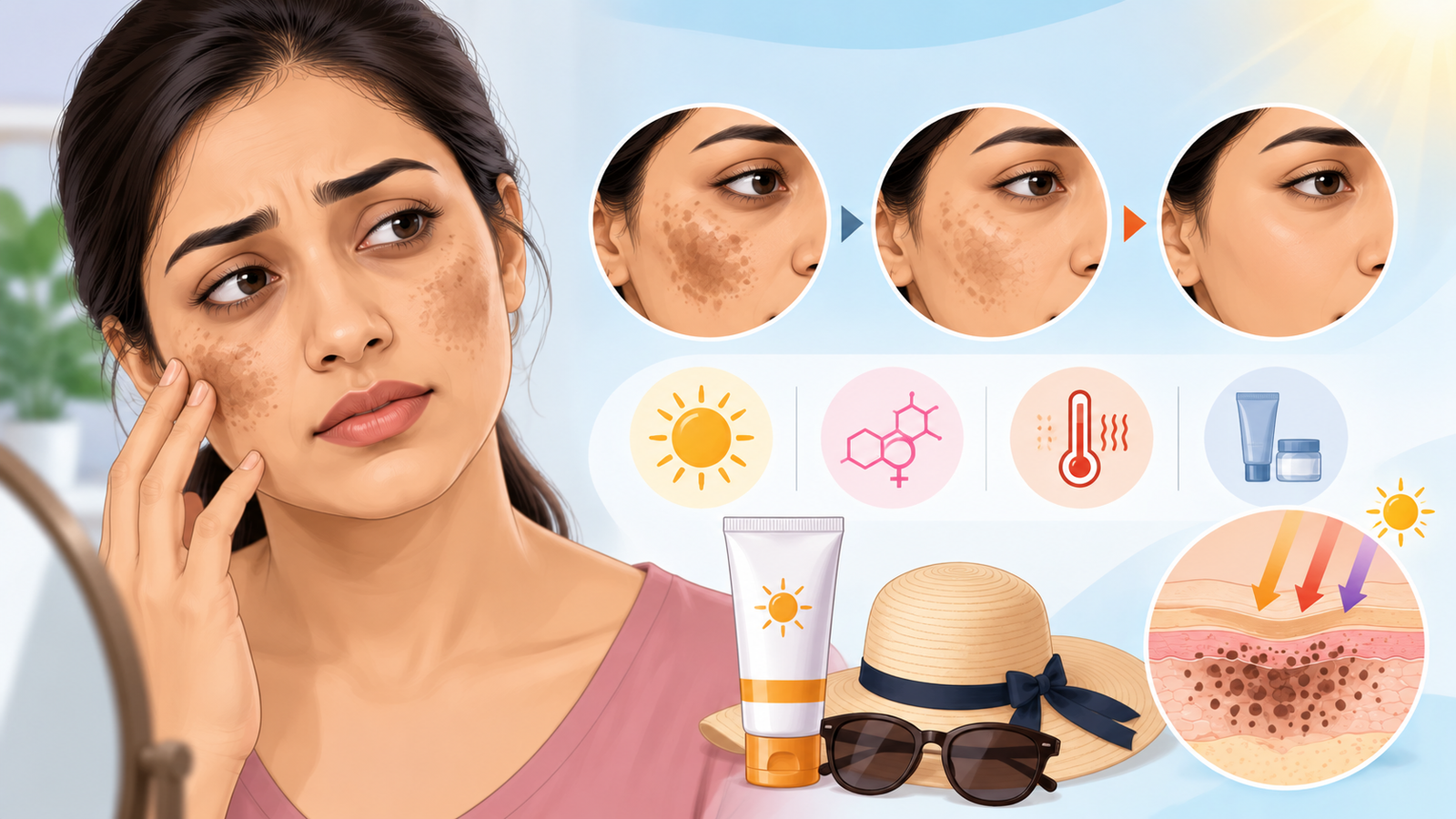
Melasma is a hormone and light driven pigmentation that appears symmetrically on the cheeks, forehead and upper lip. It relapses because the triggers, ultraviolet and visible light, heat and hormones, remain after treatment. Control comes from combining strict photoprotection with topical agents and gentle procedures, never from aggressive lasering alone.
Almost everyone reading this has already had one round of treatment. It faded. Then a summer, a pregnancy, or six months of ordinary life passed and it came back, often in exactly the same shape.
That is not a treatment failure and it is not your fault. It is what melasma does. This page explains why, how to tell melasma apart from the pigmentation it gets confused with, and what genuinely holds it down over years rather than weeks.
What is melasma, and how is it different from freckles and post-inflammatory pigmentation?
Melasma is a chronic pigmentary condition producing symmetrical brown or grey-brown patches, most often on the cheeks, forehead, upper lip and nose. The Cleveland Clinic describes it as light brown, dark brown or blue-grey patches, and lists recognised distribution patterns including centrofacial across the forehead, cheeks, nose and upper lip, malar across the cheeks and nose, and mandibular along the jawline.
It is common, and it is overwhelmingly a condition of women in their twenties and thirties. Published figures put it at between 1.5 and 33 percent of the population depending on the group studied, affecting 15 to 50 percent of pregnant women, with women accounting for around 90 percent of cases and onset typically between 20 and 40 years of age. It is more frequent in people with darker skin, which is why it is so prevalent in India.
Getting the diagnosis right matters, because the three things it is most often confused with respond very differently.
| Melasma | Freckles and sun spots | Post-inflammatory pigmentation | |
|---|---|---|---|
| Pattern | Symmetrical patches, both sides roughly mirroring each other | Discrete small spots, scattered, not symmetrical | Follows the shape of whatever caused it, so often irregular and one-sided |
| Where | Cheeks, forehead, upper lip, nose, jawline | Anywhere sun-exposed, including nose, cheeks, arms | Wherever the spot, injury, rash or treatment was |
| Edges | Blurred, blending into normal skin | Fairly sharply defined | Usually well defined, matching the original lesion |
| What drives it | Hormones plus light and heat together | Cumulative ultraviolet exposure | A single episode of inflammation: acne, eczema, a burn, a harsh treatment |
| Course | Chronic and relapsing. Fades and returns | Stable, darkens with sun | Usually fades over months once the cause has settled |
| Response to laser | Unpredictable, and can worsen. See below | Generally responds well | Depends on depth, and aggressive treatment can worsen it |
A clinician adds one more layer: whether your pigment sits in the upper layers of the skin, deeper in the dermis, or both. That distinction is made on examination, sometimes with a Wood’s lamp, and it predicts how much improvement is realistic. Deeper pigment responds considerably less to anything applied on the surface.
If your marks are following old acne spots rather than forming symmetrical patches, you are probably dealing with post-inflammatory pigmentation, which is a better prognosis and a different plan.
Why does melasma keep coming back?
Because treatment removes the pigment but nothing removes the tendency to make it, and the triggers are still there the day you finish.
This is the single most important idea on this page. Melasma is not an infection you clear or a growth you excise. It is a pigment-producing system that has become over-reactive in specific patches of skin. Treatment quietens those patches. It does not reset them.
The authorities are consistent and blunt about this. The Cleveland Clinic states plainly that there is no definitive treatment that will automatically make melasma disappear, and that the condition is typically chronic. The American Academy of Dermatology notes that melasma can last for years, or even a lifetime.
The numbers on relapse after procedures are sobering. A review in the Indian Journal of Dermatology, Venereology and Leprology reports that recurrences are common on discontinuing laser therapy, with rates reported as high as 81 percent, and 58.8 percent of patients recurring at one year.
Read those figures as information rather than as bad news. They tell you something useful: the question to ask a clinic is not “will this clear it” but “what does maintenance look like after it clears”. A clinic that has a good answer to the second question is the one worth choosing.
What actually triggers melasma?
Four things, and most people are managing only one of them.
- Ultraviolet light. The obvious one. The AAD states that sunlight causes the skin to make more pigment, which can darken existing melasma and cause new patches.
- Visible light. The one almost nobody knows about, and the reason ordinary sunscreen underperforms. High-energy visible light in the blue-violet range of roughly 415 to 455 nanometres is detected by pigment cells through a receptor called opsin 3, which triggers melanin production through a pathway that is entirely independent of ultraviolet. In other words, a sunscreen that blocks UV perfectly can still leave you exposed to a trigger that drives melasma.
- Heat. Infrared heat is a recognised trigger. This matters in Gujarat more than in the literature’s usual settings. Standing over a gas stove, a long commute in the sun, and hot kitchens all contribute, and none of them are fixed by sunscreen.
- Hormones. Pregnancy, hormonal contraceptives and hormone therapy. Pregnancy oestrogen and progesterone levels are the reason melasma affects such a high proportion of pregnant women.
Genetics sits behind all four. If your mother and sister have it, your skin is predisposed, and that predisposition does not go away.
Two more contributors worth naming because they are easily missed. Some medicines cause photosensitivity and can aggravate pigmentation, so it is worth mentioning everything you take. And irritating cosmetics or harsh treatments cause inflammation, and inflammation in melasma-prone skin makes pigment. Scrubs, strong home peels and aggressive facials frequently make this condition worse.
Can aggressive laser make melasma worse?
Yes, and this is the section most clinic pages leave out. It is worth reading carefully before you book anything.
The IJDVL review on optimising Q-switched lasers for melasma reaches a conclusion that cuts against most of what you will read on Indian clinic websites: lasers are not a first-line treatment for melasma, and are used at best as a last option in recalcitrant cases or in those who cannot tolerate other treatments.
Two specific things can go wrong.
- Rebound and worsening. Melasma-prone skin responds to injury by making pigment. Too much energy, or sessions too close together, inflames the skin and the skin answers with more pigment than you started with.
- Mottled hypopigmentation. The opposite problem, and the harder one. The same review reports mottled hypopigmentation as a recognised complication of laser toning, with the pigment inside the cells largely destroyed while the pigment cells themselves remain. The result is patchy pale spots scattered through the treated area. Pale patches on a brown face are considerably more difficult to disguise than the brown patches you came in with, and they do not reliably reverse.
When laser is reasonable, and how it should be done. The review describes the preferred approach as low fluence, a large spot size of 8 to 10 mm, a multi-pass technique, sessions spaced two weeks apart, over a course of six to ten sessions. In plain terms: gentle, spread out, and part of a plan that also includes sun protection and topical treatment.
Questions worth asking before you agree to laser for melasma:
- Have we tried photoprotection and topical treatment properly first, for long enough?
- What energy and spacing are you using, and why that rather than something stronger?
- What happens if it rebounds, and what is the plan then?
- What is the maintenance plan for after the course finishes?
A clinic that answers those four clearly is doing this properly. A clinic that offers you a package of aggressive sessions promising clearance is describing a treatment plan the literature does not support. Our approach to laser for pigmentation follows the cautious protocol for exactly this reason.
What does photoprotection that actually works look like on Indian skin?
More than one product, and more demanding than most people are told. This is the foundation, and everything else works poorly without it.
Use a tinted sunscreen, not a clear one. This is the single highest-value change most people can make. Iron oxides, which are what give a tinted sunscreen its colour, are what block visible light. The evidence reported by Dermatology Times is that iron oxide formulations provided superior protection against visible-light-induced hyperpigmentation in patients with skin of colour compared with a non-tinted mineral SPF 50 or higher sunscreen. A clear sunscreen, however high the SPF, leaves the visible-light trigger largely unaddressed.
The AAD recommends broad-spectrum SPF 30 or higher containing zinc oxide, titanium dioxide or iron oxide. For melasma specifically, aim higher and insist on the tint.
The rest of the protocol:
- Apply enough. Most people apply a third of what is tested. For a face, roughly two finger-lengths of product is the usual guide.
- Reapply. Every two to three hours of daylight exposure. A single morning application does not last a working day.
- Wear it indoors too. Visible light passes through window glass, which ultraviolet B largely does not. If you sit by a window, you are being exposed.
- Add a hat and shade. The AAD recommends wide-brimmed hats and seeking shade alongside sunscreen, not instead of it.
- Manage heat. Sunscreen does nothing about infrared. Where you can, reduce direct heat exposure to the face.
If you do nothing else from this page, switch to a tinted broad-spectrum sunscreen and reapply it. Patients who do only that often see more improvement over a year than patients who do everything else and skip it.
What do topical treatments do, and how long do they take?
They reduce pigment production, and they work slowly. Months, not weeks.
The AAD’s position is that the most effective treatment often combines sun protection with medications applied to the skin, and sometimes a procedure. Note the order. Topicals are the main treatment, not the preparation for the real one.
The Cleveland Clinic lists the agents used, including hydroquinone, tretinoin, azelaic acid, tranexamic acid and others, and notes that the combination of hydroquinone, tretinoin and a moderate topical steroid has had the best reported effect on melasma.
Three things to understand before you start.
- These are prescription decisions. The effective agents need a doctor to select them, set the strength, and decide how long to use them for. They are not interchangeable with over-the-counter creams, and the combination products in particular need supervision because a topical steroid used long-term on the face causes its own problems.
- Irritation is counterproductive here. If a product makes your skin red, sore or flaky, stop and ask rather than pushing through. In melasma-prone skin, irritation produces pigment. People frequently make this condition worse by using something too strong for too long.
- Judge it at three months, not three weeks. Pigment turnover is slow. A month of use tells you almost nothing.
This is also why buying a “pigmentation cream” without a diagnosis is a poor bet. The right agent depends on whether your pigment is superficial or deep, which you cannot see for yourself.
Which procedures genuinely help?
The gentle ones, used as support for the topical and photoprotection plan rather than as a replacement for it.
- Superficial chemical peels. Glycolic, lactic, kojic and similar agents at appropriate strengths, done as a course. These are the mainstay procedural option because they act on the surface without the energy delivery that risks rebound. The peel must be selected for your skin, since a peel that is too strong causes the same inflammation problem as aggressive laser.
- Low fluence laser toning, under the constraints described above, for cases that have not responded to first-line treatment.
- Microneedling, used in some protocols to improve delivery of topical agents. Gentle settings only, for the same reason as everything else in this list.
What to avoid. Aggressive scrubs, strong unsupervised home peels, harsh facials, and any procedure that leaves your skin visibly inflamed for days. All of them risk converting a manageable melasma into melasma plus post-inflammatory pigmentation, which is harder to treat than either alone.
The full range of options available here is on our laser treatment page, and related facial procedures under face makeover.
What about oral treatment, and why is it a prescription decision?
Low-dose oral tranexamic acid has genuine evidence in melasma. It also has a contraindication list that makes it a medical decision rather than a product choice, and this section exists mainly so you know what to tell your doctor.
What it is and what it does. Tranexamic acid is a lysine analogue that inhibits plasminogen activation. In melasma it appears to work by attenuating pigment cell activation and reducing the blood-vessel-related signals that feed the process. A narrative review of low-dose oral tranexamic acid for melasma reports that in the most informative trial, the modified melasma area and severity index fell by 49 percent with oral tranexamic acid compared with 18 percent on placebo at three months.
That is a real effect and clearly better than placebo. It is also, as with everything else here, a treatment whose effect attenuates after it is stopped.
Who should not take it. The same review sets out the situations in which it should be avoided:
- Any previous blood clot in a vein, pulmonary embolism, stroke or heart attack
- Known thrombophilia, meaning an inherited or acquired clotting tendency
- Active cancer
- Clinically significant kidney impairment
- Concurrent systemic oestrogen, which includes many hormonal contraceptives and hormone therapy
The review’s position is that safe use depends more on patient selection than on indiscriminate laboratory testing, which is a polite way of saying that the history you give matters more than any test. Tell your doctor about every clot, every hospital admission, every hormone you take and every family history of clotting, even if it seems unconnected to your face.
On the safety evidence. A propensity score-matched study of melasma patients found no significant increase in venous thromboembolism at 120, 180 or 365 days. Broader database analyses have produced conflicting signals, and the review is explicit that a small residual risk cannot be excluded. Common and reversible effects include menstrual irregularity, stomach upset and headache.
How it is used. As a course rather than indefinitely. The review recommends the shortest useful course, commonly three to six months in published practice, then transitioning to photoprotection and topical maintenance. Its use for melasma is off-label, and informed consent covering that, the relapse risk and the warning signs of a clot is part of prescribing it properly.
Deliberately not stated on this page: the dose. Tranexamic acid is easy to obtain in India and the contraindications above are real. If this is right for you, a doctor who has taken your history will tell you what to take. If it is not right for you, that is exactly the conversation you need to have.
What is safe for melasma in pregnancy?
Photoprotection, and mostly patience. Several of the effective treatments are specifically not for use in pregnancy.
What continues. Tinted broad-spectrum sunscreen, hats, shade and heat avoidance. All of it is safe and all of it is worth doing, because it limits how dark the pigmentation becomes.
What waits. Prescription lightening combinations, oral treatment and elective procedures are generally deferred. Do not start, stop or change any medicine on the basis of an article. Ask your obstetrician or dermatologist, who can tell you what is appropriate for your specific situation.
The genuinely reassuring part. Pregnancy-related melasma commonly improves on its own. The Cleveland Clinic notes that it typically fades within three months after the pregnancy ends, and also that it is not likely to clear while you are still pregnant or taking hormonal contraceptives. So if you are pregnant and watching it darken, the honest advice is to protect your skin, wait, and reassess a few months after delivery rather than pursuing treatment now.
If it has not settled several months after delivery, or if you are continuing hormonal contraception, that is the point to be assessed.
What does maintenance involve, and why does it decide the outcome?
Maintenance is not the thing that happens after treatment. It is the treatment.
Given relapse rates of the order reported above, the difference between someone whose melasma stays controlled for years and someone whose melasma returns in six months is almost entirely what happens after the active phase ends.
A realistic long-term plan looks like this:
- Photoprotection, permanently. Tinted sunscreen every day, reapplied, indoors and outdoors, in monsoon as well as summer. This is not a treatment phase, it is a change to your routine.
- A maintenance topical, usually gentler than the active-phase one, used as your doctor directs. Many plans cycle agents rather than using one continuously.
- Scheduled review, so a small relapse gets addressed early rather than after it has spread.
- Trigger management. If hormonal contraception is a driver for you, that is a conversation worth having with your doctor about alternatives. If heat exposure is a driver, some of that is modifiable.
- Restraint. Resisting the urge to escalate to something aggressive during a flare, which is how most people end up worse.
Patients who accept melasma as a long-term condition to be managed do well. Patients looking for the treatment that will finish it tend to cycle through clinics, escalate, and eventually damage their skin.
What does melasma treatment cost, and how long does it take?
These are researched market ranges across India for 2026, given so you can sanity-check a quote. They are not a quotation from this clinic.
| Item | Typical market range, India 2026 |
|---|---|
| Superficial chemical peel, per session | Roughly Rs 1,000 to Rs 6,500 depending on the agent |
| Chemical peel, Gujarat reference point | Ahmedabad figures published at about Rs 2,500 to Rs 5,000 |
| Melasma-specific advanced peel, per session | Quoted from about Rs 4,150 |
| Laser toning, per session | Quoted from about Rs 7,000 |
| General per-session range quoted for melasma treatment | About Rs 3,000 to Rs 15,000 |
| Sunscreen and prescription topicals | An ongoing monthly cost, and the one most people underestimate |
On timelines. Expect to judge topical treatment at three months rather than three weeks. A peel course runs over several sessions spaced weeks apart. Where laser toning is appropriate, the published approach is six to ten sessions at two-week intervals. And maintenance is indefinite, which is the cost line most quotes leave out.
The most useful question to ask any clinic: what does year two look like, and what does it cost. A plan that only covers the first three months is not a plan for a relapsing condition.
Melasma care at Elegance Clinic, Surat
The approach here is the one the evidence supports, in the order the evidence supports it: establish the diagnosis and the depth of pigment, build photoprotection first, add topical treatment under supervision, and use procedures as support rather than as the headline.
What an assessment involves: examination to confirm this is melasma rather than freckling or post-inflammatory pigmentation, an assessment of whether the pigment is superficial or deeper, a review of your triggers including hormones, medicines, heat exposure and what you are currently applying, and a written plan with a maintenance phase and a review date.
Three things you will not be told here. That melasma can be cleared permanently, because four separate authorities say otherwise. That a course of aggressive laser is the answer, because the Indian dermatology literature says it is a last option. Or that you can stop the sunscreen once it fades.
If you have already been treated elsewhere and it returned, bring what you were given. Knowing what has already been tried, and at what strength, genuinely changes the plan.
Next step
If your pigmentation has faded and returned more than once, the useful next step is a proper diagnosis and a plan with a maintenance phase, not another course of whatever was tried last time.
- Bring every cream and prescription you have used, including the ones that did not work
- Note when it first appeared and whether it started with a pregnancy or a contraceptive
- List any medicines you take, since some increase light sensitivity
- Be honest about sun and heat exposure, because the plan depends on it
Book a pigmentation assessment at Elegance Clinic, Surat
Medical disclaimer. This article is general health information and is not a substitute for examination, diagnosis or treatment by a qualified doctor. Prescription topical and oral treatments must be prescribed and supervised, and this page deliberately does not give doses or strengths. Do not start, stop or change any medicine on the basis of this article, particularly during pregnancy or while breastfeeding. Cost figures are researched market ranges for orientation only and are not a quotation. Seek medical assessment rather than cosmetic treatment if a pigmented patch is changing in size, shape or colour, is raised, bleeds, or appears on one side only.

