

|
Getting your Trinity Audio player ready...
|
✓ Medically reviewed by Dr. Ashutosh Shah, Plastic, Reconstructive & Cosmetic Surgeon (M.Ch., DNB)
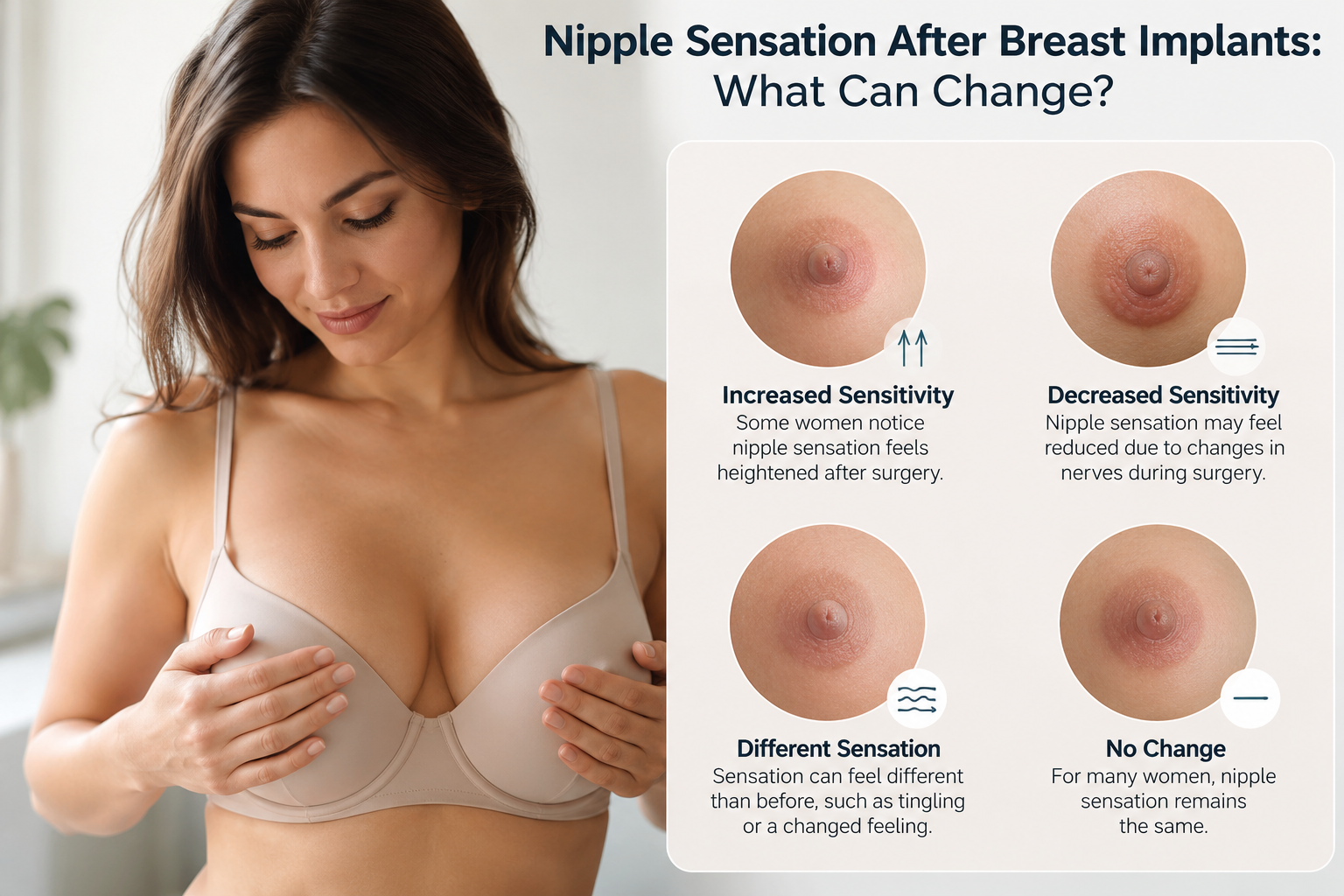
Nipple sensation after breast implants can temporarily decrease, increase, or feel different because breast augmentation may stretch or irritate sensory nerves. Many women notice gradual improvement over several months as swelling settles and nerves recover. However, some changes can last longer or become permanent. Implant size, incision placement, surgical technique, and individual anatomy influence the risk.
Breast augmentation can improve breast volume and shape, but patients often have questions beyond appearance.
Will the nipples feel normal after surgery? Can breast implants cause numbness? Will increased sensitivity make clothing uncomfortable? Could changes in sensation affect intimacy?
These are important concerns because the breasts and nipples contain sensory nerves that respond to touch, pressure, and temperature.
Understanding what changes are possible helps patients make informed decisions before breast augmentation and recognize when postoperative symptoms need medical attention.
Can Breast Implants Change Nipple Sensation?
Yes. Breast augmentation can affect nipple sensation because the operation involves creating space for an implant and stretching the surrounding tissues.
The nipple and areola receive sensory signals through nerves travelling from the chest wall into the breast.
During surgery, these nerves may experience stretching, pressure, or irritation.
In some cases, nerves may be injured.
The resulting changes may include:
- Reduced nipple sensitivity
- Complete or partial numbness
- Increased sensitivity to touch
- Tingling or pins-and-needles sensations
- Temporary burning or shooting sensations
- Unequal sensation between the breasts
Not every patient experiences these symptoms.
Many women retain normal nipple sensation after breast augmentation.
However, no surgical technique can guarantee that sensation will remain unchanged.
Why Does Numbness Occur After Breast Augmentation?
Numbness after breast augmentation can develop when sensory nerves are stretched, compressed, or disrupted during surgery.
The breast receives sensation through several nerve branches, particularly the intercostal nerves.
The fourth intercostal nerve commonly contributes significantly to nipple-areola sensation, although individual nerve patterns vary.
1. Tissue Stretching
Placing an implant increases breast volume and stretches the surrounding skin and tissues.
This stretching may temporarily affect sensory nerve function.
Larger changes in breast volume can create greater tissue tension.
2. Surgical Dissection
The surgeon creates a pocket to accommodate the implant.
Although careful surgical techniques aim to preserve important structures, nerve branches may be affected during dissection.
3. Postoperative Swelling
Swelling is a normal part of healing.
Temporary pressure from swollen tissues may contribute to altered sensation.
As swelling decreases, some patients notice improvement.
4. Scar Formation
Healing creates scar tissue around surgical areas.
In some patients, scar-related irritation or pressure may contribute to persistent sensory symptoms.
5. Individual Nerve Anatomy
Sensory nerve pathways are not identical in every patient.
This is one reason two women undergoing similar procedures may experience different postoperative sensations.
What Types of Nipple Sensation Changes Are Possible?
Not all sensory changes feel the same.
Some patients experience numbness, while others become unusually sensitive.
| Sensation Change | What It Feels Like | Possible Explanation |
|---|---|---|
| Reduced sensation | Touch feels weaker than before. | Temporary nerve irritation or injury |
| Numbness | Little or no feeling in part of the nipple or areola | Altered sensory nerve transmission |
| Hypersensitivity | Clothing or light touch feels uncomfortable. | Nerve irritation during healing |
| Tingling | Pins-and-needles sensations | Changes in nerve signaling |
| Burning sensation | Warm, sharp or uncomfortable feeling | Possible nerve irritation |
| Unequal sensation | One nipple feels different from the other. | Differences in swelling, nerve pathways,, or healing |
These symptoms can overlap.
A patient may experience numbness in one area and increased sensitivity in another.
The presence of tingling does not necessarily prove that nerve recovery is occurring.
Persistent or worsening symptoms should be discussed with the surgeon.
How Long Does Nipple Sensation Take to Return After Breast Implants?
Recovery varies considerably.
Some patients experience improvement within weeks, while others notice changes over several months.
Nerve-related recovery can continue for a year or longer in selected cases.
However, complete recovery cannot be guaranteed.
General Recovery Timeline
| Time After Surgery | Possible Sensation Changes |
|---|---|
| First 1–2 weeks | Numbness, swelling, tenderness,, or hypersensitivity |
| Weeks 3–6 | Swelling gradually decreases; sensation may fluctuate. |
| Months 2–3 | Some patients notice gradual sensory improvement. |
| Months 3–6 | Further improvement may occur as healing progresses. |
| Months 6–12 | Sensation may continue to settle. |
| Beyond 12 months | Persistent changes may improve further, but some can be permanent. |
This timeline describes possible patterns rather than guaranteed recovery milestones.
Is Numbness After Breast Augmentation Permanent?
Sometimes.
Many sensory changes improve, but some patients experience lasting reduction or alteration in nipple sensation.
The likelihood depends on factors such as nerve injury, surgical technique, implant size, and individual healing.
A surgeon cannot reliably predict complete sensory recovery for every patient.
Does Implant Size Affect Nipple Sensation?
Implant size may influence the amount of stretching placed on breast tissues.
A relatively large implant in a patient with limited existing breast tissue may create greater tension than a smaller implant.
This can potentially increase pressure or stretching around sensory nerves.
However, implant size is not the only factor.
Breast dimensions, tissue thickness, skin elasticity, and surgical technique also influence the outcome.
Are Smaller Breast Implants Safer for Sensation?
Smaller implants may reduce tissue stretching in some patients, but they do not eliminate the risk of nerve-related changes.
The most appropriate implant should match the patient’s anatomy and aesthetic goals.
Choosing implant size solely according to cup size may overlook important anatomical limitations.
A personalized assessment helps balance appearance, tissue support, and potential complications.
Does Implant Placement Affect Nipple Sensitivity?
Breast implants may be placed above or partially beneath the chest muscle.
These approaches involve different tissue planes.
Subglandular Placement
The implant sits behind the breast tissue and above the pectoral muscle.
The surgeon creates a pocket close to the breast tissue.
Sensory changes remain possible depending on tissue handling and nerve anatomy.
Submuscular Placement
The implant sits partially or substantially beneath the pectoral muscle.
This approach changes the dissection plane but does not eliminate the possibility of nerve irritation or injury.
Dual-Plane Placement
Dual-plane augmentation combines elements of submuscular positioning with controlled release of lower breast tissue.
The technique may be appropriate for certain breast shapes.
However, there is insufficient evidence to promise normal nipple sensation based on implant placement alone.
The best implant position should be chosen according to overall anatomy and surgical goals, not a guarantee of preserved sensitivity.
Can the Incision Location Affect Nipple Sensation?
Incision placement may influence the risk of sensory changes.
Common breast augmentation incisions include:
Inframammary Incision
This incision follows the natural fold beneath the breast.
It allows access to the implant pocket without making an incision directly around the nipple.
However, sensory nerve changes can still occur.
Periareolar Incision
This incision is made along part of the border of the areola.
Depending on the surgical technique, it may involve dissection near important nipple-area structures.
Patients should discuss possible sensory changes before choosing this approach.
Transaxillary Incision
This incision is placed in the armpit.
Although it avoids a visible incision on the breast, sensory changes remain possible because implant pocket creation can still affect surrounding nerves.
No incision approach completely eliminates the risk.
Can Breast Implants Increase Nipple Sensitivity?
Yes.
Some women experience increased nipple sensitivity after augmentation.
Light contact with clothing, towels, or bedsheets may feel unusually intense.
This can be uncomfortable during early recovery.
Possible contributing factors include swelling, tissue tension, and nerve irritation.
What Can Help With Increased Sensitivity?
Depending on the surgeon’s instructions, patients may benefit from:
- Wearing a comfortable postoperative support bra
- Avoiding friction from rough fabrics
- Choosing loose, soft clothing
- Avoiding unnecessary pressure on healing breasts
- Taking prescribed pain medicines as directed
- Attending scheduled postoperative reviews
Do not apply numbing creams, perform vigorous massage, or attempt nerve-desensitization exercises without medical approval.
If sensitivity becomes severe or persistent, the surgeon should assess the symptoms.
Can Breast Implants Affect Intimacy?
Changes in nipple sensation can influence how touch feels during intimacy.
Some women notice no meaningful difference.
Others experience reduced sensitivity, increased sensitivity, or discomfort.
These changes may affect personal comfort and sexual satisfaction, particularly when nipple stimulation was previously important.
However, breast augmentation does not automatically reduce sexual pleasure or overall sexual function.
Intimacy involves many physical, psychological and relationship factors.
Does Reduced Nipple Sensation Mean Reduced Sexual Pleasure?
Not necessarily.
A reduction in nipple sensitivity may change one aspect of physical sensation, but it does not determine overall sexual satisfaction.
Individual experiences vary.
Some patients report improved body confidence after augmentation, while others find unexpected sensory changes distressing.
Both experiences deserve respectful discussion during preoperative counselling.
When Is Physical Intimacy Safe After Surgery?
Patients should avoid pressure, friction and direct manipulation of healing breasts until the surgeon confirms that these activities are safe.
The appropriate timing depends on wound healing, discomfort and the extent of surgery.
Gentle non-breast contact may be possible earlier, but patients should follow their own postoperative instructions.
Can Nipple Sensation Changes Affect Breastfeeding?
Nipple sensation contributes to the nerve signals involved in milk release.
Significant nerve disruption may affect the milk-ejection reflex in some patients.
However, altered nipple sensation does not automatically prevent breastfeeding.
Milk production and breastfeeding success also depend on glandular tissue, milk ducts, hormonal factors and the baby’s ability to transfer milk.
Many women breastfeed successfully after breast augmentation.
Patients planning future pregnancies should discuss their goals before surgery.
How Is Nipple Sensation Assessed Before Breast Implant Surgery?
A preoperative consultation should include questions about existing nipple and breast sensitivity.
This helps establish whether sensory changes were present before surgery.
The surgeon may assess:
- Previous breast operations
- Existing numbness or hypersensitivity
- Breast asymmetry
- Skin and tissue thickness
- Breast dimensions
- Implant size preferences
- Incision and implant placement options
- Future pregnancy and breastfeeding plans
A documented baseline can help when reviewing postoperative changes.
Patients should understand that subjective sensation is difficult to measure precisely and may vary naturally.
Breast Sensitivity After Implants: What Is Normal and What Is Not?
Some temporary sensory changes are common during recovery.
However, certain symptoms deserve prompt evaluation.
Changes That May Occur During Healing
- Mild numbness
- Temporary tingling
- Increased sensitivity
- Gradually improving tenderness
- Differences in sensation between the breasts
Contact Your Surgeon If You Notice:
- Persistent or worsening burning pain
- Severe sensitivity that prevents normal daily activities
- Increasing redness or warmth
- New discharge from an incision
- Fever
- Sudden breast swelling
- New or progressively worsening numbness
- Significant changes in breast colour
Sudden severe pain, rapidly increasing swelling, or signs of impaired blood supply require urgent assessment.
Sensory changes accompanied by chest pain or breathing difficulty require emergency medical attention.
Can Nipple Sensation Be Restored After Breast Implants?
Treatment depends on the cause.
When symptoms result from temporary nerve irritation or swelling, observation and time may allow improvement.
The surgeon may recommend continued follow-up and appropriate symptom management.
Persistent symptoms may require further assessment to identify nerve-related pain, implant complications or another cause.
No universally effective treatment guarantees restoration of normal nipple sensation after augmentation.
Should You Massage the Nipples to Restore Sensation?
Not without medical advice.
Aggressive massage or pressure can irritate healing tissues.
Any rehabilitation or desensitisation technique should be discussed with the treating surgeon.
Nipple Sensation After Breast Implants: Consultation at Elegance Clinic
Patients considering breast augmentation should understand both cosmetic outcomes and possible changes in breast sensitivity.
At Elegance Clinic, Dr. Ashutosh A Shah, MBBS, MS, MCh and DNB, is a plastic and reconstructive surgeon practising since 2004, with over 22 years of experience. During consultation, he evaluates breast anatomy, tissue characteristics, implant size, and surgical options while discussing possible complications, including changes in nipple sensation. Patients should understand that careful surgical planning may reduce avoidable tissue injury but cannot guarantee preservation of normal sensitivity.
Women considering augmentation can explore the clinic’s breast treatment services.
An informed decision should consider appearance, recovery, scarring, nipple sensitivity, and future breastfeeding plans.
Frequently Asked Questions
1. Is Nipple Numbness Normal After Breast Implants?
Temporary numbness can occur after breast augmentation because swelling and surgical tissue manipulation may affect sensory nerves. Many patients notice improvement, but persistent changes are possible.
2. How Long Does Nipple Sensation Take to Return After Breast Augmentation?
Some patients improve within weeks or months, while others experience gradual changes over a year or longer. Complete recovery cannot be guaranteed.
3. Can Breast Implants Make Nipples More Sensitive?
Yes. Increased sensitivity may occur during healing. Clothing or light touch may feel uncomfortable. Persistent or severe hypersensitivity should be discussed with the surgeon.
4. Can Breast Implants Permanently Damage Nipple Nerves?
Permanent sensory changes are possible, although many postoperative changes improve. The risk depends on individual anatomy, surgical technique and the extent of nerve injury.
5. Does Implant Size Affect Nipple Sensation?
Larger implants may create greater tissue stretching in some patients. However, implant size alone does not predict sensory changes. Existing breast anatomy and surgical technique also matter.
6. Can Breast Implants Affect Sexual Pleasure?
Changes in nipple sensation may influence how breast stimulation feels during intimacy. However, overall sexual satisfaction varies and is not determined by nipple sensitivity alone.
7. Will Nipple Sensation Return if I Remove My Breast Implants?
Not necessarily. Implant removal may not reverse nerve injury that occurred during the original surgery. The likelihood of improvement depends on the cause of the sensory change.
8. When Should I Worry About Nipple Sensation After Breast Implants?
Seek medical advice if numbness worsens, pain becomes severe or sensory changes occur with redness, fever, discharge, or sudden swelling. These symptoms may indicate a complication requiring evaluation.
Conclusion
Nipple sensation after breast implants can remain unchanged, temporarily decrease, become more sensitive, or occasionally change permanently.
The most common contributing factors include tissue stretching, swelling, nerve irritation, and surgical dissection.
Many patients experience gradual improvement as healing progresses, but there is no guaranteed recovery timeline.
Changes in nipple sensitivity may also affect physical comfort and intimacy, making preoperative counselling important.
At Elegance Clinic, patients can discuss implant selection, surgical approaches, and possible sensory changes with Dr. Ashutosh A Shah before undergoing breast augmentation.
The most important step is understanding that breast implants can change nipple sensation and that complete preservation or recovery of sensitivity cannot be promised.
