

|
Getting your Trinity Audio player ready...
|
✓ Medically reviewed by Dr. Ashutosh Shah, Plastic, Reconstructive & Cosmetic Surgeon (M.Ch., DNB)
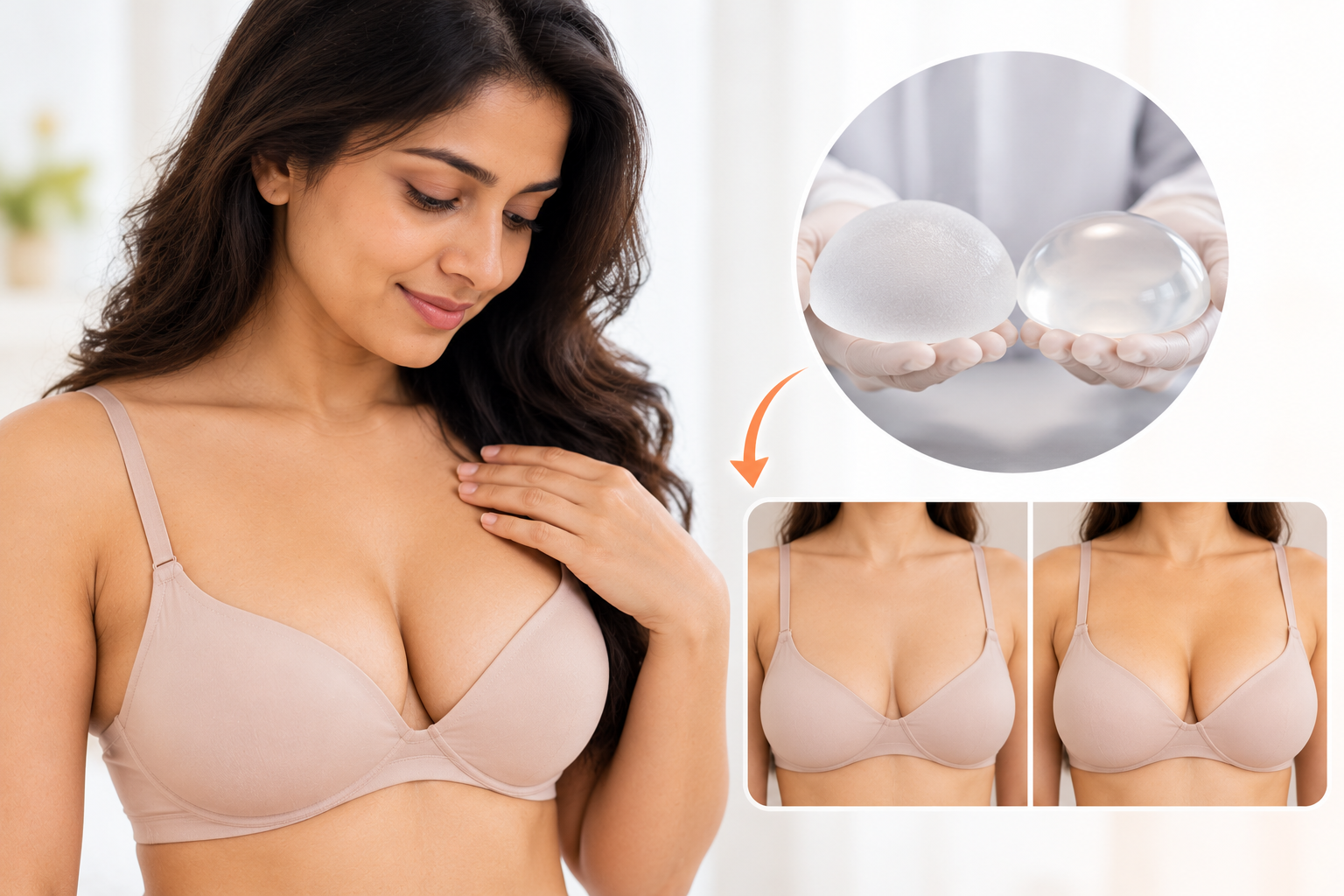
Natural looking breast implants are chosen to complement your existing breast shape, chest width and body proportions rather than create a noticeably enlarged appearance. A subtle result depends on implant dimensions, projection, placement, existing breast tissue and skin elasticity. The goal is balanced enhancement, although no implant type or technique can guarantee a completely natural appearance.
Some women want a modest increase in breast volume without a dramatic change in their appearance. Others want to restore fullness after pregnancy, breastfeeding or weight loss.
For these patients, subtle breast augmentation may be an option.
However, choosing a smaller implant does not automatically guarantee a natural result. The implant must suit the patient’s anatomy, and the surgeon must consider how it will interact with existing breast tissue.
At Elegance Clinic, Dr. Ashutosh A Shah, MS, MCh (Plastic Surgery), D.N.B., with over 22 years of experience, evaluates breast proportions, tissue coverage, skin quality and individual goals before discussing breast augmentation options.
What Are Natural Looking Breast Implants?
Natural looking breast implants are implants selected and positioned to create breast proportions that appear balanced with the patient’s body.
A natural-looking result may include:
- A gradual transition from the upper chest to the breast
- Breast volume proportionate to the shoulders and waist
- Appropriate fullness without excessive projection
- Implant edges that are not easily visible
- A breast shape that complements existing anatomy
- Reasonable symmetry, recognising that perfect symmetry is uncommon
The definition of natural appearance differs between patients.
One person may prefer a very modest increase, while another may want fuller breasts that still look proportionate.
The important question is not simply which implant looks most natural, but which implant is suitable for the individual.
Can Breast Implants Look Natural?
Yes. Breast implants can produce a relatively natural-looking appearance when their size, shape and position suit the patient’s anatomy.
However, results depend on several factors.
Patients with adequate existing breast tissue may have better implant coverage than patients with very little natural tissue.
Similarly, an implant that fits within the natural breast footprint is generally less likely to create an excessively wide or projected appearance.
A successful consultation should include discussion of the patient’s desired look, anatomical limitations and possible compromises.
What Factors Affect Natural Looking Breast Implants?
Several decisions influence the final appearance.
1. Implant size
Implant volume is measured in cubic centimetres (cc).
A larger implant generally increases breast volume more than a smaller implant, but the same volume can look different on different body types.
For example, an implant of a particular volume may appear subtle on someone with a wider chest but more prominent on someone with a narrow chest.
This is why choosing implant size from photographs alone is unreliable.
2. Chest width
The natural width of the breast helps determine the appropriate implant base diameter.
An implant that is too wide for the breast footprint may extend beyond the desired boundaries.
An implant that is too narrow may not produce the expected contour.
Chest and breast measurements are therefore important during surgical planning.
3. Implant profile
Implant profile describes how far the implant projects relative to its base width.
Common options include low, moderate and high profiles, although terminology differs between manufacturers.
A moderate-profile implant may suit some patients seeking gentle projection.
However, a high-profile implant is not automatically unnatural, and a low-profile implant is not automatically the best choice.
The correct profile depends on implant dimensions and individual anatomy.
4. Existing breast tissue
Natural breast tissue helps cover the implant.
Patients with limited tissue coverage may have a greater risk of visible implant edges or rippling.
The surgeon considers tissue thickness when selecting the implant and placement plane.
5. Skin elasticity
Skin must accommodate the selected implant.
Tight skin, loose skin and previous stretching can affect the final contour.
Patients with significant sagging may need a different surgical plan, potentially including a breast lift.
6. Implant placement
The position of the implant relative to the chest muscle and breast tissue can influence its appearance.
Placement is selected according to tissue coverage, anatomy and surgical goals.
Are Small Breast Implants Better for a Natural Result?
Small breast implants can be suitable for women who want a modest increase in volume.
They may be particularly appealing to patients who:
- Prefer subtle changes
- Want to maintain their existing body proportions
- Have a smaller chest frame
- Do not want substantial upper-breast fullness
- Prefer a less prominent silhouette in clothing
However, the term small is relative.
An implant that looks small on one person may create a substantial change on another.
A smaller implant also cannot correct every concern.
For example, patients with considerable breast sagging may not achieve the desired position simply by inserting a small implant.
Is there an ideal implant size for subtle augmentation?
There is no universal ideal size.
Implant volumes sometimes described as modest, such as approximately 150–250 cc, may produce very different appearances depending on the patient’s starting anatomy.
These figures are illustrative rather than recommended sizes.
The surgeon should use breast measurements, tissue assessment and implant dimensions to guide the choice.
Which Implant Profile Looks Most Natural?
Implant profile is an important consideration, but it should not be selected in isolation.
| Implant profile | General characteristics | Considerations for a subtle result |
|---|---|---|
| Low profile | Wider base relative to projection | May suit some patients with a wider breast footprint |
| Moderate profile | Intermediate base width and projection | May provide balanced proportions in suitable anatomy |
| High profile | More projection relative to base width | Can look prominent if poorly matched to the chest |
| Extra-high profile | Greater forward projection | Usually less aligned with a minimal-change goal, although anatomy matters |
Profile categories are not standardised across manufacturers.
A moderate-profile implant from one manufacturer may have different dimensions from a similarly labelled implant from another.
For natural looking breast implants, actual measurements matter more than the marketing label.
Round vs Anatomical Implants: Which Looks More Natural?
Breast implants are available in different shapes.
Round implants
Round implants have a symmetrical shape.
Depending on the implant dimensions, tissue coverage and placement, they can produce a natural-looking breast contour.
They are widely used for breast augmentation.
Anatomical or teardrop implants
Anatomical implants are designed with a tapered upper portion and greater fullness lower down.
They may suit selected anatomical situations.
However, shaped implants can rotate, potentially altering the breast contour.
Some anatomical implants have historically used textured surfaces, which require discussion of implant-specific safety considerations.
Comparison
| Feature | Round implants | Anatomical implants |
|---|---|---|
| Shape | Symmetrical | Tapered or teardrop |
| Natural-looking result possible | Yes | Yes |
| Rotation affecting visible shape | Usually less relevant | Can be important |
| Suitable for every patient | No | No |
| Selection depends on anatomy | Yes | Yes |
Neither shape guarantees a natural result.
Implant dimensions, existing tissue and surgical technique remain essential.
Silicone vs Saline: Which Feels More Natural?
Both silicone gel and saline implants can be used for breast augmentation.
Silicone gel implants
Silicone gel implants are designed to provide a soft, cohesive filling.
Many patients and surgeons find that certain silicone gel implants feel more similar to natural breast tissue than saline implants.
However, firmness varies between products.
Saline implants
Saline implants contain sterile saltwater.
They may feel less natural in some patients, particularly when breast tissue coverage is limited.
Both types have potential complications and require appropriate long-term monitoring.
| Feature | Silicone gel | Saline |
|---|---|---|
| Filling | Silicone gel | Sterile saline |
| Feel | Often more breast-like | May feel firmer or show fluid-related contour changes |
| Rupture | May be clinically silent | Often produces visible deflation |
| Rippling | Possible | Possible, sometimes more noticeable |
| Long-term monitoring | Important | Important |
The most suitable option depends on available products, patient anatomy, preferences and medical advice.
Does Implant Placement Affect Natural Appearance?
Yes. Implant placement can influence the contour of the upper breast and the visibility of implant edges.
Above the muscle
In subglandular placement, the implant sits beneath the breast tissue but above the pectoral muscle.
This may be appropriate for selected patients with adequate tissue coverage.
However, visible edges and rippling can be more noticeable when coverage is limited.
Below the muscle
Submuscular placement provides some additional tissue coverage over the upper implant.
It may help soften the upper-breast transition in selected patients.
However, this approach can cause animation deformity, where the implant moves or changes shape during chest muscle contraction.
Dual-plane placement
Dual-plane augmentation combines partial muscle coverage with a planned relationship between the implant and lower breast tissue.
It may be useful in selected patients, but it is not automatically superior for everyone.
Placement comparison
| Placement | Potential advantage | Important limitation |
|---|---|---|
| Subglandular | Avoids direct implant movement caused by chest muscle contraction | May provide less coverage in thin patients |
| Submuscular | Additional upper-pole coverage | Possible animation deformity |
| Dual-plane | Can balance upper coverage and lower-breast shaping | Requires suitable anatomy and careful planning |
The surgeon should explain why a particular placement is recommended.
How Do You Choose a Subtle Breast Augmentation Result?
Choosing implants involves more than selecting a cup size.
Step 1: Define your goal
Consider whether you want:
- A small increase in overall volume
- Restoration of fullness after pregnancy
- Better breast symmetry
- A more balanced appearance in clothing
- Modest enhancement without a prominent upper-breast contour
Be specific about what you want to change and what you want to preserve.
Step 2: Assess your existing breast shape
The surgeon examines breast width, nipple position, skin elasticity, tissue thickness and asymmetry.
These findings help establish realistic options.
Step 3: Compare implant dimensions
Implant volume, base width and projection should be considered together.
Two implants with the same volume can create different contours.
Step 4: Discuss reference photographs
Reference images can help communicate preferences.
However, another patient’s result cannot be reproduced exactly because anatomy differs.
Step 5: Consider implant sizing tools
External sizers or three-dimensional simulations may help patients visualise possible changes.
These tools provide estimates, not guaranteed outcomes.
Step 6: Discuss the long-term implications
Breast implants are not lifetime devices.
Future imaging, implant replacement or removal may be necessary.
Patients should consider these possibilities before choosing surgery.
For an overview of the operation, explore the clinic’s breast treatment options.
Can Breast Implants Look Natural on a Slim Body?
Yes, but careful planning is especially important when natural breast tissue coverage is limited.
In patients with a slim frame, implants may be more visible if they are too large, too wide or insufficiently covered.
Potential concerns include:
- Visible implant edges
- Rippling
- Excessive upper-breast projection
- An implant contour that appears disproportionate
- Palpable implant margins
The surgeon may consider implant dimensions, gel characteristics and placement to reduce these concerns.
However, no approach eliminates every risk.
Do Natural Looking Breast Implants Feel Natural?
Appearance and feel are separate considerations.
A breast may look natural but feel firmer than expected.
Factors affecting softness include:
- Implant filling and cohesivity
- Existing breast tissue
- Implant size
- Placement
- Scar tissue around the implant
- Individual healing
A complication called capsular contracture can cause the breast to become unusually firm, painful or distorted.
Patients should understand that implants cannot perfectly reproduce natural breast tissue.
Breast Implants vs Fat Transfer: Which Gives a More Subtle Result?
Some patients who want a modest change may also consider fat transfer.
Fat transfer uses fat collected from another area of the body, which is processed and injected into the breasts.
| Feature | Breast implants | Fat transfer |
|---|---|---|
| Volume source | Medical implant | Patient’s own fat |
| Degree of enlargement | More predictable implant volume | Usually modest and variable |
| Requires adequate donor fat | No | Yes |
| Implant-related complications | Yes | No implant-related risks |
| Fat absorption | Not applicable | Some transferred fat is reabsorbed |
| Future procedures | May require implant surgery | Additional fat transfer may be needed |
| Possible imaging changes | Implant-related imaging considerations | Fat necrosis or calcifications can occur |
Fat transfer is not suitable for every patient, and the final retained volume is unpredictable.
Patients can discuss both approaches during a breast surgery consultation.
Can Breast Implants Correct Sagging?
Implants can increase breast volume, but they do not reliably correct significant breast sagging.
If the nipple position is low or there is substantial excess skin, implants alone may not achieve the desired contour.
A breast lift may be needed with or without implants.
A patient who wants only a modest enhancement should be particularly careful about using a larger implant to compensate for sagging.
This can increase breast weight without adequately correcting nipple position.
Read more about which breast surgery may be appropriate.
What Happens During Breast Augmentation Surgery?
The general procedure includes several stages.
Before surgery
The surgeon reviews medical history, breast measurements, implant options and expected outcomes.
The patient receives instructions about medication, smoking, fasting and recovery preparation.
During surgery
Breast augmentation is commonly performed under general anaesthesia.
The surgeon creates an incision, prepares the implant pocket and inserts the selected implant.
The incision is then closed and dressings are applied.
After surgery
Patients may experience:
- Swelling
- Tightness
- Bruising
- Temporary discomfort
- Changes in breast sensation
The surgeon provides instructions about wound care, supportive clothing and activity restrictions.
How Long Does It Take for Breast Implants to Look Natural?
Breasts commonly appear swollen and relatively high or firm during early recovery.
Their appearance changes as swelling decreases and tissues adapt.
General recovery timeline
| Recovery stage | Common changes |
|---|---|
| First week | Swelling, tightness and discomfort |
| Weeks 2–4 | Gradual improvement in swelling and mobility |
| Weeks 4–6 | Increasing comfort; activity restrictions may begin easing with approval |
| Months 2–3 | Breast contour continues settling |
| Months 3–6 | Further softening and shape changes |
| Months 6–12 | Scar maturation and longer-term contour development |
The timeline varies according to implant placement, tissue characteristics and individual healing.
A natural-looking final result cannot be judged accurately immediately after surgery.
What Are the Risks of Breast Implants?
Even when the goal is subtle enhancement, breast augmentation remains surgery.
Potential risks include:
Capsular contracture
Scar tissue around the implant may tighten and cause firmness, discomfort or distortion.
Implant rupture
Implants can rupture over time.
Silicone gel rupture may not produce obvious symptoms.
Rippling
Folds or implant edges may become visible or palpable, especially when tissue coverage is limited.
Infection or bleeding
These complications may require medical treatment or additional surgery.
Changes in sensation
Breast or nipple sensation may change temporarily or permanently.
Implant displacement
An implant may move from its intended position, affecting breast symmetry or contour.
Breast implant-associated malignancies
Breast implant-associated anaplastic large cell lymphoma (BIA-ALCL) is a rare lymphoma associated predominantly with textured implants. Other rare malignancies, including certain lymphomas and squamous cell carcinoma, have also been reported in implant capsules.
Patients should discuss implant surface type, known risks and any current safety information with their surgeon.
Future surgery
Implants are not lifetime devices.
Replacement, removal or revision may be required because of complications, ageing or changing preferences.
For silicone implants, patients should discuss recommended surveillance imaging with their surgeon.
Mistakes to Avoid When Choosing Natural Looking Breast Implants
Choosing size only by cup letter
Bra cup sizes vary between brands and depend on band size.
Implant dimensions are more useful for surgical planning.
Copying another person’s implant volume
The same volume may produce very different results in different patients.
Assuming smaller always means natural
A small implant with unsuitable dimensions or placement may still look disproportionate.
Ignoring breast sagging
Implants do not replace a breast lift when significant skin excess or nipple descent is present.
Choosing an implant without discussing long-term risks
Patients should understand implant monitoring, complications and possible future operations.
Expecting perfect symmetry
Natural breasts are rarely identical.
Surgery may improve asymmetry but cannot guarantee perfect matching.
How to Discuss a Natural Result With Your Surgeon
During consultation, patients can ask:
- What implant base width suits my breast measurements?
- Would a moderate-profile implant meet my goals?
- How much existing breast tissue will cover the implant?
- Which placement is appropriate for my anatomy?
- What is my risk of visible rippling?
- Would fat transfer be an alternative?
- Do I need a breast lift?
- What changes should I expect during recovery?
- Which implant-specific risks should I understand?
- What follow-up or future imaging may be necessary?
A clear discussion helps align expectations with anatomical possibilities.
Frequently Asked Questions
1. Can breast implants look completely natural?
Breast implants can produce a natural-looking appearance in suitable patients. However, results depend on breast anatomy, implant dimensions, tissue coverage and healing. A completely natural appearance or feel cannot be guaranteed.
2. What size breast implants look most natural?
There is no single ideal volume. The most suitable size depends on chest width, existing breast tissue, body proportions and desired enhancement. Smaller implants may suit subtle goals but are not automatically the best choice.
3. Are small breast implants worth it?
Small breast implants may be worthwhile for patients who want a modest increase in volume. The decision depends on whether the expected change justifies surgery, recovery, risks and long-term implant maintenance.
4. Can I choose natural looking breast implants without obvious upper fullness?
Yes, some patients can achieve a softer upper-breast contour through appropriate implant selection and placement. However, existing anatomy and tissue coverage determine what is realistically possible.
5. Are round or teardrop implants more natural?
Both can produce natural-looking results. The appropriate choice depends on implant dimensions, breast anatomy, surface characteristics and surgical planning.
6. Does placing implants under the muscle look more natural?
Submuscular placement can provide additional upper-breast coverage in some patients. However, it is not universally superior and may cause implant movement during muscle contraction.
7. How long does it take for breast implants to settle?
Breast shape often changes over several months as swelling decreases and tissues adapt. Some patients notice continued changes for six months or longer.
8. Can breast implants look natural on a petite body?
Yes. Careful selection of implant width, projection, volume and placement is particularly important when the patient has a smaller frame or limited tissue coverage.
Key Takeaways
- Natural looking breast implants are selected according to anatomy rather than volume alone.
- Chest width, existing tissue, implant profile and placement influence the result.
- Small breast implants may suit patients seeking modest enhancement.
- Round and anatomical implants can both produce natural-looking contours.
- Adequate tissue coverage can help reduce visible implant edges.
- Breast implants do not reliably correct significant sagging.
- Fat transfer may be an alternative for selected patients.
- Results change during healing, and the final contour takes time to settle.
- All implants involve potential complications and future maintenance.
- A personalised surgical consultation is essential for realistic planning.
Conclusion
Choosing natural looking breast implants involves balancing implant size, shape, profile and placement with the patient’s existing breast anatomy.
For women who want a modest enhancement, the goal is often to improve breast fullness while maintaining natural body proportions.
However, smaller implants do not automatically produce better results. Appropriate implant dimensions, tissue coverage and realistic expectations are more important than choosing a particular volume.
At Elegance Clinic, Dr. Ashutosh A Shah, MS, MCh (Plastic Surgery), D.N.B., with over 22 years of experience, assesses breast measurements, skin quality and personal goals before discussing suitable augmentation techniques.
Patients considering subtle breast augmentation can book a consultation to discuss implant choices, recovery expectations and long-term considerations.
