

|
Getting your Trinity Audio player ready...
|
✓ Medically reviewed by Dr. Ashutosh Shah, Plastic, Reconstructive & Cosmetic Surgeon (M.Ch., DNB)
Inverted nipple correction breast feeding concerns depend on the severity of nipple inversion and whether milk ducts can be preserved during treatment. Mild cases may respond to gentle suction, while moderate or severe cases may require surgery. Duct-preserving techniques may help maintain breastfeeding potential, but successful breastfeeding cannot be guaranteed.
An inverted nipple points inward rather than projecting outward. Some people have inverted nipples from birth, while others develop them later in life.
Although inverted nipples are often harmless, they may raise concerns about appearance, irritation, hygiene, or future breastfeeding.
At Elegance Clinic, Dr. Ashutosh Shah, MS, MCh (Plastic Surgery), D.N.B., with 22+ years of experience, evaluates nipple shape, the severity of inversion, breast health, and future breastfeeding plans before recommending correction.
How Are Inverted Nipples Graded From 1 to 3?
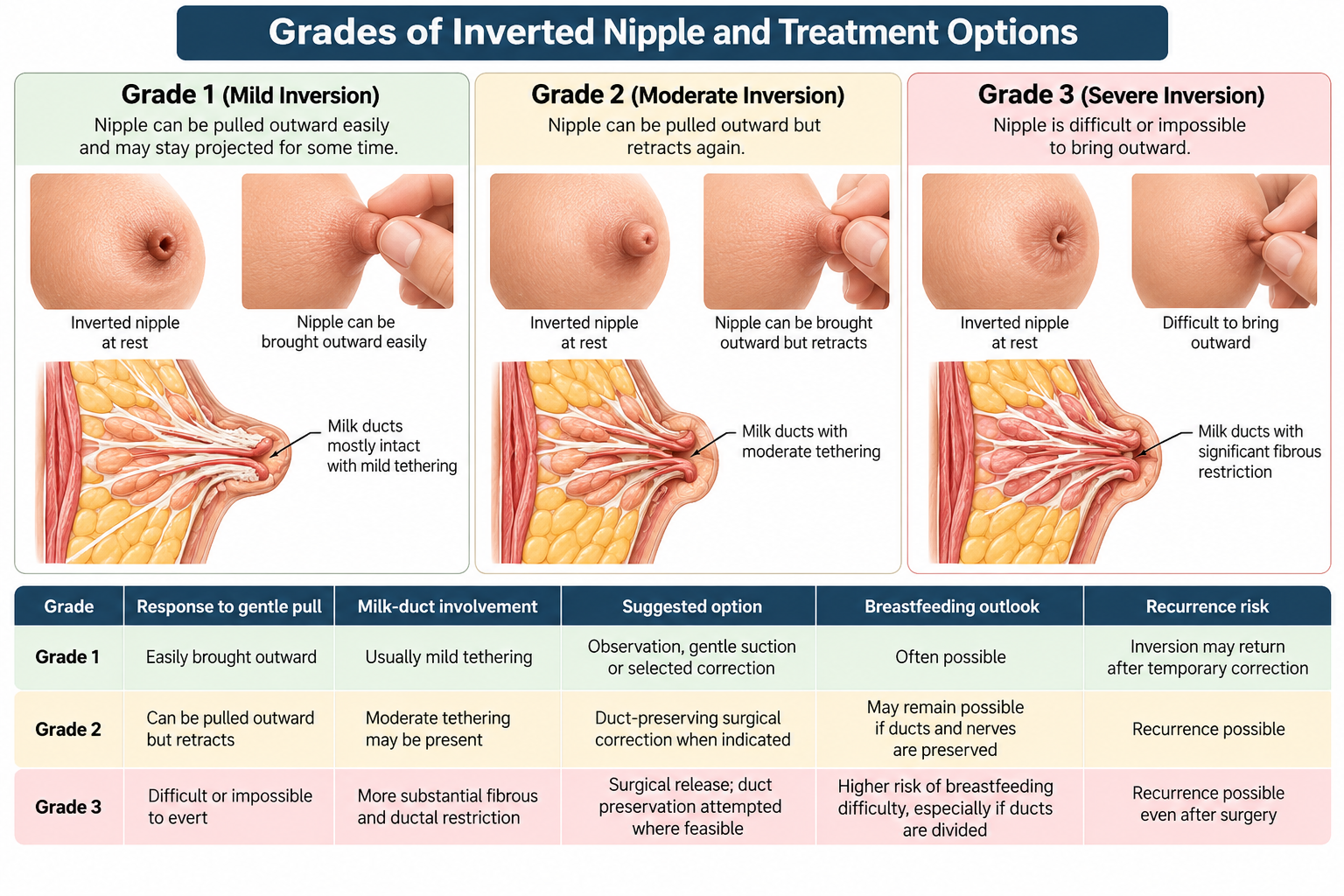
The Han and Hong (1999) classification divides inverted nipples into three grades according to how easily they can be pulled outward and the degree of underlying tissue restriction.
Grade 1: Mild inversion
The nipple can usually be brought outward easily with gentle pressure or stimulation.
It may remain projected temporarily before retracting. Milk ducts are generally less restricted, and breastfeeding may be possible without surgery.
Observation or carefully selected non-surgical measures may be sufficient.
Grade 2: Moderate inversion
The nipple can be pulled outward but often retracts when the pulling force is removed.
Moderate fibrous tethering may be present. Some patients benefit from duct-preserving surgical correction when inversion is persistent or bothersome.
Grade 3: Severe inversion
The nipple is strongly retracted and difficult or impossible to bring outward manually.
More substantial tissue restriction is commonly present. Surgery may be considered, but the extent of release depends on the individual anatomy.
Grade 3 does not automatically mean that all milk ducts must be divided.
Inverted Nipple Grades: Treatment and Breastfeeding Comparison
| Grade | Response to gentle pull | Milk-duct involvement | Suggested option | Breastfeeding outlook | Recurrence risk |
|---|---|---|---|---|---|
| Grade 1 | Easily brought outward | Usually mild restriction | Observation or selected suction methods | Often possible | Temporary correction may not last |
| Grade 2 | Projects but retracts | Moderate tethering | Duct-preserving correction when appropriate | May remain possible | Recurrence possible |
| Grade 3 | Difficult to bring outward | Significant restriction | Surgical release, preserving ducts where feasible | Higher risk of difficulty if ducts are divided | Recurrence possible |
Nipple grade alone cannot predict breastfeeding success. Milk production, functioning ducts, nipple sensation, and infant latch also influence feeding.
Can Inverted Nipples Be Corrected Without Surgery?
Inverted nipple correction without surgery may be considered for mild inversion.
Suction devices use gentle negative pressure to encourage outward nipple projection.
They may help some patients temporarily, particularly when the nipple can already be brought outward manually.
However, evidence supporting reliable, permanent correction with suction devices is limited.
Suction is less likely to work when strong fibrous tissue holds the nipple inward.
Excessive suction may cause bruising, irritation, or skin injury. Pregnant or breastfeeding patients should seek appropriate clinical guidance before using these devices.
How Does Duct-Sparing Surgery Differ From Full Release?
Choosing the right technique is particularly important when discussing inverted nipple correction breast feeding outcomes.
Duct-preserving correction
Duct-sparing techniques aim to release restrictive fibrous tissue while maintaining the milk ducts and surrounding structures.
Small sutures or tissue-support techniques may help maintain nipple projection.
Potential advantages include preserving more functional anatomy and reducing the likelihood of disrupting milk passage.
However, duct preservation does not guarantee successful breastfeeding or prevent recurrence.
Duct-dividing correction
Severe inversion may sometimes require a more extensive release involving division of some milk ducts.
This may improve nipple projection in selected cases but can compromise the movement of milk towards the nipple.
If extensive duct division is necessary, breastfeeding from the treated breast may be substantially reduced or impossible.
Patients planning pregnancy should discuss these implications before choosing surgery.
Can You Breastfeed After Inverted Nipple Correction?
The relationship between inverted nipple correction breast feeding and surgical technique is an important consideration for patients planning future pregnancy.
Breastfeeding depends on several factors:
- Adequate milk production
- Functioning milk ducts
- Preserved breast and nipple sensation
- Effective infant latch and milk transfer
After duct-preserving surgery
Breastfeeding may remain possible when milk ducts and important nerve structures are preserved.
However, scarring, the original nipple anatomy, and other factors may still affect milk transfer.
After duct-dividing surgery
Dividing ducts can interrupt milk flow through the treated nipple.
The effect depends on the number of ducts divided and the remaining functional anatomy.
Some patients may still breastfeed from the opposite breast.
Should surgery be delayed until after pregnancy?
Patients who strongly prioritise future breastfeeding may consider postponing elective correction until after pregnancy and breastfeeding.
Naturally inverted nipples do not always prevent breastfeeding, and lactation support can be helpful.
Inverted Nipple Treatment Near Ghod Dod Road Surat: How Is the Procedure Selected?
The first step is determining whether inversion has existed for many years or developed recently.
At Elegance Clinic, Dr. Ashutosh A Shah evaluates:
- Whether one or both nipples are affected
- The degree of inversion
- Whether the nipple can be brought outward
- Any discharge, lump, or skin changes
- Previous breast surgery or injury
- Future pregnancy and breastfeeding plans
- Expectations about appearance and recurrence
Patients can explore breast treatment options to understand the available procedures.
Treatment should reflect the patient’s anatomy and priorities rather than relying on nipple grade alone.
When Should a Newly Inverted Nipple Be Checked?
A nipple that becomes inverted for the first time in adulthood should receive medical assessment before cosmetic correction.
This is especially important when only one nipple is affected.
New inversion can sometimes result from infection, inflammation, scarring, duct changes, or an underlying breast lesion, including breast cancer.
Warning signs include a breast lump, bloody or spontaneous discharge, skin dimpling, persistent crusting or progressive retraction.
A clinician may recommend breast examination and imaging according to the patient’s age, symptoms, and findings.
Cosmetic correction should not proceed until concerning causes have been appropriately investigated.
What Happens During Inverted Nipple Correction Surgery?
For suitable patients, the surgeon may perform inverted nipple correction under local anaesthesia.
The surgeon gently lifts the nipple and releases the tight tissues that pull it inward.
Whenever possible, the surgeon preserves the milk ducts to support future breastfeeding.
The surgeon may use sutures or supportive techniques to maintain the nipple’s outward position.
The surgeon makes small incisions to minimise visible scarring.
Patients may experience temporary swelling, tenderness, and changes in nipple sensitivity during recovery.
For more information, read Pain after nipple correction surgery.
Can Inverted Nipples Return After Surgery?
Yes. Recurrence is possible after surgical correction.
The likelihood depends on the severity of inversion, surgical technique, residual tethering, and healing.
Patients should understand that maintaining nipple projection and preserving milk ducts may involve different surgical trade-offs.
No technique can guarantee permanent correction.
Read more about nipple shape improvement and the considerations involved in treatment.
Frequently Asked Questions
Can inverted nipples fix themselves after pregnancy?
Nipple projection may change during pregnancy and breastfeeding. Some mild inversions become easier to evert, while others remain unchanged. Pregnancy does not reliably correct severe inversion.
Is inverted nipple surgery done under local anaesthesia?
Many isolated corrections can be performed under local anaesthesia. The final decision depends on the procedure, patient comfort, and medical history.
Will the nipple sink back in after surgery?
Recurrence is possible, especially with more severe inversion. The surgeon should explain the expected stability of the selected technique.
Can both nipples be corrected in one sitting?
Yes, bilateral correction may be possible during the same procedure when clinically appropriate.
Does correction change nipple sensation?
Temporary numbness or increased sensitivity may occur. Permanent changes are also possible, depending on the surgical technique and extent of tissue dissection.
Is inverted nipple correction possible for men?
Yes. Men can have congenital or acquired nipple inversion. Newly developed inversion should be medically assessed before cosmetic treatment.
Can I breastfeed after inverted nipple correction surgery?
Inverted nipple correction breast feeding outcomes depend on the original nipple anatomy and whether milk ducts and nerves are preserved. Patients considering inverted nipple treatment near Ghod Dod Road, Surat should discuss future breastfeeding plans before surgery.
Do suction devices work for inverted nipples, or do I need surgery?
Suction devices may temporarily improve mild inversion, but lasting results are uncertain. Persistent moderate or severe inversion may require surgical correction when treatment is desired.
What is the difference between Grade 2 and Grade 3 inverted nipples?
Grade 2 nipples can generally be brought outward but retract again. Grade 3 nipples are much more difficult to evert because of stronger underlying tissue restriction.
Key Takeaways
- Grade 1 inversion is usually mild and may not need surgery.
- Grade 2 inversion may be suitable for duct-preserving correction.
- Grade 3 inversion often requires more extensive release.
- Suction devices may temporarily improve mild inversion.
- Preserving milk ducts may improve the possibility of breastfeeding after surgery.
- New nipple inversion in adulthood requires clinical assessment.
- Recurrence and altered nipple sensation are possible after correction.
Conclusion
Understanding inverted nipple correction breast feeding considerations is essential before choosing a surgical technique.
Mild inversion may require only reassurance or conservative management. Moderate cases may benefit from duct-preserving correction, while severe cases sometimes require a more extensive release.
At Elegance Clinic, Dr. Ashutosh A Shah evaluates nipple anatomy, treatment expectations, and future breastfeeding plans to help patients make informed decisions.
Patients can book a private consultation to discuss the available options.
