

|
Getting your Trinity Audio player ready...
|
✓ Medically reviewed by Dr. Ashutosh Shah, Plastic, Reconstructive & Cosmetic Surgeon (M.Ch., DNB)
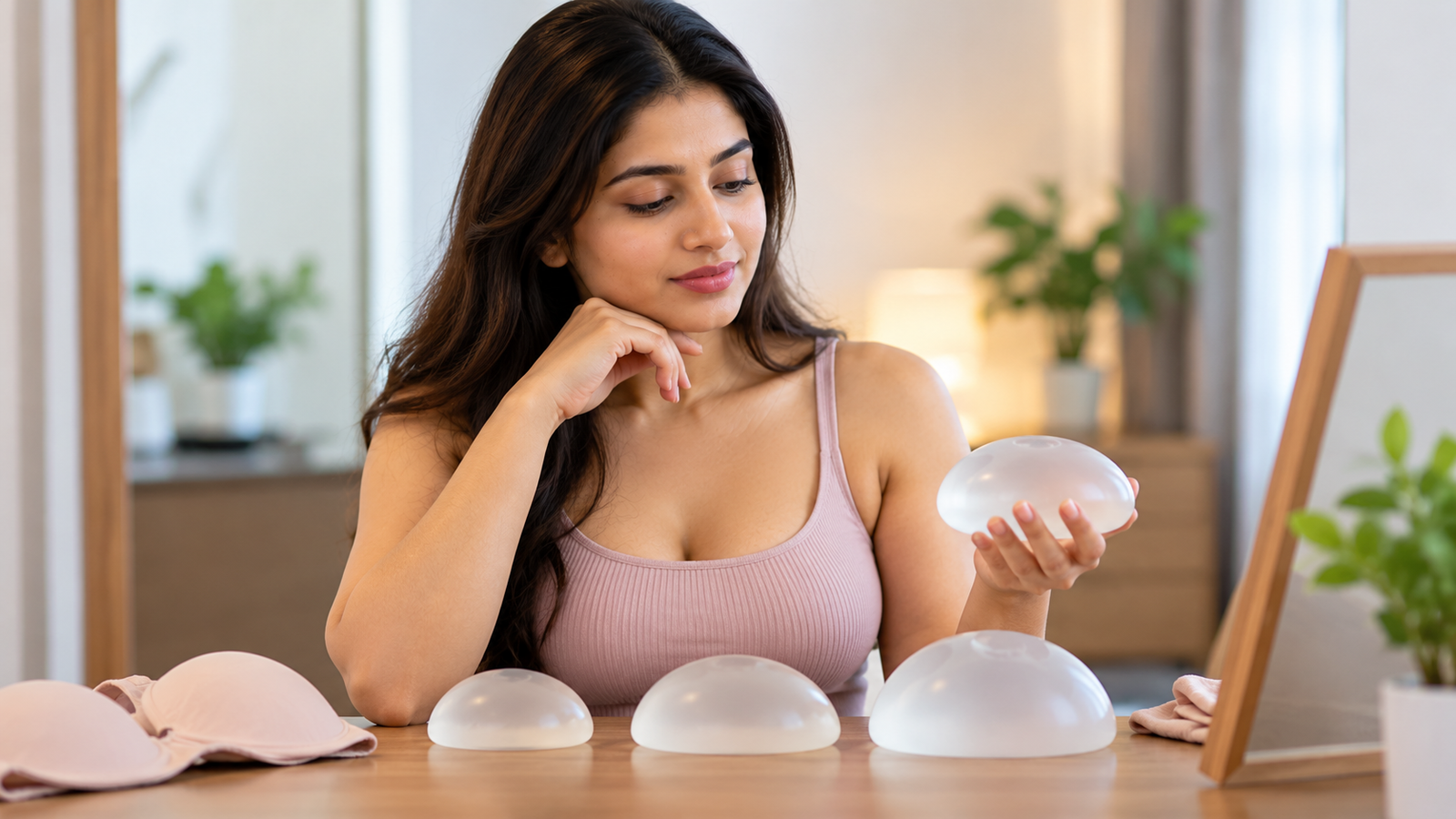
Choosing the right breast implant size depends on your chest width, existing breast tissue, skin elasticity, body proportions, and personal goals. Plastic surgeons measure your anatomy and discuss implant volume in cubic centimetres (cc), shape, and projection before recommending suitable options. The goal is to achieve a balanced result without placing unnecessary strain on your tissues.
Many women begin their breast augmentation journey with a particular bra cup size in mind. Some want a subtle increase in volume, while others prefer a fuller appearance.
However, choosing breast implants involves more than selecting a number.
A 300 cc implant may look natural on one person but appear noticeably larger on someone with a narrower chest. Your existing breast shape and tissue also influence the final appearance.
This breast implant size guide explains how surgeons select implant volume, what different cc sizes mean, and how you can make an informed decision during your consultation.
How to Choose Breast Implant Size Based on Your Body
The best implant size should complement your natural anatomy and support your desired appearance.
Your plastic surgeon considers several measurements before recommending a suitable implant.
1. Chest Width
Chest width plays an important role in implant selection.
A surgeon measures the width of your breast base to understand how much space your natural anatomy provides.
An implant that extends too far beyond the breast’s natural boundaries may create an unnatural appearance or increase the risk of complications.
For example, a woman with a narrow chest may need a different implant diameter than someone with a broader chest, even when both want similar fullness.
2. Existing Breast Tissue
Your current breast tissue affects how an implant looks and feels.
Women with more natural breast tissue may have greater coverage over the implant.
Women with very little breast tissue may need additional attention to implant dimensions, placement, and visibility.
The surgeon assesses tissue thickness to reduce the risk of visible implant edges or rippling.
3. Skin Elasticity
Your skin must accommodate the additional volume.
Skin that stretches easily may tolerate certain implant dimensions differently from skin that feels tight or has limited elasticity.
Previous pregnancy, breastfeeding, weight changes, and ageing may also influence skin quality.
The surgeon examines these factors before suggesting a size.
4. Body Proportions
Your height, shoulder width, chest shape, and overall frame influence the appearance of breast implants.
A volume that looks moderate on a taller or broader-framed person may look more prominent on someone with a petite frame.
The aim is not to match a standard body measurement.
Instead, the surgeon helps you choose proportions that suit your individual goals.
5. Personal Preferences
Some patients want a subtle change that looks natural in everyday clothing.
Others prefer more noticeable upper-breast fullness.
Neither preference automatically determines the correct implant size.
Your surgeon must balance your goals with the limits of your anatomy.
For a broader overview of breast augmentation, explore breast treatment options at Elegance Clinic.
What Does Implant Size in CC Mean?
Breast implant manufacturers measure implant volume in cubic centimetres (cc).
One cc equals one millilitre of volume.
For example:
- 200 cc represents 200 millilitres of implant volume.
- 250 cc represents 250 millilitres.
- 300 cc represents 300 millilitres.
- 350 cc represents 350 millilitres.
- 400 cc represents 400 millilitres.
However, implant size in cc does not directly equal a particular bra cup size.
Two women can receive implants with the same volume and achieve different visual results.
Why Does the Same CC Size Look Different on Different Women?
Several factors influence the final appearance:
- Existing breast volume
- Chest width
- Implant diameter
- Implant projection
- Breast tissue thickness
- Skin elasticity
- Implant placement
- Natural breast shape
For example, a 300 cc implant may produce a more noticeable increase on someone who starts with very little breast tissue.
The same implant volume may create a subtler change on someone who already has moderate breast volume.
This is why surgeons recommend implants according to measurements rather than cup-size estimates alone.
Breast Implant Size Guide: 200 CC to 400 CC
The following table explains how patients commonly think about different implant volumes.
These descriptions offer general context rather than predictions of surgical results.
| Implant Volume | General Consideration | Important Point |
|---|---|---|
| 200 cc | Patients seeking a relatively small volume increase may consider this range | Appearance depends on existing breast tissue |
| 250 cc | May suit some patients seeking modest enhancement | Implant width and projection remain important |
| 300 cc | A commonly discussed mid-range volume | Can look subtle or prominent depending on anatomy |
| 350 cc | May provide more noticeable fullness | Requires suitable tissue support and chest dimensions |
| 400 cc | Represents a larger volume than the options above | May increase tissue demands for some patients |
Important: These volumes do not correspond to fixed cup sizes, and no particular volume suits every patient.
Your surgeon may recommend sizes outside this range.
The appropriate choice depends on your anatomy, implant design, and surgical goals.
Can You Choose Breast Implant Size by Bra Cup Size?
You can discuss your desired cup size, but surgeons cannot reliably guarantee a specific postoperative bra size.
Bra sizing varies between manufacturers.
A C cup in one brand may fit differently from a C cup in another.
Cup size also depends on band measurement.
For example, a 32C and a 36C do not represent the same breast volume.
Why Do Surgeons Prefer CC Measurements?
Implant volume provides a standardized measurement.
However, volume alone does not describe the implant’s width or projection.
Your surgeon considers all three dimensions when comparing implants.
What Should You Tell Your Surgeon Instead?
Explain the appearance you want.
For example:
- I want a small increase that looks natural.
- I want more upper-breast fullness.
- I want better balance between my breasts.
- I want my breasts to look fuller in fitted clothing.
- I want to avoid an overly prominent appearance.
These descriptions help the surgeon understand your priorities.
How Do Implant Width and Projection Affect Breast Size?
Two implants can contain the same volume but have different shapes.
Manufacturers offer different combinations of width and projection.
Implant width describes the diameter of the implant base.
Implant projection describes how far the implant extends forward from the chest wall.
Low-Projection Implants
Low-projection implants generally have a wider base and less forward projection relative to their volume.
They may suit selected anatomical situations.
Moderate-Projection Implants
Moderate-projection implants provide an intermediate relationship between width and forward fullness.
Surgeons may consider them when the dimensions match the patient’s anatomy and goals.
High-Projection Implants
High-projection implants generally have a narrower base and greater forward projection for a comparable volume.
They may create a more projected appearance.
However, higher projection does not automatically mean a better result.
Implant Projection Comparison
| Implant Profile | General Shape | Main Consideration |
|---|---|---|
| Low | Wider base with less projection | Must match breast width and desired shape |
| Moderate | Balanced width and projection | Suitability depends on individual anatomy |
| High | Narrower base with greater projection | Requires careful assessment of tissue support |
Manufacturers use different profile names and measurements.
Your surgeon should explain the actual dimensions of the implants under consideration.
How Can You Choose Natural-Looking Breast Implants?
Natural-looking results depend on more than choosing a smaller implant.
The surgeon considers the relationship between the implant and your existing breast tissue.
Match the Implant to Your Chest
An implant with suitable dimensions can support a balanced appearance.
Consider Your Existing Breast Shape
The surgeon evaluates breast position, tissue distribution, and natural asymmetry.
Avoid Excessive Volume
Choosing an implant that exceeds your tissue capacity may increase the risk of stretching, visible edges, or long-term changes.
Discuss Implant Placement
Implant placement can influence tissue coverage and appearance.
Surgeons may place implants above or below the pectoral muscle, or use a dual-plane approach, depending on the patient’s anatomy.
Each option has advantages and limitations.
Review Your Desired Appearance in Different Clothing
Some patients prefer subtle fullness in everyday clothing.
Others want a more noticeable change.
Discuss both your unclothed breast shape goals and how you want clothing to fit.
For more information about breast augmentation options, read Breast Size Increase Surgery.
How Do Surgeons Decide Breast Implant Size During Consultation?
A breast augmentation consultation helps translate your preferences into realistic surgical options.
Step 1: Discuss Your Goals
The surgeon asks what you want to change about your current breast size and shape.
You can explain whether you prefer subtle enhancement, moderate fullness, or a more prominent result.
Step 2: Examine Your Breasts
The surgeon evaluates:
- Breast width
- Existing breast volume
- Skin elasticity
- Tissue thickness
- Breast position
- Natural asymmetry
- Chest wall shape
Step 3: Review Implant Options
The surgeon compares implant volumes, diameters, projections, and other design features.
Step 4: Use Implant Sizers
Some clinics offer external implant sizers that patients can place inside a suitable bra.
Sizers may help you visualize relative volume changes.
However, they cannot reproduce the exact appearance of a surgically placed implant.
Step 5: Discuss 3D Imaging When Available
Some practices use three-dimensional imaging to demonstrate possible outcomes.
These simulations may support decision-making, but they cannot guarantee a particular result.
Step 6: Review Risks and Limitations
The surgeon explains the potential complications, recovery requirements, and long-term considerations associated with the proposed implants.
Step 7: Make a Shared Decision
You and your surgeon discuss which options best balance your preferences and anatomical measurements.
At Elegance Clinic, Dr. Ashutosh Shah, a plastic surgeon, can discuss breast augmentation goals, anatomical considerations, and appropriate surgical options during a consultation.
Is 300 CC a Good Breast Implant Size?
Many patients ask whether 300 cc provides a natural-looking result.
The answer depends on the individual.
A 300 cc implant does not produce the same appearance in every patient.
When Might 300 CC Be Considered?
A surgeon may discuss this volume when its width, projection, and tissue requirements suit the patient’s anatomy.
However, another patient may achieve her desired appearance with a smaller or larger implant.
Does 300 CC Mean a C Cup?
No.
There is no reliable conversion between implant volume and bra cup size.
Your original breast volume and chest measurements influence the result.
Should You Choose 300 CC Because Someone Else Did?
No.
Photos and other patients’ experiences can help communicate your preferences, but they cannot establish the right size for your body.
Your surgeon should recommend options based on your measurements.
What Happens If You Choose Breast Implants That Are Too Large?
Larger implants may create more strain on breast tissues, especially when their dimensions exceed the body’s natural support.
Potential concerns include:
Skin Stretching
Additional volume can stretch breast skin over time.
Implant Visibility
Patients with limited tissue coverage may notice implant edges or rippling.
Breast Discomfort
Some patients experience discomfort associated with implant weight or tissue tension.
Changes in Breast Position
Implants may shift or descend over time.
Bottoming Out
An implant may move downward relative to the intended breast fold or nipple position.
Revision Surgery
Some patients eventually seek surgery to change implant size or address complications.
Larger implants do not guarantee these problems, but careful size selection helps reduce avoidable risks.
Can Breast Implants Be Too Small?
Some patients worry about choosing implants that produce less enhancement than expected.
This concern deserves discussion during the planning stage.
A smaller implant may provide a subtle result, but the visible change depends on your starting anatomy.
How Can You Avoid Size Regret?
- Explain your desired appearance clearly.
- Discuss more than one suitable implant size.
- Review implant dimensions, not just volume.
- Use sizers or simulation tools when available.
- Understand that swelling affects early results.
- Avoid choosing an implant based only on someone else’s photographs.
A realistic discussion before surgery can help align expectations with achievable results.
Should You Choose Breast Implants or a Breast Lift?
Breast augmentation and breast lift surgery address different concerns.
Breast implants primarily increase volume.
A breast lift, also called mastopexy, repositions and reshapes existing breast tissue while removing excess skin.
When Might Implants Help?
Implants may suit patients who want:
- Increased breast volume
- More fullness after weight loss or pregnancy
- Selected improvements in breast shape
- Correction of some volume differences
When Might a Breast Lift Help?
A lift may suit patients with significant breast sagging who want improved breast position.
Can You Combine Both Procedures?
Some patients may benefit from a breast lift with implants.
However, combining procedures adds complexity and may increase certain risks.
The surgeon should assess breast position, tissue quality, and your goals before recommending an approach.
Explore breast sagging correction to understand how lifting differs from increasing breast volume.
You can also read Which Breast Surgery Is Right for You? for a broader comparison of treatment options.
Does Implant Size Affect Recovery?
Implant size may influence tissue tension and postoperative discomfort, but recovery depends on several factors.
These include:
- Surgical technique
- Implant placement
- Tissue characteristics
- Individual healing response
- Overall health
- Procedure complexity
First Few Days
Patients may experience swelling, tightness, and discomfort.
The surgeon may recommend pain-relief medication and a supportive garment.
First Few Weeks
Swelling generally begins to improve.
Patients gradually resume activities according to their surgeon’s instructions.
Following Months
Breast shape continues to settle as swelling decreases and tissues adapt.
The final appearance may take several months to develop.
Avoid judging implant size from the earliest postoperative photographs.
Will Breast Implant Size Change Over Time?
The implant’s manufactured volume does not normally change simply because time passes.
However, the appearance of your breasts can change.
Factors include:
- Ageing
- Weight fluctuations
- Pregnancy
- Breastfeeding
- Changes in skin elasticity
- Implant position
- Scar tissue around the implant
Breast implants are not lifetime devices.
Patients may eventually need additional surgery because of complications, implant rupture, changes in appearance, or personal preferences.
Regular follow-up and recommended imaging help monitor implant condition.
For silicone gel implants, follow the manufacturer’s and your clinician’s surveillance recommendations.
Can You Change Breast Implant Size Later?
Yes, surgeons can sometimes replace existing implants with a different size.
However, implant exchange requires another operation and carries additional risks.
Why Do Patients Consider Implant Exchange?
Common reasons include:
- Desire for smaller implants
- Desire for larger implants
- Changes in breast shape
- Implant-related complications
- Changes in personal preferences
Is Implant Exchange Simple?
Not always.
The surgeon must assess the existing implant pocket, skin, breast tissue, and scar tissue.
Some patients may also need a breast lift or another corrective procedure.
Choosing a suitable implant during the first operation may reduce the likelihood of size-related dissatisfaction, although it cannot eliminate the possibility of revision.
Questions to Ask Before Choosing Breast Implant Size
Bring these questions to your consultation:
- What is my natural breast base width?
- Which implant volumes suit my chest measurements?
- How will different implant profiles change the appearance?
- Do I have enough tissue to cover the proposed implant?
- Would a smaller implant better support my long-term tissue health?
- Can I compare suitable implant sizes using sizers?
- Would a breast lift help achieve my goals?
- What complications should I consider with larger implants?
- How might pregnancy or weight changes affect my results?
- What follow-up and implant monitoring will I need?
You can also review Breast Surgery FAQs Answered by Dr. Ashutosh Shah for additional information about breast surgery planning.
Frequently Asked Questions
1. How do I know which breast implant size is right for me?
Your surgeon measures your breast width, evaluates existing tissue, checks skin elasticity, and discusses your desired appearance. These findings help identify suitable implant volumes, widths, and projections. Personal preference matters, but your anatomy determines which options are appropriate.
2. Is 250 CC or 300 CC better for a natural look?
Neither size guarantees a natural-looking result. A 250 cc implant may suit one patient, while a 300 cc implant may suit another. Your existing breast volume, chest width, implant profile, and tissue coverage influence the final appearance.
3. How many CC are needed to increase one cup size?
No fixed cc amount reliably produces a one-cup-size increase. Bra sizing varies, and patients start with different breast volumes and chest measurements. Your surgeon can discuss approximate changes without guaranteeing a particular cup size.
4. Do high-profile implants look bigger than moderate-profile implants?
High-profile implants project farther forward relative to their base width. Two implants with the same volume can therefore create different shapes. However, their visual appearance also depends on your anatomy and tissue coverage.
5. Can I choose my breast implant size during consultation?
Yes. You can explain your preferences and compare appropriate options with your surgeon. The final choice should account for your chest measurements, tissue characteristics, medical considerations, and realistic goals.
6. What happens if I choose implants that are too large?
Implants that exceed your tissue capacity may increase the risk of skin stretching, visible implant edges, discomfort, implant displacement, and future revision surgery. Your surgeon should explain the risks of each proposed size.
Key Takeaways
- The right breast implant size depends on your individual anatomy.
- Surgeons measure implant volume in cc rather than bra cup sizes.
- Chest width, existing tissue, and skin elasticity influence implant selection.
- Implant width and projection matter as much as volume.
- A 300 cc implant does not look the same on every patient.
- Natural-looking results require balanced dimensions and adequate tissue support.
- Implant sizers and 3D simulations may help you compare options, but they cannot guarantee results.
- Excessively large implants may increase tissue-related risks.
- Breast implants increase volume, while a breast lift addresses sagging.
- A detailed consultation helps you make an informed decision.
Conclusion
Understanding how to choose breast implant size starts with recognizing that no single volume suits every body.
Your chest width, existing breast tissue, skin elasticity, implant projection, and personal preferences all influence the final result.
Instead of focusing only on a particular cup size or cc number, discuss the overall appearance you want with a qualified plastic surgeon.
At Elegance Clinic, Dr. Ashutosh Shah can assess your anatomy, explain suitable breast implant options, and discuss the benefits, limitations, and risks of surgery.
To discuss your goals, you can book a consultation and explore which approach may suit your body.
