

|
Getting your Trinity Audio player ready...
|
✓ Medically reviewed by Dr. Ashutosh Shah, Plastic, Reconstructive & Cosmetic Surgeon (M.Ch., DNB)
Cosmetic surgery in India can be performed safely when the surgeon is appropriately qualified and registered, the procedure is carried out in a properly equipped facility, anaesthesia is provided by an appropriately qualified professional when required, and there is a clear plan for monitoring, recovery and complications. Price or a clinic’s social media presence cannot establish safety.
If you are considering an operation, asking is cosmetic surgery safe in India is an important starting point. But the country in which an operation takes place is only one part of the question.
Safety depends on who performs the surgery, where it is performed, how anaesthesia is managed, whether the patient has been properly assessed and what happens if something does not go according to plan.
In India, patients can verify a doctor’s registration through official medical registration records rather than relying only on a website profile, advertisement or social media biography.
Here is what you should check before booking cosmetic surgery.
What Actually Determines Whether Cosmetic Surgery Is Safe?
No surgical procedure is completely risk free.
Even an elective cosmetic operation can involve risks related to anaesthesia, bleeding, infection, blood clots, wound healing, scarring and the procedure itself.
Good surgical care focuses on identifying risks before surgery and taking appropriate steps to reduce them.
Important safety factors include:
- appropriate surgeon training and registration
- accurate patient selection
- a complete medical history
- appropriate investigations
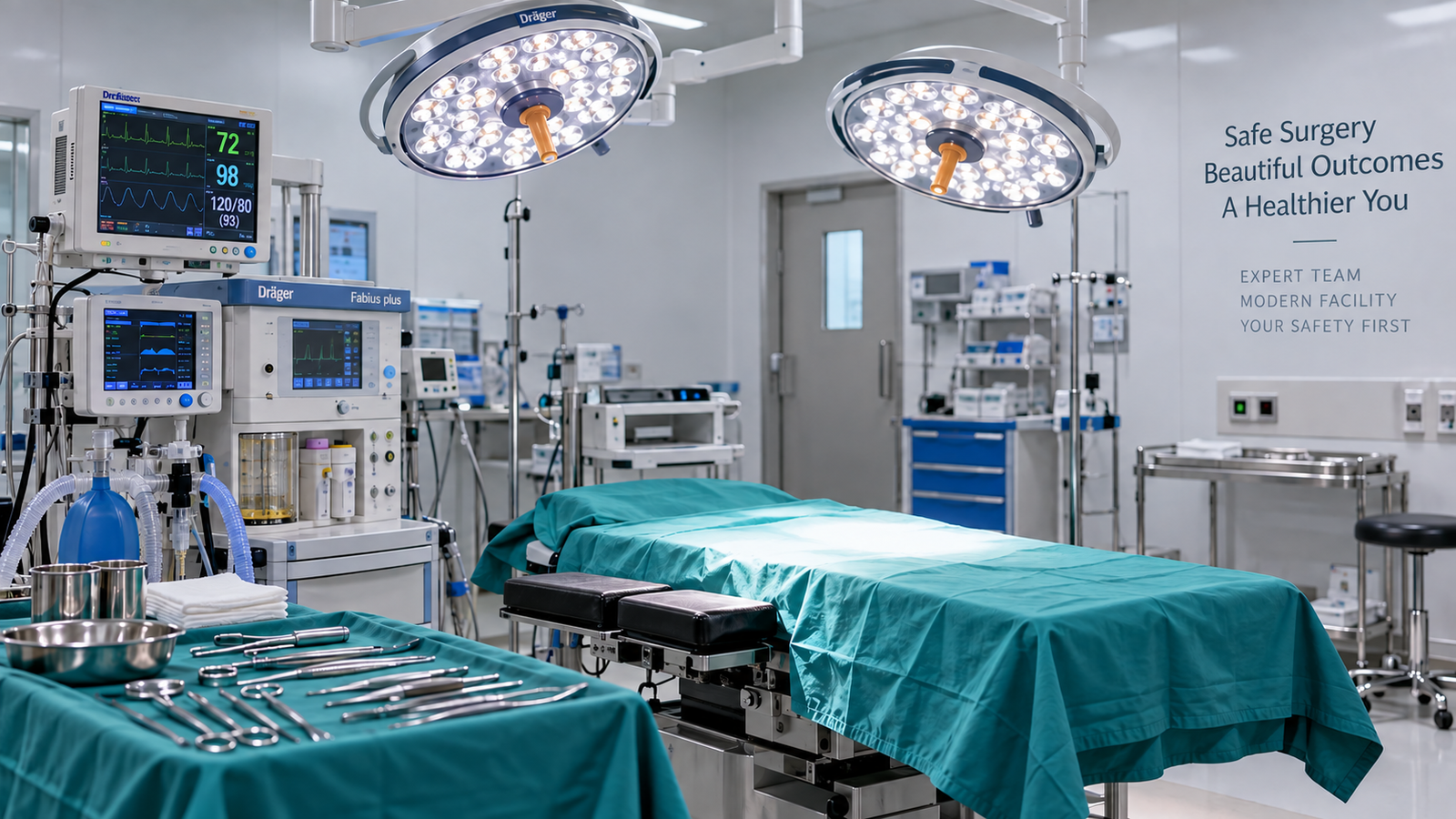
- a properly equipped operating theatre
- qualified anaesthesia care when required
- appropriate infection control
- monitoring during and after surgery
- trained nursing and support staff
- emergency medicines and equipment
- a clear escalation or hospital transfer plan
- written informed consent
- appropriate follow up after discharge
A clinic should be able to explain these arrangements clearly before you book surgery.
How Do You Verify a Surgeon’s Qualification?
Do not rely only on the title “cosmetic surgeon.”
Ask for the surgeon’s full name, medical qualifications, specialist qualifications and medical registration details.
Check the registration through the appropriate official medical registration system. You can also ask to see relevant degree certificates and qualification details.
The important question is not simply whether someone is a doctor. You should understand what specialist surgical training the doctor has for the operation being proposed.
A professional profile, online reviews or a large social media following should not replace qualification verification.
Before proceeding, you can also meet the surgical team and understand who will be involved in your care.
What Qualification Should the Surgeon Hold?
The appropriate specialist qualification depends on the operation being considered.
For procedures that fall within plastic and reconstructive surgery, patients should ask whether the surgeon has recognised postgraduate or super speciality training relevant to plastic surgery.
The qualification and medical registration should be independently verifiable.
Ask your surgeon:
What is your medical registration number?
What specialist qualification do you hold?
Where did you obtain your specialist training?
How frequently do you perform this procedure?
Who will actually perform my operation?
Where will my operation take place?
These questions should receive clear answers before you make a financial commitment.
Pre Booking Cosmetic Surgery Safety Checklist
Use this checklist before paying a deposit or confirming your operation.
| What to Verify | Where to Verify It | What a Failed Check Looks Like |
|---|---|---|
| Medical registration | Official medical registration records or the appropriate registration council | Registration details cannot be provided or verified |
| Specialist qualification | Degree certificate and recognised qualification records | Only vague professional titles are provided |
| Who performs the operation | Consultation and written treatment plan | Nobody clearly confirms who will operate |
| Experience with your procedure | Ask the surgeon during consultation | Relevant procedural experience is not discussed clearly |
| Operating facility | Ask where surgery will occur and visit where appropriate | Surgery location remains unclear |
| Operating theatre | Theatre visit where permitted and discussion with the clinic | Theatre arrangements cannot be explained |
| Anaesthetist | Ask for the anaesthesia professional’s name and qualifications | Nobody clearly identifies who will provide anaesthesia |
| Monitoring equipment | Ask what monitoring is used during surgery and recovery | Staff cannot explain basic monitoring arrangements |
| Emergency equipment | Ask about emergency medicines and resuscitation equipment | No clear emergency setup can be described |
| Emergency backup | Ask what happens if your condition deteriorates | No escalation plan can be explained |
| Hospital transfer plan | Ask which hospital or higher level facility would be used if required | Nobody can explain where you would be transferred |
| Preoperative assessment | Medical history, examination and investigations when required | Surgery is booked without meaningful health assessment |
| Written informed consent | Read the consent document before surgery | Risks and alternatives are missing or consent is rushed |
| Postoperative monitoring | Ask where and by whom you will be monitored | No defined recovery or observation plan |
| Postoperative contact | Obtain written follow up and emergency contact information | Nobody can explain whom to contact after discharge |
This checklist turns the broad question of safety into specific points you can verify.
What Should the Facility and Theatre Provide?
A safe surgical environment requires more than an operating table.
The exact requirements depend on the procedure, anaesthesia and complexity of the operation.
A suitable facility should have appropriate infection control procedures, monitoring equipment, trained staff, emergency medicines and equipment, and a structured recovery area.
The team should also know what to do if a patient’s condition changes unexpectedly.
Some healthcare facilities may also hold recognised accreditation. If a facility claims accreditation, patients can verify that status through the organisation that issued it.
However, accreditation alone does not guarantee that every procedure is appropriate for every patient.
An accredited cosmetic clinic in India still needs an appropriately qualified surgical team, suitable equipment and the correct capabilities for the procedure being performed.
Is a Day Care Clinic as Safe as a Hospital?
A day care surgical facility may be appropriate for selected cosmetic procedures and suitable patients.
A hospital may be more appropriate for extensive operations, patients with important medical conditions or situations where longer monitoring and additional medical resources may be required.
The words “clinic,” “day care centre” and “hospital” alone do not determine safety.
What matters is whether the facility has the resources required for your particular procedure and your individual health needs.
Ask what happens if you need a higher level of care than originally planned.
Who Gives the Anaesthesia?
Do not wait until the day of surgery to find out.
For procedures requiring general anaesthesia, regional anaesthesia or significant sedation, ask who will administer the anaesthesia and monitor you.
The anaesthesia professional assesses important medical factors before surgery and monitors physiological functions during the procedure.
Patients should know the name and role of the person responsible for their anaesthesia.
Understanding why the anaesthesia team matters can help you prepare for this part of surgery.
Why Does Anaesthesia Matter for Safety?
Anaesthesia involves considerably more than medication that makes you sleep.
Depending on the type of anaesthesia, important functions such as oxygen levels, breathing, heart rate and blood pressure require monitoring.
Your medical history can also affect anaesthesia planning.
Previous anaesthesia problems, allergies, medications, heart conditions, lung conditions, diabetes, sleep apnoea and other medical issues may change how your care is planned.
This is one reason a proper preoperative assessment matters.
What Happens If There Is a Complication?
Every surgical facility should be able to answer this clearly.
Complications vary in severity.
Some can be treated within the surgical facility. Others may require additional tests, another operation, hospital admission or access to more advanced medical support.
Before surgery, ask:
What emergency equipment is available?
Who responds if my condition changes?
What happens if I need hospital admission?
Which hospital would I be transferred to?
How would that transfer occur?
A clear backup plan does not mean complications are expected. It means the team has prepared for situations that may require additional care.
What Should Happen Before Surgery?
Safety begins well before you enter the operating theatre.
You should have a proper consultation.
The proposed operation, expected outcome, limitations, scars, important risks, alternatives and recovery should be discussed.
Your medical history should be reviewed.
Medications and supplements should be documented.
Relevant investigations should be performed when clinically indicated.
You should receive clear instructions about fasting, medications, smoking, transport and postoperative care.
Using a plastic surgery consultation checklist can help you prepare questions before deciding whether to proceed.
What Does Proper Informed Consent Mean?
Consent should not simply be a signature on a form.
Before surgery, you should understand:
- what procedure is being performed
- what outcome can realistically be expected
- where scars may occur
- important possible complications
- available alternatives
- what recovery involves
- whether implants or other medical devices will be used when relevant
You should also have enough time to ask questions.
Be cautious if an important consent document is presented immediately before surgery without adequate time for discussion.
Can I Ask to See the Operation Theatre?
Yes.
Whether you can physically enter the theatre may depend on infection control policies and whether the room is being used.
Being prevented from casually walking into a sterile operating environment is not itself a warning sign.
However, the clinic should still be able to explain where the surgery will occur, what monitoring is available, how infection control is managed and what emergency arrangements are available.
The important issue is transparency about the environment in which your operation will take place.
What Are the Red Flags That Should Stop You Booking?
Several warning signs deserve attention.
Be cautious if the surgeon’s medical registration or specialist qualification cannot be verified.
Other red flags include:
- pressure to make an immediate payment
- little or no medical history being taken
- no meaningful physical assessment
- unclear information about who will perform the operation
- no clear anaesthesia plan
- no explanation of where surgery will happen
- no discussion of important complications
- no written consent process
- no clear postoperative follow up
- no emergency escalation plan
- guarantees of a perfect result
- claims that an operation has absolutely no risk
Statements such as “100 percent safe,” “zero risk” or “guaranteed result” should be treated cautiously.
Responsible surgical counselling should explain both expected benefits and realistic risks.
Is the Cheapest Cosmetic Surgery Option Safe?
Price alone cannot determine whether an operation is safe or unsafe.
Different quotations can reflect differences in the procedure, facility, anaesthesia, implants, hospital stay and postoperative care.
The concern arises when a low price is achieved by compromising important elements of care.
Instead of comparing only the final quotation, ask exactly what is included.
Who performs the surgery?
Who provides the anaesthesia?
Where does surgery take place?
What monitoring is provided?
What happens after surgery?
What happens if a complication occurs?
Patients considering treatment at Elegance Clinic can review why patients choose Elegance Clinic while researching their options.
The same verification process should be applied before choosing any cosmetic surgery provider.
How Do You Check an Accredited Cosmetic Clinic in India?
If a clinic or hospital claims a particular accreditation, verify the claim directly with the organisation that provides that accreditation.
Do not rely solely on an accreditation logo displayed on a website or advertisement.
You should also remember that accreditation is only one part of plastic surgery safety India.
You still need to verify the surgeon, anaesthesia arrangements, operating facility, emergency plan and postoperative care.
An accredited cosmetic clinic India search should therefore be followed by procedure specific questions.
Why Patient Selection Matters
Even an appropriately performed procedure may not be suitable for every patient.
Your surgeon needs to consider your general health, previous operations, medications, smoking history, allergies and relevant medical conditions.
The extent of surgery also matters.
Combining several procedures can change operation time, recovery requirements and overall risk.
Patients should provide accurate medical information rather than withholding conditions or medications because they are worried that surgery might be postponed.
Sometimes delaying or modifying an operation is part of making surgery safer.
What Should You Know About Recovery and Follow Up?
Safety does not end when the operation finishes.
Postoperative monitoring helps the team assess your immediate recovery.
Before leaving the facility, you should understand wound care, medications, activity restrictions, follow up appointments and warning symptoms.
You should also know whom to contact if you develop a concern after returning home.
Symptoms such as unexpected breathing difficulty, chest pain, heavy bleeding, rapidly increasing swelling, severe unexplained pain or significant deterioration require prompt medical attention.
Your surgical team should provide procedure specific instructions about which symptoms require urgent assessment.
Final Takeaway
So, is cosmetic surgery safe in India?
Cosmetic surgery can be performed safely when appropriate systems are in place, but no operation can be guaranteed to be completely free of risk.
The most useful approach is to verify each part of your care.
Check the surgeon’s registration and relevant specialist qualification.
Know exactly where the operation will happen.
Understand who will provide your anaesthesia.
Ask about theatre standards and monitoring.
Confirm the emergency backup plan.
Read your written consent carefully.
Understand your postoperative care.
A qualified plastic surgeon India, suitable operating environment, appropriate anaesthesia team, careful patient selection and clear complication plan are all important elements of cosmetic surgery safety.
Make these checks before paying your deposit and before fixing your operation date.
Frequently Asked Questions
Is cosmetic surgery safe in India?
Cosmetic surgery can be performed safely in India when the patient is appropriately selected and care is provided by qualified professionals in a suitable surgical environment. No cosmetic operation is completely risk free.
What qualification should the surgeon hold?
The surgeon should have medical registration and appropriate recognised specialist training relevant to the operation being performed. Ask for the exact qualification and verify the registration rather than relying only on advertising titles.
Is a day care clinic as safe as a hospital?
A properly equipped day care facility may be suitable for selected patients and procedures. Extensive surgery or patients with additional medical risks may require hospital resources. The appropriate setting depends on the individual situation.
Who administers the anaesthesia?
The person providing anaesthesia should have appropriate qualifications for the type of anaesthesia required. Ask who will administer and monitor your anaesthesia before the operation.
What happens if there is a complication?
The facility should have trained staff, appropriate emergency equipment and a clear escalation plan. More serious complications may require hospital transfer, admission, additional treatment or another operation.
Can I ask to see the operation theatre?
Yes. Access may be restricted for infection control or operational reasons, but you can ask where your operation will take place and request information about the theatre, monitoring, infection control and emergency arrangements.

