

|
Getting your Trinity Audio player ready...
|
✓ Medically reviewed by Dr. Ashutosh Shah, Plastic, Reconstructive & Cosmetic Surgeon (M.Ch., DNB)
Written by Dr. Ashutosh Shah, M.Ch., DNB (Plastic Surgery)
Founder & Director, Elegance Clinic, Surat
Dr. Ashutosh Shah is a Board-Certified Plastic, Cosmetic, Reconstructive and Hair Transplant Surgeon with more than 22 years of surgical experience. He completed his M.Ch. in Plastic Surgery from The M.S. University of Baroda and holds a DNB in Plastic Surgery. He has advanced training in microvascular and cosmetic surgery and has performed thousands of cosmetic and reconstructive procedures.
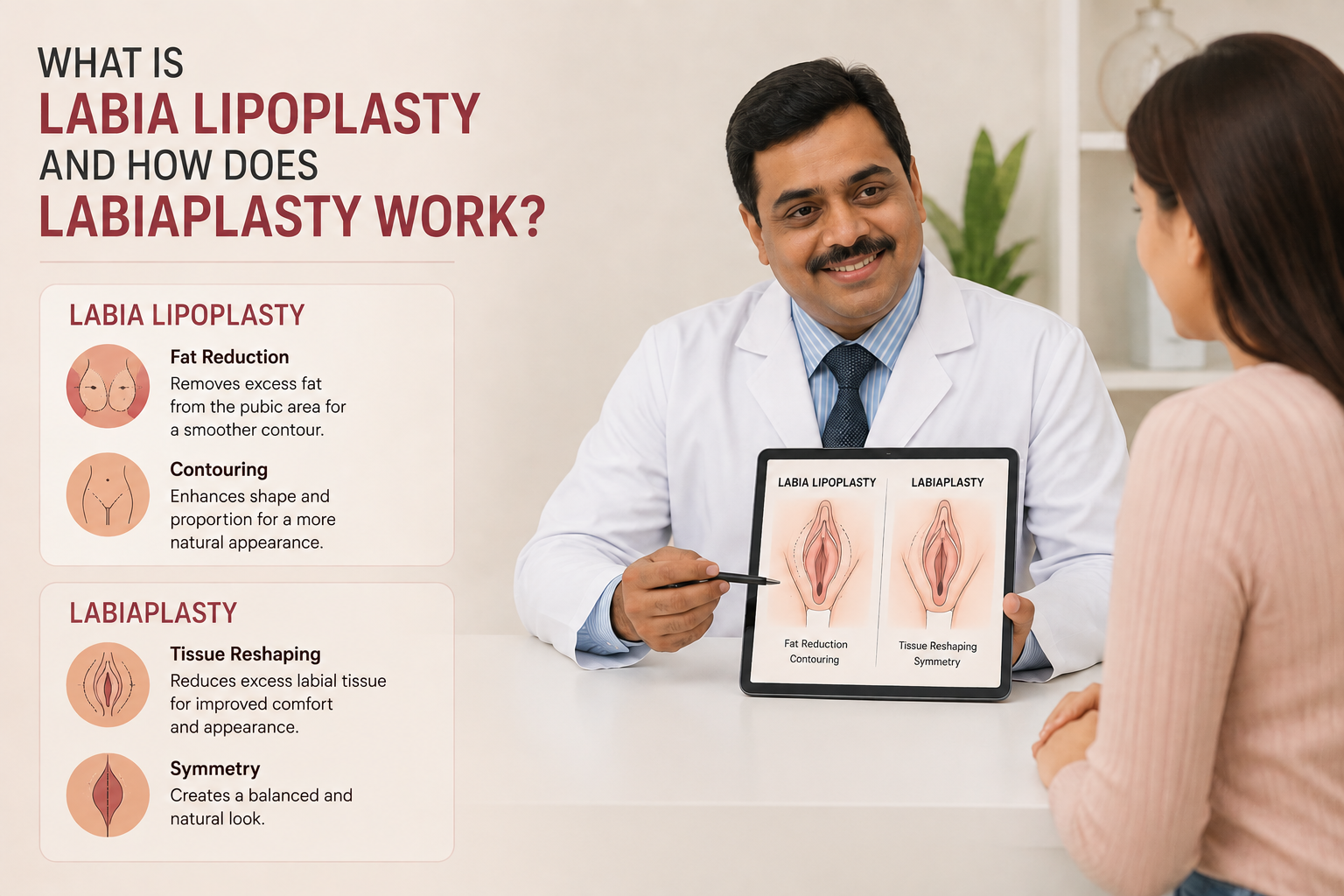
“Labia lipoplasty” is a term some patients use when searching for surgery to reduce or reshape the labia. The more established medical term is labiaplasty. Labiaplasty most commonly refers to surgery that reduces or reshapes the labia minora, the inner folds of tissue around the vaginal opening. A different procedure, labia majoraplasty, may address excess tissue of the outer labia.
Importantly, there is a wide range of normal labial size, shape, colour and asymmetry. Having visible or uneven labia does not by itself mean that treatment is medically necessary. Some adults consider surgery because of persistent rubbing, pulling or discomfort during exercise, clothing or sexual activity. Others may have an aesthetic concern.
A useful consultation therefore starts with a different question from “How much tissue should be removed?” The first question is what is actually causing the concern? The answer determines whether labiaplasty, another procedure, non-surgical management or no treatment is appropriate.
The goal of responsible labiaplasty is not to create one “ideal” appearance. Treatment should preserve function while making a carefully planned change based on individual anatomy and goals.
Key Takeaways
- “Labia lipoplasty” commonly refers to what is medically called labiaplasty.
- Labiaplasty most often reshapes or reduces the labia minora.
- Natural labial asymmetry and variation are common and do not automatically require treatment.
- The amount and location of tissue reduction should be individually planned.
- Swelling, soreness and bruising can occur during early recovery.
- Surgery has potential risks, including bleeding, infection, scarring, altered sensitivity and healing problems.
- A physical assessment is necessary before deciding whether surgery is appropriate.
Why Might Someone Consider Labia Lipoplasty?
Adults may consider labiaplasty because enlarged, prominent or asymmetric labial tissue causes physical discomfort or because its appearance creates a personal concern. Surgery is elective in many cases, and visible or asymmetric labia can be entirely normal.
Physical concerns can include repeated rubbing against clothing, pulling during certain activities, irritation or discomfort. ASPS lists twisting, tugging, irritation and discomfort during activities among reasons some patients seek labiaplasty.
A consultation should also consider whether another skin, gynaecological or medical condition could be contributing to symptoms before assuming excess labial tissue is the cause.
Labia Minora: The inner folds of tissue forming part of the external female genital anatomy.
What Does Labiaplasty Actually Change?
Labiaplasty changes the size, contour or symmetry of labial tissue. It does not create a standardised appearance, and the procedure should not be designed around the assumption that one particular labial shape is “normal” or preferable.
Most commonly, treatment involves the labia minora. If the concern instead involves the outer, hair-bearing labia majora, assessment and treatment are different. ASPS distinguishes labiaplasty from labia majoraplasty, which reduces excess outer labial tissue.
This distinction matters because “labia lipoplasty” can be an imprecise search term. The correct procedure depends on which tissue is causing the concern.
How Is Labia Lipoplasty or Labiaplasty Performed?
Labiaplasty involves carefully removing and reshaping selected labial tissue before closing the surgical area. Different techniques can be used, and technique selection depends on anatomy, tissue distribution, desired change and the surgeon’s clinical assessment.
Two commonly described approaches are trim and wedge techniques. A trim approach removes selected tissue along the edge, while a wedge approach removes a section while preserving more of the natural border. Neither technique is automatically better for every patient.
The procedure may be performed using local anaesthesia with sedation or general anaesthesia depending on the planned surgery and individual circumstances.
| Approach | Main Principle | Important Consideration |
|---|---|---|
| Trim technique | Removes selected tissue along the labial edge | Changes the treated edge |
| Wedge technique | Removes a section while retaining more natural border | Wound healing must be considered |
| Labia majoraplasty | Addresses excess outer labial tissue | Different from labia minora reduction |
Is Every Patient Treated the Same Way?
No. Labiaplasty should be customised to the patient’s anatomy rather than performed according to a fixed measurement or template.
During consultation, a surgeon may assess symmetry, tissue distribution, the exact location of discomfort, previous surgery or childbirth, medical history, medications, expectations and general health. ASPS also recommends discussing treatment options, likely outcomes, risks and anaesthesia during consultation.
An important part of planning is deciding what should not be removed. Excessive tissue reduction can create functional problems, dryness, scarring or discomfort.
What Is Recovery Like After Labiaplasty?
Swelling, tenderness and bruising are common during early labiaplasty recovery. Many patients need time away from strenuous activity, and complete tissue settling takes longer than the first visible stage of healing. Recovery instructions should be personalised by the operating surgeon.
NHS patient guidance notes that soreness, bruising and swelling can occur after surgery and that full skin healing can take considerably longer than the initial recovery period.
Friction and pressure on the surgical area usually need to be limited during early healing. Exercise, sexual activity and other activities affecting the area are resumed according to the surgeon’s assessment rather than simply because discomfort has disappeared.
Feeling better and being fully healed are not necessarily the same stage of recovery.
When Will You See the Final Result?
Early appearance can be affected significantly by swelling. As swelling decreases and tissues settle, the postoperative contour becomes easier to assess.
The aim may be reduced prominence, improved symmetry or relief of specific tissue-related discomfort. However, perfect symmetry cannot be guaranteed, and individual healing influences the final appearance.
Scars also change with time. A realistic assessment of the result should therefore not be made during the earliest postoperative days.
What Are the Possible Risks and Side Effects?
Labiaplasty is surgery and therefore carries potential complications. These can include bleeding, infection, scarring, altered sensitivity and wound-healing problems. Excessive tissue removal can also produce longer-term functional problems.
ASPS specifically notes risks such as bleeding, hematoma and infection, while NHS guidance also identifies scarring and reduced genital sensitivity as possible complications.
Risk varies according to anatomy, health, surgical extent, technique and healing. A qualified surgeon should discuss the risks that apply to the individual patient before consent.
Who May Be Suitable for Labia Lipoplasty?
An adult may consider assessment when labial tissue causes persistent functional discomfort or when the patient has a well-considered aesthetic concern and realistic expectations.
Suitability cannot be determined from photographs or measurements alone. Medical history, anatomy, symptoms, goals and surgical risk all matter.
The NHS specifically notes that labiaplasty should not be performed on girls younger than 18 because labial development can continue beyond puberty into early adulthood.
When Should You See a Specialist?
Professional evaluation is particularly useful when labial discomfort is persistent, interferes with everyday activities, appears after a significant anatomical change, or when a patient is unsure whether the problem is actually related to labial size.
Symptoms such as unexplained pain, itching, sores, discharge, a new lump or sudden tissue change should not simply be assumed to require cosmetic surgery. These concerns may need appropriate medical or gynaecological assessment.
Frequently Asked Questions
Q: Is labia lipoplasty the same as labiaplasty?
“Labia lipoplasty” is sometimes used informally in searches, but labiaplasty is the commonly recognised medical term for surgical reduction or reshaping of labial tissue.
Q: Is it normal for one labia to be larger than the other?
Yes. Natural variation and asymmetry are common. Asymmetry alone does not mean surgery is medically necessary.
Q: Does labiaplasty tighten the vagina?
No. Labiaplasty primarily changes external labial tissue. It should not be confused with procedures intended to address the vaginal canal.
Q: Does labiaplasty leave scars?
Any surgical incision produces scar tissue. Scar visibility and maturation vary with technique, anatomy and individual healing.
Q: Is labiaplasty painful?
Tenderness, swelling and discomfort can occur after surgery. The degree and duration vary, and postoperative pain management should be discussed with the surgeon.
Q: Can labiaplasty change sensation?
Changes in sensitivity are a potential surgical risk, although individual outcomes vary. This should be specifically discussed during informed consent.
Q: Can I exercise immediately after labiaplasty?
Strenuous exercise generally needs to be restricted during early healing. The operating surgeon should determine when particular activities can safely resume.
Q: How do I know whether I need labiaplasty?
There is no single appearance that means someone “needs” labiaplasty. A clinical assessment can determine whether symptoms relate to the labia and whether surgery or another approach is appropriate.
Conclusion
Labia lipoplasty, more commonly called labiaplasty, is a surgical option for selected adults who want to reduce or reshape labial tissue because of functional discomfort or a well-considered aesthetic concern.
The most important part of treatment is not simply removing tissue. Good planning requires understanding which anatomical structure is responsible for the concern, how much change is appropriate, what should be preserved, and whether surgery is necessary at all.
Labiaplasty can alter labial contour and symmetry, but it cannot guarantee a particular appearance, perfect symmetry or complication-free healing. Recovery also occurs gradually, and final assessment should allow time for swelling and tissues to settle.
A personalised examination with an appropriately qualified surgeon is therefore essential before making a treatment decision.
About Dr. Ashutosh Shah and Elegance Clinic
Dr. Ashutosh Shah, M.Ch., DNB (Plastic Surgery) is the Founder and Director of Elegance Clinic, Surat, and has more than 22 years of surgical experience. His work includes plastic, cosmetic and reconstructive surgery, with advanced training in microvascular and cosmetic surgery.
Established in 2014, Elegance Clinic provides cosmetic and plastic surgery, dermatology, hair restoration, laser and reconstructive services, with centres in Adajan and Vesu, Surat.
Considering labiaplasty or experiencing persistent discomfort related to labial tissue?
Book a personalised consultation with Dr. Ashutosh Shah at Elegance Clinic, Surat, to understand your anatomy, treatment options, expected recovery, limitations and whether surgery is appropriate for your needs.

