

|
Getting your Trinity Audio player ready...
|
✓ Medically reviewed by Dr. Ashutosh Shah, Plastic, Reconstructive & Cosmetic Surgeon (M.Ch., DNB)
Dr. Ashutosh Shah, M.Ch., DNB (Plastic Surgery)
Board-Certified Plastic, Reconstructive & Cosmetic Surgeon
Founder & Director, Elegance Clinic
22+ Years of Surgical Experience
Pain after clitoroplasty can be concerning, particularly because the surgical area is sensitive and patients may be unsure what is part of normal healing and what could indicate a complication.
Some tenderness, swelling, sensitivity and discomfort can occur during the early recovery period after clitoroplasty. However, postoperative pain should generally follow an improving pattern. Pain that becomes progressively stronger, develops suddenly after initially improving, or occurs with fever, increasing redness, unusual discharge, significant bleeding or wound problems requires medical attention.
The amount of discomfort can vary considerably. It depends on the exact procedure performed, the extent of tissue correction, individual sensitivity, swelling, wound healing and whether any additional intimate surgery was performed at the same time.
For this reason, there is no single pain level or recovery timeline that applies to every patient.
A more useful way to evaluate recovery is to look at the pattern of pain and associated symptoms, rather than comparing your experience with someone else’s surgery.
Key Takeaways
- Some pain, tenderness and swelling can occur after clitoroplasty.
- Postoperative discomfort should generally become easier as healing progresses.
- Swelling can temporarily increase sensitivity in the operated area.
- Increasing pain after initial improvement deserves attention.
- Fever, spreading redness, unusual discharge, heavy bleeding or wound separation should be reported promptly.
- Recovery varies according to the exact operation and individual healing.
- The surgeon’s postoperative instructions should take priority over generic online advice.
Understanding Pain After Clitoroplasty
Why Can Clitoroplasty Cause Pain?
Any surgical procedure creates controlled tissue injury that needs time to heal.
Following clitoroplasty, the body’s normal inflammatory response can cause temporary:
- tenderness,
- swelling,
- bruising,
- sensitivity,
- tightness,
- and discomfort around the incision.
The surgical area also contains sensitive tissues, so postoperative sensations can sometimes feel more noticeable than patients expect.
Pain alone, however, does not tell the entire story.
The more important question is:
Is the pain gradually improving or becoming worse?
That pattern provides much more useful information during recovery.
What Type of Pain Can Occur During Normal Healing?
During early recovery, patients may notice tenderness or soreness around the operated area.
There may also be discomfort caused by swelling or contact with clothing.
As healing progresses, the intensity of these symptoms should generally decrease.
Recovery can be thought of as:
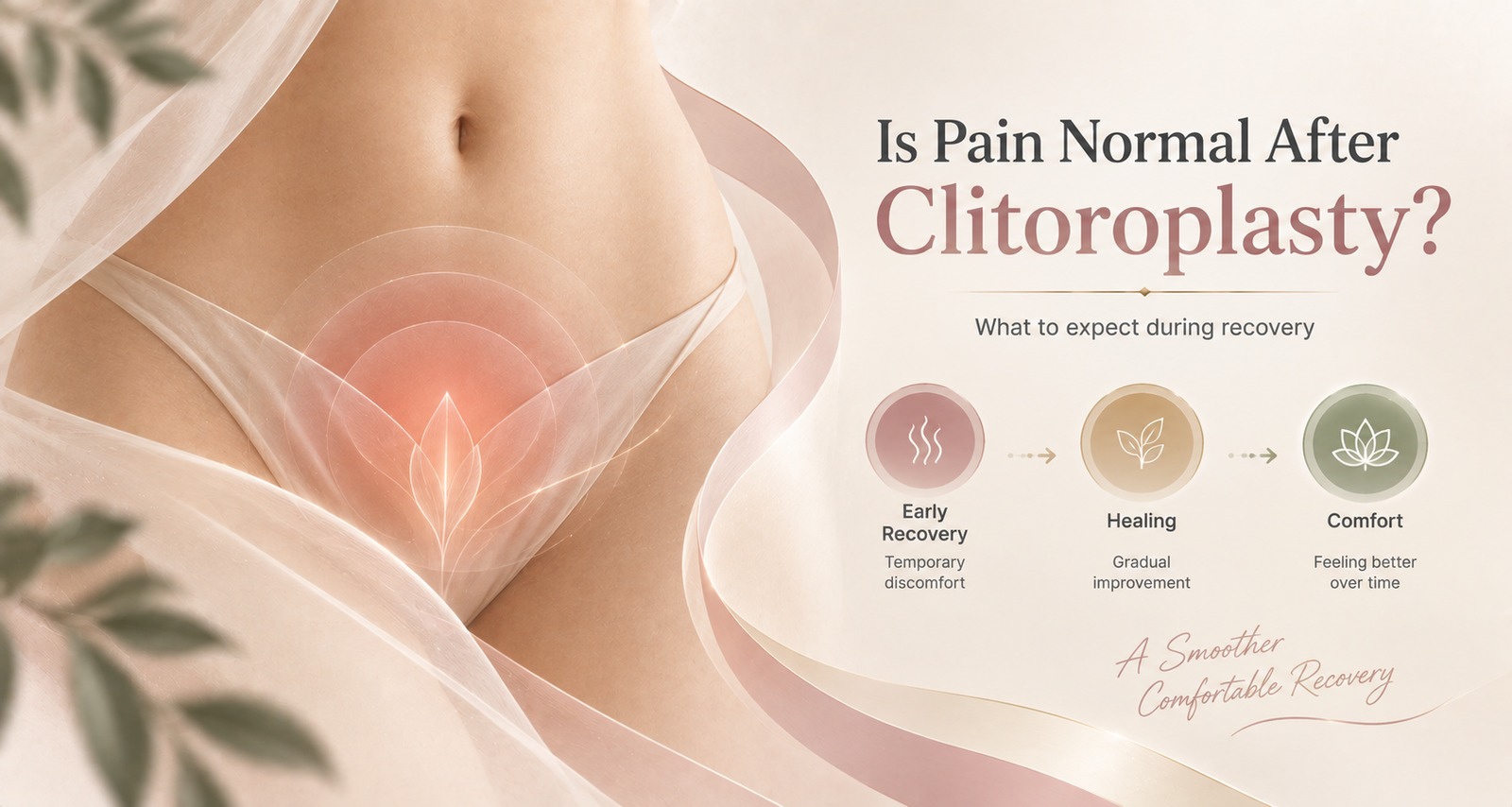
Surgery → Swelling and tenderness → Progressive healing → Reduced sensitivity → Increasing comfort
This does not mean every day will feel exactly better than the previous day. Minor fluctuations can happen.
The overall direction, however, should usually be toward improvement.
Why Can the Surgical Area Feel Extra Sensitive?
Sensitivity can be influenced by both swelling and the healing response of local tissues.
Immediately after surgery, the area may therefore feel different from its normal baseline.
Temporary changes in sensation do not necessarily indicate that something has gone wrong.
However, severe, persistent or unexpected sensory changes should be discussed with the operating surgeon.
Patients should also avoid repeatedly touching or checking the operated area because unnecessary manipulation can irritate healing tissues.
How Much Pain Is Too Much?
There is no universal pain score that determines whether recovery is normal.
One patient may describe normal postoperative discomfort as mild, while another may experience it more strongly.
Instead of focusing only on a number from 1 to 10, consider:
Direction of pain – Is it improving?
Swelling – Is it gradually settling or rapidly increasing?
Wound appearance – Is there worsening redness or separation?
General health – Is fever developing?
Discharge – Is there unusual or foul-smelling drainage?
A combination of worsening symptoms is more concerning than expected early tenderness alone.
When Should Pain After Clitoroplasty Be Checked?
Pain should be medically assessed when it is unexpectedly severe or progressively worsening.
Contact the treating surgical team particularly if pain occurs with:
- rapidly increasing swelling,
- significant bleeding,
- spreading redness,
- fever,
- unusual or foul-smelling discharge,
- wound opening,
- worsening tenderness,
- or another unexpected postoperative change.
Do not wait for a scheduled follow-up when symptoms are rapidly deteriorating.
Can Swelling Cause Pain After Clitoroplasty?
Yes.
Postoperative inflammation naturally brings additional fluid into healing tissues. This produces swelling and can increase local pressure and sensitivity.
Swelling can also temporarily change the appearance of the operated area.
This is particularly important psychologically because patients may look at the early postoperative appearance and worry that the result is uneven or incorrect.
Early swelling is not the final surgical result.
Tissues need time to settle before the eventual appearance can be assessed.
Can Clothing Make the Area Uncomfortable?
Friction and pressure can irritate healing tissue.
Patients should follow the specific clothing and wound-care instructions provided by their surgical team.
The exact recommendations depend on the procedure and healing stage.
Patients should avoid experimenting with unapproved topical products, dressings or home remedies on a fresh surgical wound without checking with their doctor.
How Is Pain Managed After Clitoroplasty?
Pain management should follow the postoperative plan provided by the operating surgeon.
Depending on the procedure and individual situation, the surgeon may recommend or prescribe appropriate medication and wound-care measures.
Patients should take medications only as directed.
Using additional medicines, creams or home treatments without medical advice may create unnecessary risks.
The objective of postoperative care is not simply to eliminate every sensation. It is to maintain reasonable comfort while protecting healing tissues.
Can Physical Activity Increase Pain?
It can.
Activities that produce friction, pressure or excessive movement around healing tissues may increase discomfort.
This is why activity restrictions are an important part of recovery.
The exact timeline for returning to exercise and other activities depends on the operation performed and individual healing.
A patient who feels better should not automatically assume that deeper tissues have completed healing.
Feeling comfortable and being fully healed are not the same thing.
When Can Normal Activities Resume?
There is no universal return-to-activity timeline.
Recovery depends on:
Extent of surgery → Tissue healing → Swelling → Wound condition → Individual recovery
Light routine activities and strenuous physical activity do not necessarily resume at the same time.
The operating surgeon should guide the progression according to the patient’s healing.
Can Pain Mean the Surgery Has Failed?
No.
Pain during early healing does not by itself determine the final surgical outcome.
Likewise, swelling can temporarily alter the appearance of the area.
The result should be assessed only after sufficient healing.
However, severe or worsening pain should not simply be dismissed as normal recovery because it can occasionally indicate a complication requiring assessment.
What Are Possible Complications After Clitoroplasty?
Potential surgical complications vary according to the procedure but can include:
- bleeding,
- infection,
- wound-healing problems,
- swelling,
- scarring,
- wound separation,
- altered sensation,
- persistent discomfort,
- asymmetry,
- and dissatisfaction with the outcome.
The presence of a possible complication cannot be diagnosed reliably through symptoms described online.
A physical assessment may be necessary.
What Can Help Support Safe Recovery?
The most important principle is to protect the healing tissues.
Patients should:
follow the prescribed wound-care instructions,
take medication as directed,
respect activity restrictions,
avoid unnecessary friction or manipulation,
attend scheduled follow-up appointments,
and report unexpected symptoms promptly.
Following the surgeon’s specific instructions is more appropriate than copying another patient’s recovery routine from social media or online forums.
Why Does Follow-Up Matter?
Follow-up allows the surgeon to assess:
Wound healing
Swelling
Incision condition
Symptoms
Recovery progress
and eventually the surgical result.
Some problems are easier to manage when identified early.
Patients should therefore attend follow-up even when they believe recovery is progressing normally.
More information about the surgical experience and approach of Dr. Ashutosh Shah can help patients understand the clinical background behind treatment planning at Elegance Clinic.
A Simple Way to Monitor Recovery
Instead of asking:
“Should I have zero pain by now?”
Ask:
Is it better, the same or worse?
Better: generally more consistent with progressive recovery.
Same: may require monitoring depending on the stage and other symptoms.
Worse: particularly with redness, fever, discharge, bleeding or increasing swelling, deserves medical review.
This framework is more useful than comparing your recovery with another patient’s exact number of postoperative days.
Recovery Should Move Toward Improvement
Pain after clitoroplasty should be considered as part of the overall healing picture rather than evaluated in isolation.
Temporary tenderness, swelling and sensitivity may accompany early recovery. What matters most is whether these symptoms progressively improve.
Worsening pain-particularly when combined with increasing swelling, fever, redness, discharge, bleeding or wound changes-needs medical evaluation.
At Elegance Clinic, postoperative assessment is based on the exact procedure and individual healing rather than a one-size-fits-all recovery timeline.
Patients experiencing an unexpected change after surgery can use the clinic’s contact page to arrange an appropriate assessment.
Frequently Asked Questions
Is pain normal after clitoroplasty?
Some temporary tenderness and discomfort can occur following surgery. The overall pattern should generally improve as healing progresses.
How long does pain last after clitoroplasty?
There is no universal duration. It depends on the extent of surgery, individual sensitivity and healing.
Is swelling normal after clitoroplasty?
Temporary postoperative swelling can occur and may initially increase tenderness or alter appearance.
When should I worry about pain?
Increasing or severe pain, especially with fever, spreading redness, significant bleeding, unusual discharge or wound separation, should be medically assessed.
Can I exercise after clitoroplasty?
Exercise should be resumed according to the operating surgeon’s instructions because excessive movement or friction can affect healing.
Can sensation feel different after surgery?
Temporary sensory changes may occur. Persistent or unexpected changes should be discussed with the surgeon.
Does pain mean something went wrong?
Not necessarily. Some discomfort is expected after surgery, but worsening or unusual pain should not be ignored.
