

|
Getting your Trinity Audio player ready...
|
✓ Medically reviewed by Dr. Ashutosh Shah, Plastic, Reconstructive & Cosmetic Surgeon (M.Ch., DNB)
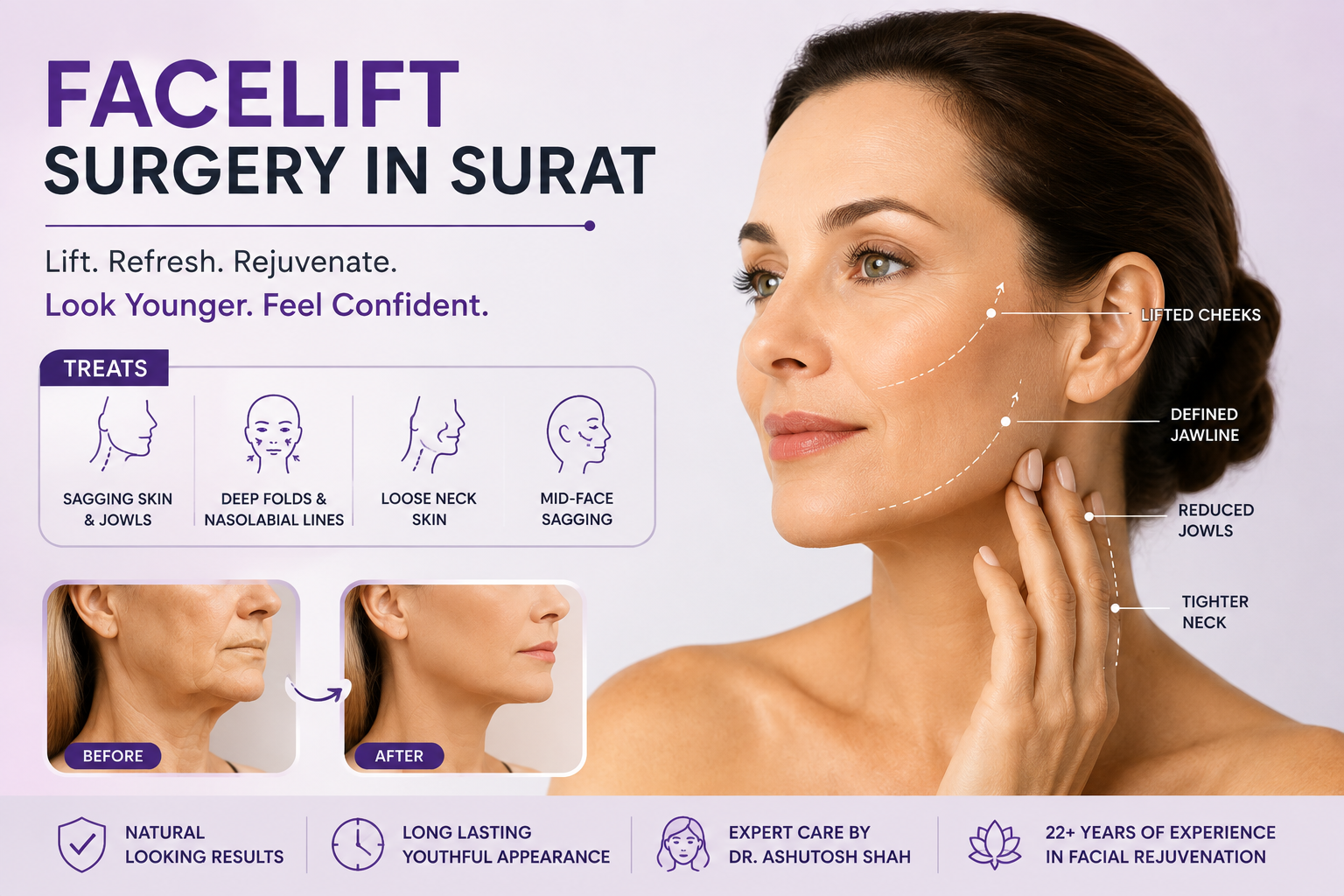
You typically need a facelift when sagging skin, jowls, or loose neck tissue no longer respond to non-surgical treatments — most commonly in the lower face, jawline, and neck, where gravity and lost skin elasticity show up first. A facelift doesn’t treat fine lines or sun damage; it treats structural sagging, which is why knowing the difference matters before you book anything.
“Do I need a facelift?” is a harder question to answer than it sounds, mostly because the term gets used loosely to cover everything from a five-minute filler session to full surgery. This guide walks through the actual signs that point toward a facelift, exactly which areas it addresses, how it compares with non-surgical options, and when in life most people genuinely consider it.
What Signs Mean You Might Need a Facelift?
A facelift is generally the right conversation to have when you notice:
- Jowls — sagging skin along the jawline that breaks up a once-defined jaw contour
- Deep nasolabial folds — pronounced lines running from the nose to the corners of the mouth
- Loose neck skin — often described as “turkey neck,” caused by loosened neck muscles and skin
- Sagging mid-face volume — cheeks that have dropped rather than simply thinned
- Skin that no longer responds to fillers or Botox — when injectables stop giving a meaningful lift because the underlying structure has genuinely sagged
What a facelift will not fix: fine surface wrinkles, sun damage, or skin texture and pigmentation issues — those are better addressed with resurfacing treatments or injectables, sometimes in combination with a facelift rather than instead of one.
Facelift vs Non-Surgical Alternatives: When Is Surgery the Right Call?
| Facelift Surgery | Non-Surgical Options (Threads, Fillers, Liquid Facelift) | |
|---|---|---|
| Best for | Significant sagging skin and jowls | Mild volume loss and early sagging |
| Downtime | 2–3 weeks | Minimal, days at most |
| Results duration | Often a decade or more | Months to around 1–2 years |
| Degree of change | Substantial, structural | Subtle, temporary |
Many patients start with non-surgical options such as a non-surgical thread lift or liquid facelift and move to surgery once sagging has progressed beyond what injectables can meaningfully lift. Neither path is “better” universally — it depends entirely on how far your skin has already sagged.
Where on the Face Does a Facelift Actually Treat?
A traditional facelift specifically targets the lower two-thirds of the face and the neck — jawline, cheeks, jowls, and loose neck skin. It does not lift the forehead or brow area, which is instead addressed with a separate brow lift, or the eyelids, which need blepharoplasty. Many patients combine a facelift with one of these procedures for a more complete result, but each targets a genuinely different zone of the face.
What Age Is Right for a Facelift?
Most people consider a facelift somewhere in their 40s to 60s, though there’s no fixed age requirement — the right time depends on how your individual skin has aged, not a birthday. Someone with strong skin elasticity and moderate sagging in their late 50s may still be a better candidate for non-surgical lifting than someone in their mid-40s with more pronounced jowls from genetics or sun exposure.
Types of Facelift Incisions and Techniques
- Traditional facelift: An incision along the hairline at the temples, down and around the ear, and into the lower scalp — used for more extensive lifting, sometimes with a small incision under the chin for the neck.
- Short-scar (limited incision) facelift: A shorter incision along the hairline above the ear, extending in front of it but not into the lower scalp — suited to more moderate sagging.
- Neck lift incision: Starts near the earlobe and extends into the lower scalp, often with a small incision under the chin, used when neck laxity is the primary concern.
What Does Research Say About Facelift Outcomes?
Facelift surgery has a large and growing evidence base comparing techniques. A 2024 systematic review comparing major facelift approaches — including SMAS (superficial musculoaponeurotic system), deep plane, and subperiosteal techniques — found consistent improvements in aesthetic outcomes and patient quality of life across methods, while also noting that technique choice affects the balance between scar quality, complication risk, and recovery time (Meretsky et al., Cureus, 2024). This reinforces why the specific technique your surgeon recommends should be matched to your face and goals, rather than a single “best” method applied to everyone.
What to Expect During Recovery
Swelling and bruising are most noticeable in the first one to two weeks, with most people feeling comfortable returning to low-key social situations by around week three, though full settling of the final result can take a few months. Keeping your head elevated, taking prescribed pain medication, and using cold compresses in the early days all support smoother healing.
Facelift Surgery at Elegance Clinic, Surat
At Elegance Clinic, facelift surgery is performed by Dr. Ashutosh Shah, a board-certified plastic and cosmetic surgeon with over 22 years of experience in Surat, Gujarat. As an expert doctor treating both surgical and non-surgical facial rejuvenation, Dr. Shah’s consultations focus on identifying exactly where your face has sagged and whether that calls for surgery, injectables, or a staged combination — rather than defaulting every consultation toward the same procedure.
Book a Facelift Consultation
Whether a facelift, a non-surgical alternative, or a combination is right for you depends on exactly where and how much your face has sagged — a decision best made face-to-face. Book a consultation with Elegance Clinic in Surat, or reach out directly on WhatsApp to discuss your options.
Disclaimer: This article is for general educational purposes only and is not a substitute for professional medical advice. Please consult Dr. Ashutosh Shah or a qualified plastic surgeon for an individual assessment.

