

|
Getting your Trinity Audio player ready...
|
✓ Medically reviewed by Dr. Ashutosh Shah, Plastic, Reconstructive & Cosmetic Surgeon (M.Ch., DNB)
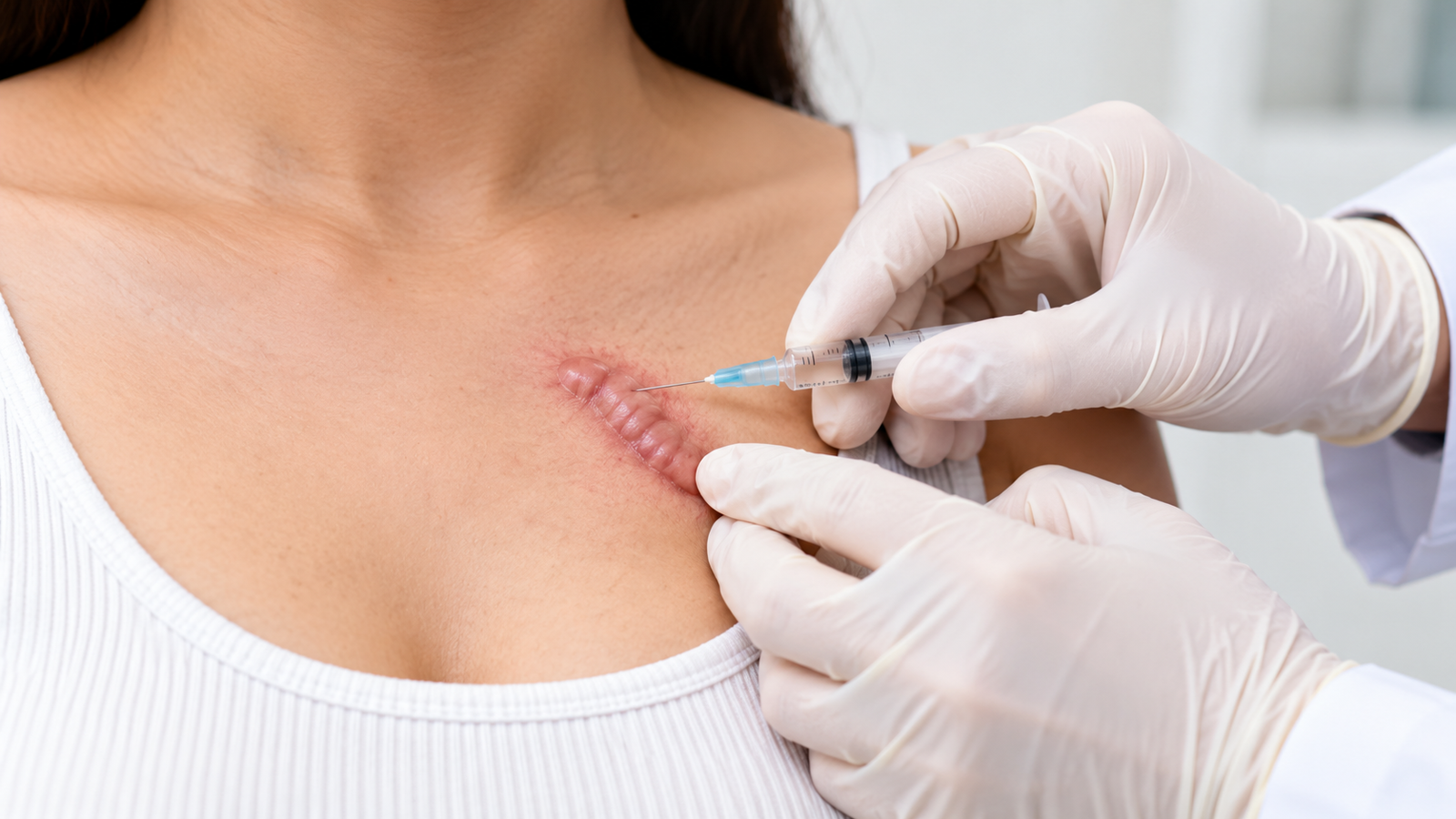
Keloid injection treatment commonly involves steroid injections given directly into a raised scar every four to six weeks. Some patients need approximately three to six sessions, although treatment duration varies according to scar size, thickness, and response. Doctors monitor flattening, itching and side effects before deciding whether to continue, adjust or stop injections.
Keloids can develop after acne, surgery, burns, ear piercing or minor skin injuries. Unlike ordinary scars, keloids extend beyond the original wound boundaries and may continue growing.
They can cause itching, tenderness, discomfort, and cosmetic concerns.
Steroid injections are among the established non-surgical treatment options for keloids. However, patients often have practical questions: How many injections will I need? Will they hurt? What happens if my skin becomes lighter? When should treatment stop?
This guide explains the injection schedule, expected response, side effects, costs, and follow-up planning.
What Is Keloid Injection Treatment?
Keloid injection treatment involves placing medication directly into the raised scar tissue.
Doctors commonly use an injectable corticosteroid called triamcinolone acetonide.
This treatment is also known as an intralesional steroid injection.
The medication helps reduce inflammation and excessive scar tissue activity.
Over time, treatment may:
- Reduce keloid thickness
- Soften firm scar tissue
- Relieve itching
- Reduce tenderness
- Improve scar flexibility
- Limit further growth in some cases
Steroid injections do not guarantee complete keloid removal.
Some scars respond well, while others improve only partially or recur after treatment.
For a detailed explanation, see Intralesional Keloid Injections.
How Do Steroid Injections Shrink a Keloid?
Keloids develop when the healing process produces excessive collagen and scar tissue.
The scar may continue growing even after the original wound heals.
Intralesional corticosteroids help suppress some of the inflammatory and collagen-producing processes involved in abnormal scarring.
What Changes Can Patients Notice?
Reduced itching: Some patients notice less itching before the scar becomes visibly flatter.
Softer scar tissue: A firm keloid may gradually become more flexible.
Reduced thickness: Repeated treatment may decrease the raised portion of the scar.
Less discomfort: Pain or tenderness may improve as inflammation decreases.
However, the colour of a keloid may not return completely to the surrounding skin tone.
Even a flatter scar may remain visible.
How Many Keloid Steroid Injections Are Usually Needed?
Many patients receive approximately three to six injections during an initial treatment course.
However, this is only a general planning estimate.
Some smaller keloids improve after fewer sessions.
Larger, thicker, or longstanding scars may require additional treatment or a different approach.
What Determines the Number of Sessions?
The doctor considers:
- Keloid thickness
- Scar size
- Scar location
- Duration of the keloid
- Previous treatment
- Symptoms such as itching and pain
- Response to earlier injections
- Skin changes caused by treatment
A scar that becomes flatter and stops itching may not need further injections.
A scar that shows little improvement may require reassessment rather than repeated injections without a clear benefit.
Example Treatment Timeline
| Visit | Approximate Timing | What the Doctor Checks |
|---|---|---|
| First visit | Week 0 | Scar assessment, symptoms and treatment suitability |
| Second visit | Week 4–6 | Early response, itching and side effects |
| Third visit | Week 8–12 | Changes in thickness and scar softness |
| Fourth visit | Week 12–18 | Whether further injections offer meaningful benefit |
| Fifth visit | If needed | Continued improvement and skin safety |
| Sixth visit | If needed | Whether to stop, pause, or change treatment |
This table illustrates a possible schedule. It does not prescribe a fixed number of injections.
How Far Apart Should Keloid Injections Be?
Doctors commonly schedule intralesional triamcinolone injections at intervals of approximately four to six weeks.
The interval allows time to assess the effect of the previous treatment and monitor local skin changes.
Some treatment protocols use different intervals according to scar characteristics, medication concentration, and clinical response.
Why Not Inject Every Week?
Steroid medication continues acting after the injection.
Repeating treatment too frequently or using excessive doses may increase the risk of local complications.
These include skin thinning, pigment changes, and visible blood vessels.
Can I Delay My Next Injection?
A short scheduling delay does not automatically mean treatment has failed.
However, the best interval depends on the individual scar.
Contact your treating clinician if you need to postpone an appointment.
Do not try to compensate for a missed session by increasing the dose or shortening the next interval yourself.
Keloid Doctor Near Valsad: Planning Injection Visits
Patients who travel for scar treatment should discuss the full follow-up plan during their first consultation.
Because treatment may involve several visits, a practical schedule can reduce unnecessary travel.
Step 1: Arrange an Initial Assessment
The doctor examines the scar and confirms whether it is consistent with a keloid.
Not every raised scar is a keloid. Hypertrophic scars and other skin conditions may require different management.
Step 2: Discuss the Expected Treatment Course
Ask whether injections are suitable and how many sessions may be reasonable to plan initially.
Step 3: Schedule Follow-Up Reviews
A four-to-six-week review schedule may be appropriate when the clinician recommends ongoing injections.
Step 4: Track Your Scar Between Visits
Keep photographs taken under similar lighting and record itching, discomfort, and visible changes.
Step 5: Confirm Where Treatment Will Take Place
Patients can review the Valsad OPD Centre information when planning an appointment.
Important: Confirm directly with the clinic whether steroid injections are administered at that OPD or whether the appointment is for assessment and follow-up only.
Dr. Ashutosh Shah at Elegance Clinic can assess keloid characteristics and discuss appropriate scar-management options. The injection location, availability, and treatment schedule should be confirmed when booking.
What Are the Side Effects of Keloid Steroid Injections?
Most side effects involve the skin around the injection site.
Their likelihood depends on the medication, concentration, injection technique, treatment frequency, and individual skin response.
1. Temporary Injection Pain
The injection may cause stinging, pressure, or discomfort.
Keloid tissue can be firm, which may make the injection uncomfortable.
2. Skin Thinning
Steroids can cause local skin atrophy.
The treated area may become thinner or appear slightly depressed.
3. Skin Lightening
Some patients develop hypopigmentation, meaning the treated skin becomes lighter than surrounding skin.
This change may improve over time, but it can sometimes persist.
4. Visible Blood Vessels
Small surface blood vessels, called telangiectasias, may become more noticeable.
5. Local Tissue Depression
Steroid effects may extend into surrounding tissue and produce a visible indentation.
6. Rare Infection or Other Reactions
Infection is uncommon but possible after a skin injection.
Increasing redness, warmth, swelling, pus, or fever requires prompt medical assessment.
Side Effects and Recommended Actions
| Side Effect | What You May Notice | What to Do |
|---|---|---|
| Injection discomfort | Temporary pain or tenderness | Discuss pain-control options |
| Skin thinning | Thin or depressed skin | Inform the doctor before another injection |
| Hypopigmentation | Lighter patches | Request reassessment of the treatment plan |
| Visible vessels | Fine red blood vessels | Discuss whether to pause or change treatment |
| Persistent pain | Pain that continues or worsens | Arrange clinical review |
| Possible infection | Increasing redness, warmth, discharge, or fever | Seek prompt medical attention |
Do not continue repeated injections without reassessment if significant skin changes appear.
When Should Keloid Steroid Injections Stop?
Steroid injections should not continue indefinitely simply because a scar remains visible.
The clinician evaluates both treatment benefit and possible harm.
Stop or Pause When the Keloid Becomes Flat
If the scar has flattened sufficiently and symptoms have improved, further injections may offer limited benefit.
The doctor may recommend observation.
Change Treatment if Skin Thinning Develops
New atrophy or depressed skin may indicate that additional steroid treatment could cause further damage.
Reassess When Pigment Changes Appear
Skin lightening or visible blood vessels may prompt a change in dose, injection technique, or treatment strategy.
Reconsider the Plan When the Scar Does Not Respond
If the keloid shows little meaningful improvement after several appropriately spaced injections, the clinician may recommend another treatment or a combination approach.
Review the Diagnosis if the Scar Behaves Unusually
Rapid growth, ulceration, unexplained bleeding, or unusual changes require medical evaluation.
The clinician may need to reconsider the diagnosis.
Practical Stop-or-Change Rules
- Flat scar with symptoms controlled: Consider stopping injections and monitoring.
- Continued improvement without significant side effects: The clinician may continue treatment.
- Skin thinning or visible vessels: Pause and reassess before further treatment.
- Persistent pigmentation changes: Review the medication and treatment plan.
- Minimal response after several sessions: Discuss alternative or combined treatment.
- Suspected infection or unusual scar changes: Arrange prompt examination.
These decisions require a clinician’s assessment; they are not instructions to stop prescribed care independently.
What if a Keloid Does Not Improve After Three Injections?
Three injections can provide a useful early point for reviewing treatment response.
However, lack of complete flattening after three sessions does not automatically mean the treatment has failed.
The doctor may examine:
- Whether the keloid has softened
- Whether its height has decreased
- Whether itching has improved
- Whether the injection technique and medication are appropriate
- Whether side effects limit further treatment
If the scar shows no meaningful improvement, the clinician may consider a different approach.
Possible options include selected combination injections, silicone-based scar care, laser treatment, cryotherapy, or surgery with recurrence-prevention measures.
Treatment choice depends on scar size, location, skin type, and previous response.
When Are Keloid Injections Combined With Other Treatments?
Some keloids respond better to a combination strategy.
Steroid Injections and Silicone Therapy
Silicone gel or sheets may help manage certain raised scars.
The doctor can explain whether silicone treatment is suitable between injection sessions.
Steroid Injections and Laser Treatment
Selected laser treatments may help address redness, thickness, or other scar characteristics.
The clinician should discuss realistic benefits and pigment-related risks.
Steroid Injections and Surgery
Surgery may help remove selected large or symptomatic keloids.
However, surgical removal alone carries a substantial recurrence risk.
Doctors may recommend additional treatment to reduce the likelihood of regrowth.
Steroid Injections and Pressure Therapy
Pressure therapy may help selected scars, particularly certain ear keloids.
Not every body area can accommodate effective pressure treatment.
Read more about Keloid Recurrence Prevention to understand why follow-up matters even after a scar improves.
Keloid Injection Price in India: What Affects the Cost?
The cost of keloid injections varies between clinics and patients.
There is no single reliable price for every injection session.
Factors That Affect Cost
Keloid size: Larger scars may require more medication or treatment time.
Number of scars: Treating multiple keloids may change the total cost.
Medication and technique: The treatment protocol can influence charges.
Doctor’s assessment: Consultation and review fees may be separate.
Number of sessions: Patients who need more appointments generally face a higher overall treatment cost.
Combination procedures: Laser, surgery, or other scar treatments may add to the expense.
What Should a Written Estimate Include?
| Cost Component | What to Confirm |
|---|---|
| Consultation | Whether the initial assessment has a separate fee |
| Injection session | Whether the quoted amount covers one visit |
| Medication | Whether the medicine is included |
| Multiple keloids | Whether each scar has a separate charge |
| Follow-up review | Whether review visits are included |
| Additional treatment | Whether laser or other procedures cost extra |
Ask the clinic for its current fees before scheduling treatment.
Avoid relying on an online price estimate that does not specify scar size, medication, or the number of sessions.
Patient Keloid Injection Log
Keeping a treatment record helps patients and clinicians compare changes between appointments.
Use the following table after each visit.
| Date | Keloid Height and Colour | Itch/Pain Score | Dose Given | Side Effects | Next Visit |
|---|---|---|---|---|---|
| Visit 1 | /10 | Doctor to record | |||
| Visit 2 | /10 | Doctor to record | |||
| Visit 3 | /10 | Doctor to record | |||
| Visit 4 | /10 | Doctor to record | |||
| Visit 5 | /10 | Doctor to record | |||
| Visit 6 | /10 | Doctor to record |
How to Use the Log
Record your itch or pain score on a scale from zero to ten.
Use zero for no symptoms and ten for the worst symptoms imaginable.
If possible, ask the clinician to measure the scar’s height consistently.
Record any skin lightening, thinning, new blood vessels, or tenderness.
The treating clinician should document the medication concentration and actual dose. Patients should not calculate or administer steroid doses themselves.
Frequently Asked Questions
1. Is a keloid injection painful?
Keloid injections can cause temporary stinging, pressure, or discomfort because scar tissue is often firm. The doctor may use pain-reduction techniques when appropriate. Discomfort varies according to the scar’s location, thickness, and individual sensitivity.
2. What is the name of the injection used for keloids?
Doctors commonly use triamcinolone acetonide, a corticosteroid injected directly into the scar. The concentration and amount depend on the keloid and treatment plan. Other injectable medicines may be considered in selected cases.
3. Can keloid injections be taken during pregnancy?
Pregnant patients should discuss treatment with their obstetrician and treating specialist. Although intralesional injections generally involve localized treatment, the decision depends on the medication, dose, clinical need, and individual circumstances. Elective treatment may sometimes be postponed.
4. Why is my keloid lighter than my skin after injections?
Steroid injections can cause hypopigmentation, making treated skin lighter than surrounding areas. This change may gradually improve, but it can sometimes persist. Tell your doctor before receiving another injection so the treatment plan can be reassessed.
5. What if my keloid does not respond after three injections?
The doctor should review changes in scar height, softness, itching, and pain. If improvement remains limited, the clinician may adjust the treatment or discuss combination therapy. Continuing injections without reassessing benefits and side effects may not be appropriate.
6. How much does one keloid injection cost, and where can I find a keloid doctor near Valsad?
The cost depends on scar size, medication, consultation charges and whether multiple keloids need treatment. Patients can contact Elegance Clinic to confirm current pricing, appointment availability, and whether injections are offered at the relevant OPD or require a separate treatment visit.
Key Takeaways
- Keloid injection treatment commonly uses intralesional triamcinolone.
- Doctors often schedule sessions approximately four to six weeks apart.
- Some patients need around three to six sessions, but treatment duration varies.
- Injections may reduce scar thickness, itching, and discomfort.
- Skin thinning, hypopigmentation, and visible blood vessels are important side effects.
- Treatment should pause or change when risks outweigh further benefits.
- Poor response after several injections requires reassessment.
- Large or recurrent keloids may need combination treatment.
- Surgery alone can carry a high risk of recurrence.
- A patient injection log helps track progress and side effects.
Conclusion
Keloid injection treatment can help flatten raised scars and reduce symptoms such as itching and tenderness.
Doctors commonly use a four-to-six-week interval, but the number of sessions depends on how the scar responds.
The most important part of treatment is not simply completing a fixed number of injections. It is monitoring scar improvement, recognizing side effects, and knowing when to stop or change the approach.
Dr. Ashutosh Shah at Elegance Clinic can discuss suitable keloid-management options and follow-up planning based on individual scar characteristics.
Patients should confirm appointment arrangements, treatment availability, and current fees directly with the clinic before travelling.
