

|
Getting your Trinity Audio player ready...
|
✓ Medically reviewed by Dr. Ashutosh Shah, Plastic, Reconstructive & Cosmetic Surgeon (M.Ch., DNB)
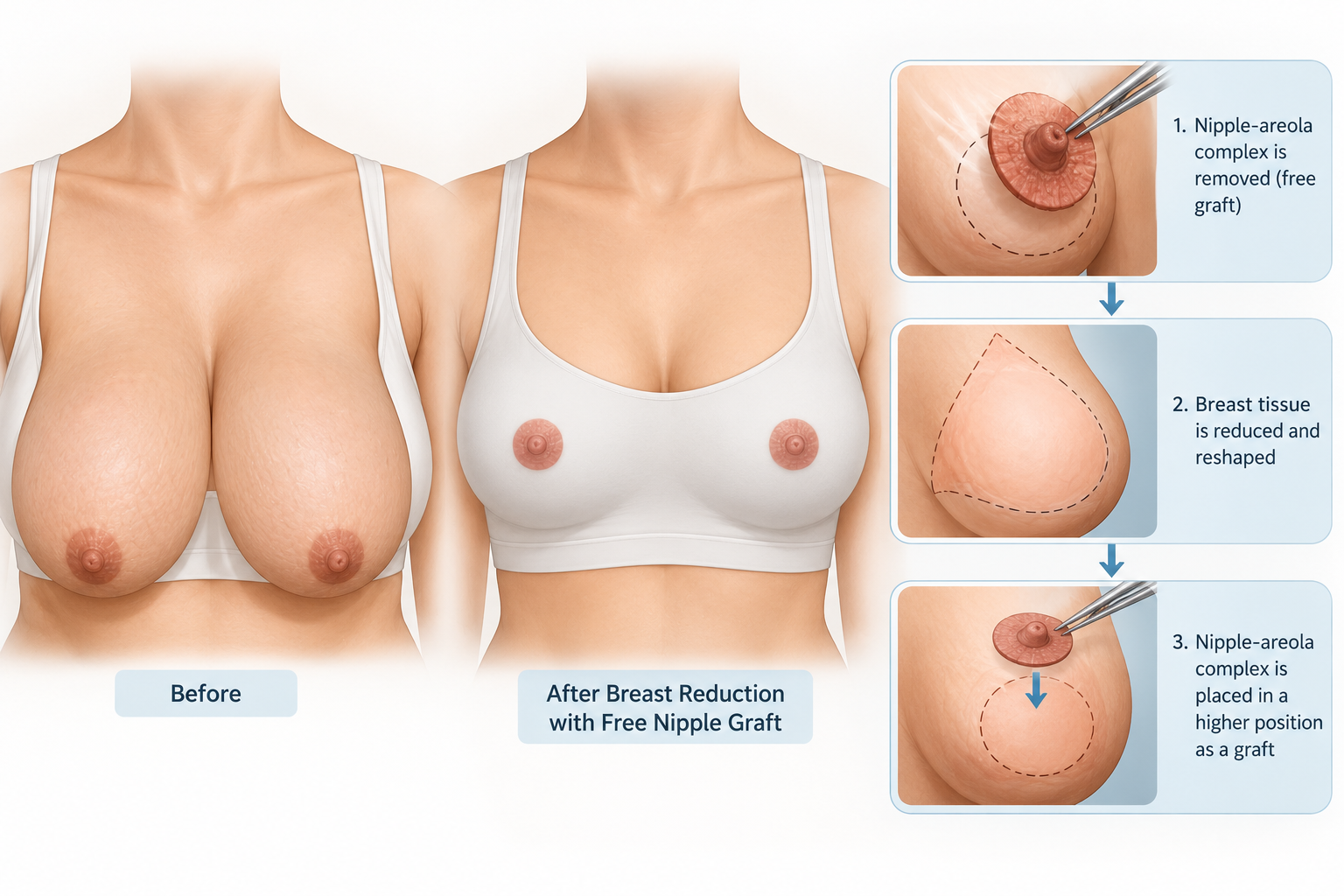
A free nipple graft breast reduction is a specialised surgical technique in which the nipple and areola are completely detached and reattached to the reshaped breast. Surgeons may consider it for exceptionally large breasts, severe sagging or complex anatomy when preserving the nipple’s original blood supply is difficult. However, most breast reductions can be performed without a free nipple graft.
Many women considering breast reduction worry about whether the surgeon will remove their nipples during surgery.
In most cases, surgeons preserve the nipple-areola complex while removing excess breast tissue and reshaping the breasts. However, certain patients with extremely large breasts or complex anatomy may require a different approach.
A free nipple graft is one possible option.
Understanding how this procedure works, when surgeons recommend it and what limitations it carries helps patients make informed decisions.
What Is a Free Nipple Graft in Breast Reduction?
A free nipple graft is a technique used during selected breast reduction procedures.
The surgeon completely separates the nipple-areola complex from its original tissue connections. After reducing and reshaping the breast, the surgeon places the nipple and areola in a higher position as a graft.
Unlike conventional breast reduction, the graft no longer has its original blood supply.
Instead, it must establish a new blood supply from the underlying tissue during healing.
What Is the Nipple-Areola Complex?
The nipple-areola complex includes:
- The nipple
- The surrounding pigmented areola
- Sensory nerve endings
- Milk duct openings
- Associated skin structures
In standard breast reduction, surgeons generally preserve a supporting tissue attachment that contains blood vessels and may retain important nerve and ductal connections.
This is known as a pedicle.
Patients can also read about nipple repositioning during a breast lift to understand how surgeons usually move the nipple while preserving its tissue attachment.
Internal link publishing note: Confirm that the linked nipple-repositioning article is live before publication.
When Is a Free Nipple Graft Breast Reduction Needed?
Most breast reductions do not require free nipple grafting.
Surgeons usually prefer techniques that preserve the nipple’s original tissue connections whenever these approaches are suitable.
However, certain anatomical situations may make free nipple grafting worth considering.
1. Extremely Large Breasts
Patients with very large breasts may require removal of substantial amounts of breast tissue.
The nipple may also sit far below its planned position.
Moving the nipple upward while maintaining adequate circulation can become technically challenging in selected cases.
A free nipple graft may be considered when the surgeon believes that a tissue-preserving technique would create an unacceptable risk to nipple circulation.
2. Severe Breast Sagging
Severe breast sagging, also called ptosis, can cause the nipple to move significantly downward.
The surgeon must assess how far the nipple needs to move and whether the supporting tissue can maintain reliable blood flow.
However, severe sagging alone does not automatically require a free nipple graft.
Many patients with substantial sagging can undergo conventional breast reduction.
3. Gigantomastia
Gigantomastia refers to exceptionally excessive breast growth.
It may cause physical and functional difficulties, including:
- Chronic neck and shoulder pain
- Back discomfort
- Skin irritation beneath the breasts
- Deep bra-strap grooves
- Difficulty finding suitable clothing
- Restrictions in physical activities
In selected cases of gigantomastia surgery, a free nipple graft may be considered when breast size and anatomy make conventional nipple preservation less suitable.
4. Previous Breast Surgery
Previous operations may alter breast tissue, blood vessels and scar patterns.
These changes can affect the available surgical options.
However, a history of breast surgery does not automatically mean a free nipple graft is necessary.
The surgeon must evaluate the remaining tissue and circulation before recommending a technique.
How Does Free Nipple Graft Breast Reduction Work?
The procedure involves several carefully planned stages.
Step 1: Preoperative Assessment
The surgeon examines breast size, skin quality, nipple position and the degree of sagging.
Measurements help estimate the amount of tissue removal and nipple repositioning required.
The surgeon also reviews the patient’s medical history and previous procedures.
Step 2: Anaesthesia
Breast reduction with a free nipple graft is generally performed under general anaesthesia.
The anaesthesia team monitors the patient throughout surgery.
Step 3: Preparing the Nipple-Areola Graft
The surgeon carefully separates the nipple-areola complex and prepares it for grafting.
The tissue must be handled gently to support graft survival.
Step 4: Removing Excess Breast Tissue
The surgeon removes the planned amount of breast tissue and excess skin.
The remaining tissue is reshaped to create a smaller breast contour.
Step 5: Repositioning the Graft
The surgeon prepares a recipient site at the planned nipple position.
The nipple-areola graft is secured to the reshaped breast.
Special dressings may help protect the graft and minimise movement during early healing.
Step 6: Recovery and Follow-Up
The surgical team monitors wound healing, graft survival and breast shape.
Patients receive instructions about dressings, supportive garments, activity restrictions and follow-up visits.
The exact procedure depends on the patient’s anatomy and surgical requirements.
Free Nipple Graft vs Pedicle Breast Reduction
The most important difference is whether the nipple remains attached to its original tissue connections.
| Feature | Pedicle Breast Reduction | Free Nipple Graft |
|---|---|---|
| Nipple remains attached during repositioning | Yes | No |
| Original blood supply | Preserved through the pedicle | Divided during graft preparation |
| Nipple sensation | May be preserved or altered | Usually substantially reduced or lost |
| Breastfeeding potential | May remain possible | Generally lost through the grafted nipple |
| Graft-healing risk | No free nipple graft | Present |
| Typical application | Most breast reductions | Selected complex reductions |
| Breast reshaping | Yes | Yes |
| Scarring | Yes | Yes |
A free nipple graft is not automatically better because it allows extensive nipple repositioning.
The preferred technique depends on surgical safety, breast anatomy and the patient’s priorities.
Does Every Very Large Breast Reduction Need a Free Nipple Graft?
No.
Breast size alone does not determine whether free nipple grafting is necessary.
Surgeons also consider nipple position, tissue quality, circulation, previous procedures and the planned amount of reduction.
Many patients with very large breasts can undergo a pedicle-based procedure.
Factors That Influence Surgical Planning
| Assessment Factor | Why It Matters |
|---|---|
| Breast volume | Helps estimate the extent of tissue removal |
| Nipple position | Determines how much repositioning is required |
| Degree of sagging | Influences reshaping and incision planning |
| Skin elasticity | Affects contour and wound closure |
| Previous breast surgery | May alter tissue circulation |
| Smoking or nicotine exposure | Increases wound-healing concerns |
| Medical conditions | May affect surgical and recovery risks |
| Breastfeeding goals | Important when selecting a technique |
There is no universally accepted breast weight or nipple-distance measurement that automatically requires a free nipple graft.
The decision must be individualised.
What Are the Benefits of Free Nipple Grafting?
In appropriately selected patients, free nipple grafting can offer several surgical advantages.
Allows Extensive Breast Reduction
The surgeon may remove substantial breast tissue without needing to preserve a long nipple-bearing pedicle.
Allows Major Nipple Repositioning
The technique allows the surgeon to place the graft at the planned location on the reshaped breast.
Provides an Alternative in Complex Cases
When a conventional tissue attachment may not maintain reliable circulation, free nipple grafting provides another option.
May Improve Physical Symptoms
A substantial breast reduction may improve selected symptoms associated with very large breasts.
These include shoulder discomfort, skin irritation and restrictions in physical activity.
However, results vary, and complete symptom relief cannot be guaranteed.
Will Nipple Sensation Be Lost After a Free Nipple Graft?
Loss of normal nipple sensation is one of the major limitations of free nipple graft breast reduction.
During the procedure, the surgeon divides the original nerve connections supplying the nipple-areola complex.
As the graft heals, some patients may regain limited sensation.
However, normal nipple sensation generally cannot be expected.
Can Nipple Sensation Return?
Some sensory recovery may occur over time.
However, the amount and quality of sensation are unpredictable.
Patients should understand that substantial or permanent sensory loss is likely.
This is an important difference between free nipple grafting and conventional tissue-preserving breast reduction.
Can You Breastfeed After a Free Nipple Graft?
Breastfeeding through a free nipple graft is generally not possible.
The procedure separates the nipple from its original milk ducts and glandular connections.
Although the graft may heal successfully, the original ductal connections are not restored.
Patients planning future pregnancies should discuss breastfeeding goals before surgery.
What About Conventional Breast Reduction?
Breastfeeding may remain possible after some pedicle-based breast reductions.
However, conventional breast reduction can also affect milk production and delivery.
No surgical technique guarantees successful breastfeeding.
For patients who strongly wish to preserve breastfeeding potential, this consideration may influence the recommended approach.
What Are the Risks of Free Nipple Graft Breast Reduction?
Free nipple grafting carries specific risks in addition to the general risks of breast reduction surgery.
Partial or Complete Graft Loss
The graft must establish circulation from the recipient tissue.
If this process fails, part or all of the graft may not survive.
Changes in Nipple Colour
The graft may heal with lighter, darker, or uneven pigmentation.
Permanent Sensory Changes
Normal nipple sensation is usually substantially reduced or lost.
Loss of Breastfeeding Function
The original milk duct connections are divided.
Reduced Nipple Projection
The nipple may become flatter during healing.
Scarring
Breast reduction creates permanent scars.
Their pattern depends on the surgical technique and extent of skin removal.
General Surgical Risks
Additional complications may include:
- Bleeding
- Infection
- Delayed wound healing
- Breast asymmetry
- Fluid collection
- Anaesthesia-related complications
- Need for additional surgery
Patients should discuss these risks before providing informed consent.
How Long Does a Free Nipple Graft Take to Heal?
Recovery occurs gradually.
The early healing period is particularly important because the graft must establish a new blood supply.
| Recovery Period | Expected Healing Changes |
|---|---|
| First week | Protective dressings support graft attachment |
| Weeks 2–3 | Graft healing continues; superficial crusting or colour changes may occur |
| Weeks 4–6 | Incisions continue healing, and daily activity may gradually increase |
| Months 2–3 | Swelling decreases, and breast shape continues settling |
| Months 3–6 | Scars and graft appearance continue changing |
| Months 6–12 | Longer-term breast contour and scar maturation become clearer |
These are approximate timelines.
Recovery varies according to the procedure and individual healing response.
Recovery Instructions
Patients should:
- Keep dressings in place as instructed
- Avoid unnecessary pressure over the graft
- Wear the recommended supportive garment
- Avoid smoking and nicotine exposure
- Follow activity restrictions
- Attend scheduled follow-up appointments
- Report unusual symptoms promptly
Patients should not remove specialised graft dressings unless their surgeon instructs them to do so.
When Should You Contact Your Surgeon?
Seek prompt medical assessment if you notice increasing pain, fever, spreading redness, unusual discharge, bleeding or wound separation.
Sudden significant darkening, unusual paleness, or deterioration of the graft requires urgent evaluation.
Some colour changes may occur during normal graft healing, but patients should not attempt to diagnose graft problems themselves.
Will the Breasts Look Natural After Free Nipple Grafting?
Surgeons aim to create a balanced breast contour and suitable nipple position.
However, the final appearance depends on several factors.
These include:
- Original breast size
- Amount of tissue removed
- Skin quality
- Healing response
- Graft survival
- Scar formation
- Natural breast asymmetry
The nipple-areola complex may appear flatter or develop pigmentation changes after grafting.
Patients should understand these possibilities before surgery.
Perfect symmetry and a specific cosmetic result cannot be guaranteed.
How Does a Surgeon Decide Whether a Free Nipple Graft Is Needed?
The decision begins with a detailed consultation.
The surgeon evaluates the patient’s anatomy and compares the available surgical techniques.
Important questions include:
- How much breast tissue needs to be removed?
- How far must the nipple move?
- Can a pedicle technique preserve adequate circulation?
- Has the patient undergone previous breast surgery?
- Does the patient wish to breastfeed in the future?
- How important is preserving nipple sensation?
- What are the patient’s expectations regarding scars and breast shape?
At Elegance Clinic, Dr. Ashutosh Shah, MBBS, MS, MCh and DNB, a plastic and reconstructive surgeon practising since 2004, evaluates breast size, nipple position, tissue quality and individual goals before recommending a breast reduction technique. He considers whether a conventional pedicle-based approach can preserve nipple circulation or whether free nipple grafting should be discussed for complex anatomy or an exceptionally large reduction.
The goal is to select a technique that balances surgical safety, breast contour and the patient’s priorities.
Frequently Asked Questions
1. What Is a Free Nipple Graft in Breast Reduction?
A free nipple graft is a technique in which the surgeon separates the nipple-areola complex from its original breast tissue and reattaches it to the reshaped breast. The graft must establish a new blood supply during healing.
2. Is a Free Nipple Graft Necessary for Every Large Breast Reduction?
No. Many large breast reductions can be performed using techniques that preserve the nipple’s original tissue connections. A free nipple graft is generally considered only when individual anatomy or surgical requirements make a pedicle-based technique less suitable.
3. Is Free Nipple Graft Breast Reduction Safe?
It can be an appropriate technique for selected patients, but it carries important risks, including graft loss, pigmentation changes, permanent sensory loss and loss of breastfeeding function. A qualified plastic surgeon should explain the risks and alternatives.
4. Can Nipple Sensation Return After a Free Nipple Graft?
Some limited sensation may return, but normal nipple sensation should not be expected. Because the original nerve connections are divided, substantial or permanent sensory loss is common.
5. Can I Breastfeed After Free Nipple Grafting?
Breastfeeding through a grafted nipple is generally not possible because the original milk duct connections are severed. Patients planning future pregnancies should discuss this before choosing the procedure.
6. Is Free Nipple Grafting Common in Gigantomastia Surgery?
It may be considered in selected cases involving exceptionally large breasts or complex anatomy. However, not every patient undergoing gigantomastia surgery requires a free nipple graft.
7. Does a Free Nipple Graft Leave More Scars?
The breast reduction incision pattern determines much of the scarring. Free nipple grafting also involves a graft attachment site around the areola. Scar appearance depends on the technique, skin characteristics and healing response.
8. How Long Does a Free Nipple Graft Take to Heal?
Initial graft attachment and healing occur over the first several weeks, while swelling, scars and breast shape continue changing for months. Follow-up is especially important during early healing.
Conclusion
Free nipple graft breast reduction is a specialised option for selected patients undergoing extensive breast reduction.
It involves separating the nipple-areola complex and reattaching it after reshaping the breast.
The technique may be useful when preserving nipple circulation through a conventional tissue attachment is considered unreliable.
However, it has important limitations, including likely permanent changes in nipple sensation and loss of breastfeeding function through the grafted nipple.
Most patients undergoing breast reduction do not require free nipple grafting.
At Elegance Clinic, Dr. Ashutosh Shah evaluates breast anatomy, surgical requirements and patient priorities before recommending an appropriate reduction technique.
