

|
Getting your Trinity Audio player ready...
|
✓ Medically reviewed by Dr. Ashutosh Shah, Plastic, Reconstructive & Cosmetic Surgeon (M.Ch., DNB)
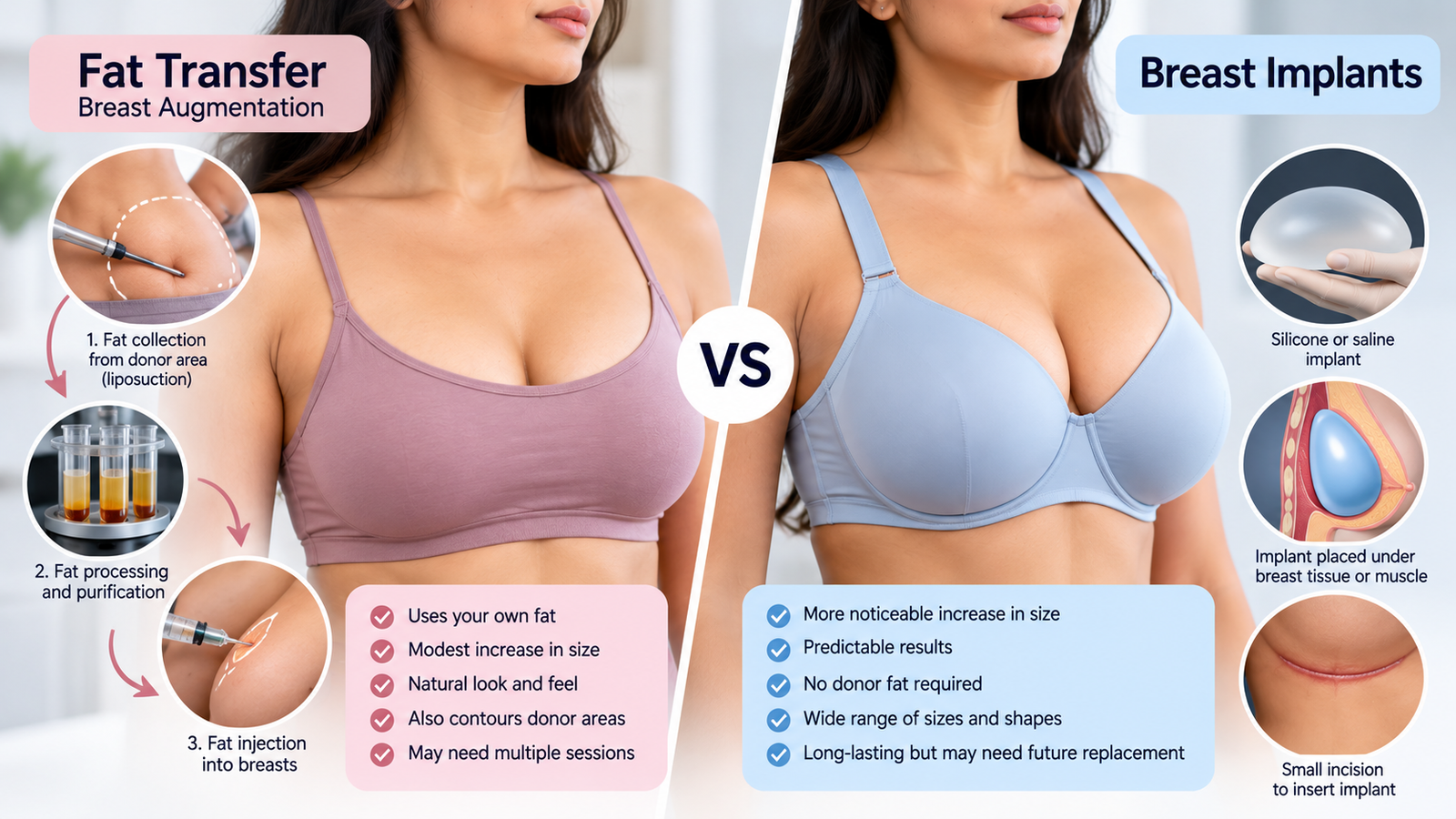
Fat transfer vs breast implants comes down to the amount of enlargement you want, your available body fat and your preference for natural tissue or an implant. Fat transfer usually offers a modest increase using your own fat, while implants provide more predictable volume. Both require surgery and carry different risks.
Many women consider breast augmentation to improve breast fullness, restore volume after pregnancy or address differences in breast size. However, choosing the most suitable technique can be confusing.
Some patients prefer using their own body fat because they want to avoid an implant. Others want a more noticeable increase in breast size that may be difficult to achieve with fat transfer alone.
Understanding the differences between these procedures helps patients set realistic expectations before making a decision.
At Elegance Clinic, Dr. Ashutosh A Shah, MS, MCh (Plastic Surgery), DNB, discusses breast augmentation options based on individual anatomy, skin quality, available donor fat and desired results. A consultation helps determine whether fat transfer, breast implants or another procedure may be appropriate.
What Is Fat Transfer Breast Augmentation?
Fat transfer breast augmentation is a surgical procedure that uses fat collected from another part of the patient’s body to increase breast volume.
The technique is also called autologous fat grafting or breast fat transfer.
Fat is commonly collected from areas such as:
- Abdomen
- Thighs
- Flanks
- Hips
- Other suitable areas with sufficient fatty tissue
The collected fat is processed and carefully injected into selected areas of the breasts.
The goal is to improve breast fullness or contour using the patient’s own tissue.
How Does Fat Transfer Work?
The procedure generally involves three stages.
Step 1: Fat collection
The surgeon uses liposuction to remove fat from a suitable donor area.
Step 2: Fat processing
The collected material is prepared to separate usable fat from unwanted fluid and other components.
Step 3: Fat injection
Small amounts of prepared fat are placed into selected breast tissue planes to improve volume and contour.
Not all transferred fat survives.
Some is naturally reabsorbed during healing, which can affect the final breast size.
What Are Breast Implants?
Breast implants are medical devices placed within the breast area to increase volume and modify breast shape.
Implants are commonly filled with silicone gel or saline.
They are available in different sizes, shapes, projections and surface types.
The surgeon selects the implant according to the patient’s anatomy, tissue coverage and desired result.
How Does Breast Implant Surgery Work?
During breast augmentation, the surgeon makes an incision and creates a pocket for the implant.
The implant may be positioned:
- Beneath the breast tissue
- Beneath the chest muscle
- In a dual-plane position involving both tissue planes
The incision is then closed, and postoperative recovery begins.
Patients considering augmentation can review the clinic’s information about breast size increase surgery.
Fat Transfer vs Breast Implants: Main Differences
Both techniques can increase breast volume, but they differ in materials, achievable enlargement, recovery and long-term considerations.
| Feature | Fat transfer | Breast implants |
|---|---|---|
| Material used | Patient’s own fat | Silicone gel or saline implant |
| Main purpose | Modest volume and contour improvement | More predictable volume increase |
| Enlargement | Usually limited per session | Wider range of implant volumes |
| Requires donor fat | Yes | No |
| Incisions | Small liposuction and injection sites | Surgical incision for implant placement |
| Visible scars | Usually small | Depends on incision location |
| Volume predictability | Some fat is reabsorbed | Implant volume is known |
| Long-term changes | Surviving fat changes with body weight | Implant remains but surrounding tissue changes |
| Future procedures | Additional grafting may be needed | Revision or replacement may be needed |
| Main risks | Fat necrosis, oil cysts, calcifications, fat reabsorption | Capsular contracture, rupture, displacement and implant-related complications |
| Suitable for very slim patients | May be limited by donor fat | May be possible with appropriate planning |
The best option depends on individual anatomy and treatment goals.
1. Which Procedure Gives a More Natural Look?
Both fat transfer and breast implants can produce natural-looking results when appropriately planned.
However, they achieve their effects differently.
Natural Appearance With Fat Transfer
Fat transfer uses the patient’s own tissue.
The transferred fat can blend with surrounding breast tissue, making it useful for subtle contour improvement.
It may be particularly suitable for patients who want a small increase rather than a dramatic change.
Natural Appearance With Implants
Breast implants can also look natural when their size, profile and placement suit the patient’s anatomy.
Factors affecting the result include:
- Chest width
- Existing breast tissue
- Skin elasticity
- Implant dimensions
- Implant placement
- Desired projection
Choosing an excessively large implant relative to available tissue may increase the likelihood of visible edges or rippling.
Which Feels More Natural?
Surviving transferred fat generally behaves like other fatty tissue.
Implants may also feel soft, but their feel depends on the device, tissue coverage and development of any scar capsule.
Neither procedure guarantees a particular appearance or sensation.
2. Which Option Can Increase Breast Size More?
The amount of achievable enlargement is one of the most important differences.
Fat Transfer: Usually a Modest Increase
Fat grafting is generally more suitable for patients seeking a limited increase in breast fullness.
The achievable volume depends on:
- Available donor fat
- Breast tissue characteristics
- Skin capacity
- Fat graft survival
- Surgical technique
Some patients may need more than one session to reach their desired result.
Breast Implants: More Predictable Volume
Implants are available in measured volumes.
This makes them suitable for patients seeking a more substantial or clearly defined increase.
However, the surgeon must still select an implant that fits the patient’s tissue and chest dimensions.
A larger implant is not automatically safer or more aesthetically appropriate.
Can Fat Transfer Increase Breasts by Two Cup Sizes?
A two-cup-size increase should not be promised from a single fat transfer session.
Cup sizes are not standardised measurements of breast volume, and graft survival varies.
Patients seeking substantial enlargement may find implants more suitable, depending on their anatomy.
3. Which Procedure Is Better for Breast Volume Loss After Pregnancy?
Pregnancy and breastfeeding can change breast volume and skin elasticity.
Some women notice reduced upper breast fullness or a flatter breast shape.
Both augmentation techniques may help selected patients.
When Fat Transfer May Help
Fat transfer may be considered when:
- Volume loss is mild
- A subtle increase is desired
- Suitable donor fat is available
- Nipple position remains acceptable
- The patient wants to avoid an implant
When Implants May Help
Breast implants may be considered when:
- More noticeable volume restoration is desired
- Existing breast tissue is limited
- Donor fat is insufficient
- A more predictable volume increase is important
What If the Breasts Also Sag?
Neither fat transfer nor implants reliably correct significant breast ptosis.
When nipples have descended or excess skin is substantial, a breast lift may be required.
Patients can explore breast sagging correction to understand how lifting differs from adding volume.
4. Can Fat Transfer Correct Breast Asymmetry?
Fat transfer may help improve selected differences in breast volume or contour.
For example, a surgeon may place more fat in one breast to reduce a noticeable size difference.
It can also be used to improve certain localised contour irregularities.
Can Implants Correct Uneven Breasts?
Yes, implants may also help with breast asymmetry.
The surgeon may select different implant volumes or combine augmentation with tissue reshaping.
However, neither technique guarantees perfectly identical breasts.
Differences in chest wall shape, skin, breast folds and nipple position may remain.
5. Which Procedure Has Less Scarring?
Both techniques involve incisions, but the scar patterns differ.
Scars After Fat Transfer
Fat transfer generally requires small openings for liposuction and fat injection.
These may leave small scars at the donor and treatment sites.
Scars After Breast Implants
Implant surgery requires an incision large enough for implant insertion.
Common incision locations include the fold beneath the breast and selected other approaches.
Scar visibility depends on incision placement, healing and individual skin characteristics.
Fat transfer often involves smaller individual incisions, but it is not a scar-free procedure.
6. Fat Transfer vs Breast Implants: Recovery Time
Recovery varies according to surgical technique, the extent of treatment and individual health.
Recovery After Fat Transfer
Patients recover from both liposuction and fat injection.
Common early symptoms include:
- Swelling
- Bruising
- Tenderness at donor sites
- Temporary breast swelling
- Mild to moderate discomfort
Compression garments may be recommended for liposuction areas.
Patients are usually advised to avoid pressure on the grafted breasts during early healing.
Recovery After Breast Implants
Breast implant surgery may cause:
- Chest tightness
- Swelling
- Bruising
- Temporary discomfort
- Restricted upper-body activity
A supportive postoperative bra may be recommended.
General Recovery Comparison
| Recovery factor | Fat transfer | Breast implants |
|---|---|---|
| Main recovery areas | Breasts and liposuction sites | Breasts and chest |
| Light daily activities | Often within several days to 1–2 weeks | Often within several days to 1–2 weeks |
| Strenuous exercise | Usually restricted for several weeks | Usually restricted for several weeks |
| Swelling | Breast and donor-site swelling | Mainly breast and chest swelling |
| Final result | Assessed after graft survival stabilises | Assessed as swelling settles and implants settle |
These are general ranges rather than guaranteed recovery timelines.
Follow the operating surgeon’s specific instructions.
7. Which Results Last Longer?
Both procedures can provide long-lasting changes, but neither guarantees a permanently unchanged breast shape.
How Long Does Fat Transfer Last?
Transferred fat that successfully establishes a blood supply can remain long term.
However, some grafted fat is reabsorbed during the early healing period.
The remaining fat may increase or decrease in size with future weight changes.
Ageing, pregnancy and hormonal changes can also affect breast appearance.
How Long Do Breast Implants Last?
Breast implants are not lifetime devices.
They may remain in place for many years, but future surgery may be required because of:
- Implant rupture
- Capsular contracture
- Implant displacement
- Changes in breast appearance
- Personal preference
- Other complications
There is no universal requirement to replace every implant after exactly ten years.
Patients should follow recommended monitoring and discuss new symptoms with their surgeon.
8. What Are the Risks of Fat Transfer Breast Augmentation?
Fat transfer uses the patient’s own tissue, but it still involves surgery and potential complications.
Possible risks include:
- Bleeding
- Infection
- Bruising and swelling
- Fat reabsorption
- Fat necrosis
- Oil cyst formation
- Calcifications
- Contour irregularities
- Asymmetry
- Donor-site irregularities
- Need for additional procedures
- Anaesthesia-related complications
Rare serious complications can occur with fat grafting and liposuction.
Can Fat Transfer Affect Breast Screening?
Fat grafting may produce oil cysts, fat necrosis or calcifications that appear on breast imaging.
Radiologists can often distinguish typical postoperative changes, but additional imaging or biopsy may sometimes be needed.
Patients should inform their breast imaging team about previous fat transfer.
Fat transfer does not replace recommended breast cancer screening.
9. What Are the Risks of Breast Implants?
Breast implant surgery carries general surgical risks and additional device-related considerations.
Possible complications include:
- Infection
- Bleeding
- Scarring
- Changes in breast or nipple sensation
- Capsular contracture
- Implant rupture
- Implant displacement
- Rippling
- Persistent asymmetry
- Need for revision surgery
Breast implant-associated anaplastic large cell lymphoma (BIA-ALCL) is a rare lymphoma associated particularly with textured breast implants.
Other rare implant-associated cancers have also been reported in the capsule surrounding implants.
Some patients report systemic symptoms such as fatigue, joint pain or cognitive difficulties, sometimes called breast implant illness. The causes and relationship to implants remain incompletely understood.
These risks should be discussed during informed consent.
10. Which Procedure Costs More?
The cost of fat transfer and breast implants depends on different factors.
Fat Transfer Cost Factors
Expenses may depend on:
- Amount of liposuction required
- Number of donor areas
- Operating time
- Anaesthesia
- Hospital facilities
- Complexity of fat grafting
- Need for additional sessions
Breast Implant Cost Factors
Implant augmentation costs may depend on:
- Implant type and manufacturer
- Surgical technique
- Anaesthesia
- Hospital charges
- Postoperative care
- Follow-up appointments
Is Fat Transfer Always Cheaper?
No.
Fat transfer may involve liposuction from multiple areas and additional treatment sessions.
Implant surgery includes the cost of the device and carries the possibility of future implant-related procedures.
A written estimate should explain what is included and what may be charged separately.
Who May Be a Suitable Candidate for Fat Transfer?
Fat transfer may suit selected adults who:
- Want a modest increase in breast volume
- Prefer using their own tissue
- Have sufficient donor fat
- Have realistic expectations
- Understand that some fat will be reabsorbed
- Accept the possibility of additional sessions
- Do not require substantial correction of sagging
Very slim patients may not have enough donor fat for their desired enlargement.
The surgeon must also assess breast health, skin characteristics and relevant medical history.
Who May Be a Suitable Candidate for Breast Implants?
Breast implants may be considered for patients who:
- Want a more noticeable increase in breast size
- Have limited donor fat
- Prefer a predictable implant volume
- Want to restore lost breast fullness
- Have selected breast volume differences
- Understand implant-related risks and future monitoring
Implants may not be appropriate for every patient.
The decision should consider overall health, breast anatomy and long-term expectations.
Can Fat Transfer and Breast Implants Be Combined?
Yes. In selected patients, fat grafting may be combined with breast implants.
This approach is sometimes called composite breast augmentation.
The implant provides the main volume increase, while fat grafting may improve tissue coverage or selected contour areas.
Potential uses include:
- Softening visible implant edges
- Improving upper breast transitions
- Correcting minor contour differences
- Adding tissue coverage in selected areas
Combining procedures also adds complexity and may introduce risks associated with both techniques.
Not every patient needs or benefits from this approach.
Breast Enlargement Without Implants: Is Fat Transfer the Best Choice?
For patients seeking breast enlargement without implants, fat transfer is one surgical option.
It may be appropriate when the desired increase is modest and enough donor fat is available.
However, the procedure is not entirely non-invasive.
It requires liposuction, fat processing and injection.
The results also depend on graft survival, and additional sessions may be necessary.
Patients should avoid treatments marketed as permanent, non-surgical breast enlargement when those claims lack reliable clinical evidence.
Creams, supplements and chest exercises cannot reliably produce the same volume increase as augmentation surgery.
How to Choose Between Fat Transfer and Breast Implants
The right choice depends on your priorities.
If You Want a Small, Subtle Increase
Fat transfer may be worth discussing if suitable donor fat is available.
If You Want a Larger Volume Increase
Breast implants may offer more predictable enlargement.
If You Have Very Little Body Fat
Implants may be more practical because fat grafting requires donor tissue.
If You Want to Avoid an Implant
Fat transfer may be an option, provided you understand its limitations and surgical risks.
If You Have Significant Sagging
A breast lift may be more appropriate than either augmentation method alone.
If You Have Breast Asymmetry
Either procedure may help, depending on the type and severity of the difference.
A qualified plastic surgeon can explain which approach is technically suitable.
For a broader overview, patients can explore the clinic’s breast treatment options.
What Happens During a Breast Augmentation Consultation?
A consultation helps establish whether your goals can be achieved safely and realistically.
Step 1: Discuss Your Desired Change
Explain whether you want more volume, improved symmetry, restored fullness or a subtle contour adjustment.
Step 2: Assess Breast Anatomy
The surgeon evaluates breast size, existing tissue, skin elasticity, nipple position and chest dimensions.
Step 3: Assess Donor Fat
If fat transfer is being considered, potential liposuction areas are examined.
Step 4: Review Surgical Options
The surgeon explains fat transfer, implants, lifting or combined approaches where appropriate.
Step 5: Discuss Risks and Recovery
Patients should understand the possible complications, expected healing process and potential need for future procedures.
Step 6: Review Costs and Follow-Up
A treatment estimate should clarify procedure charges, postoperative care and possible additional expenses.
Patients can book a consultation at Elegance Clinic to discuss their concerns and available options.
Frequently Asked Questions
1. Is Fat Transfer Better Than Breast Implants?
Neither procedure is universally better. Fat transfer may suit patients wanting modest enlargement using their own tissue, while implants may be more appropriate for larger, predictable volume increases. Suitability depends on anatomy and personal goals.
2. How Much Bigger Can Breasts Get With Fat Transfer?
Fat transfer generally provides a limited increase per session. The amount depends on available donor fat, breast tissue capacity and graft survival. A particular cup-size increase cannot be guaranteed.
3. Is Fat Transfer Breast Augmentation Permanent?
Fat that survives the healing process can remain long term. However, some transferred fat is naturally reabsorbed, and future weight changes, ageing or pregnancy can affect breast volume.
4. Which Is Safer: Fat Transfer or Breast Implants?
Both procedures involve risks. Fat transfer can cause fat necrosis, cysts, calcifications and donor-site complications. Implants carry risks such as capsular contracture, rupture and rare implant-associated cancers. Individual suitability requires surgical assessment.
5. Can Fat Transfer Replace Breast Implants Completely?
Fat transfer can be an alternative for selected patients seeking modest enlargement. However, it may not provide enough volume for those wanting substantial augmentation or those with insufficient donor fat.
Key Takeaways
- Fat transfer uses the patient’s own fat to increase breast volume.
- Breast implants use medical devices to provide additional fullness.
- Fat transfer generally offers a more limited volume increase.
- Implants provide more predictable implant volume.
- Both techniques can produce natural-looking results.
- Fat transfer requires adequate donor fat.
- Some transferred fat is reabsorbed during healing.
- Breast implants are not lifetime devices.
- Neither procedure reliably corrects significant breast sagging.
- Both approaches involve surgery and potential complications.
- A combined technique may suit selected patients.
- Individual anatomy and expectations determine the most suitable approach.
Conclusion
Choosing between fat transfer vs breast implants depends on how much enlargement you want, your body composition and your preference for natural tissue or an implant.
Fat transfer may be suitable for modest breast enlargement without implants, particularly when adequate donor fat is available. Breast implants offer a wider range of volume options and more predictable initial enlargement.
Neither technique is automatically safer or better for every patient.
A detailed consultation with a qualified plastic surgeon can help clarify the benefits, limitations, recovery requirements and long-term considerations of each procedure.
