

|
Getting your Trinity Audio player ready...
|
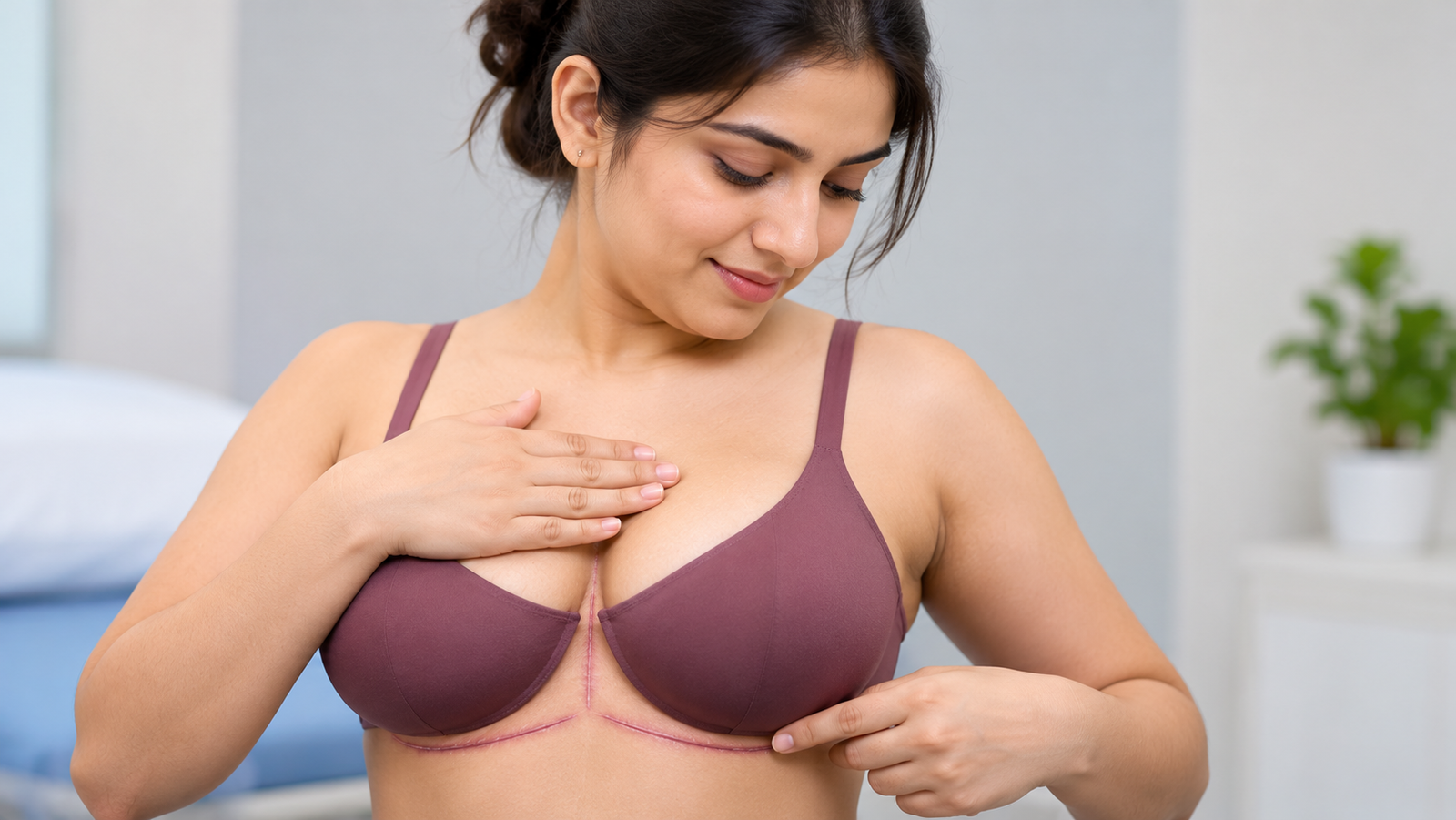
✓ Medically reviewed by Dr. Ashutosh Shah, Plastic, Reconstructive & Cosmetic Surgeon (M.Ch., DNB)
Breast reduction scars do not usually disappear completely, but they often become softer, flatter, and less noticeable as healing progresses. Breast reduction scar healing varies depending on incision placement, skin characteristics, surgical technique, and postoperative care. Following your surgeon’s instructions, protecting healed scars from sunlight, and discussing suitable scar treatments may improve their appearance over time.
Breast reduction surgery, also called reduction mammoplasty, removes excess breast tissue, fat, and skin to reduce breast size and improve breast shape.
Because incisions are necessary, some degree of permanent scarring is expected. However, scars typically change considerably during recovery.
At Elegance Clinic, Dr. Ashutosh Shah, M.S., M.Ch., D.N.B., can assess incision healing and recommend suitable scar care based on individual recovery.
This guide explains scar appearance, healing stages, treatment options, and warning signs.
1. Do Breast Reduction Scars Go Away Completely?
Breast reduction scars are permanent because surgery involves incisions through the skin.
Although they generally become less noticeable, their final appearance depends on how the body produces and remodels scar tissue.
Initially, scars may appear pink, red, darker than the surrounding skin, or slightly raised.
As healing progresses, many scars gradually soften and flatten.
Factors affecting scar appearance
Several factors influence breast reduction scar healing:
- Genetics: Some individuals naturally develop more prominent scars.
- Skin characteristics: Skin tone and pigmentation may affect scar colour.
- Incision location: Scar patterns depend on the surgical technique.
- Wound healing: Infection or wound separation may affect scar quality.
- Smoking: Nicotine exposure can impair blood supply and healing.
- Sun exposure: UV radiation can worsen pigmentation in healing scars.
Patients should discuss their expectations before surgery because completely scar-free breast reduction is not possible.
2. Breast Reduction Scar Healing: Month-by-Month Timeline
Scar healing occurs gradually rather than immediately after the incisions close.
The following table describes general changes that may occur during recovery. These are educational stages, not guaranteed outcomes.
| Recovery Stage | What May Happen | Recommended Care |
|---|---|---|
| First 2 weeks | Incisions begin healing; swelling and bruising may be present | Follow dressing and wound-care instructions |
| Weeks 3–6 | Scars may appear pink, red, firm, or slightly raised | Avoid friction and unapproved scar products |
| Months 2–3 | Scar colour and texture continue changing | Discuss silicone treatment if wounds are fully healed |
| Months 3–6 | Some scars gradually flatten and soften | Continue approved scar care and sun protection |
| Months 6–12 | Scar maturation continues; colour may become less noticeable | Attend follow-ups if scars remain raised or uncomfortable |
| Months 12–18+ | Further scar changes may occur | Discuss persistent concerns with the surgeon |
Why do scars sometimes look worse before improving?
During the early healing period, scar tissue may become firmer or more noticeable.
This can occur as collagen develops and the body remodels the incision.
However, rapidly increasing redness, warmth, discharge, or pain should not be assumed to be normal scar maturation.
Does everyone heal at the same speed?
No. Age, genetics, medical conditions, surgical technique, and wound complications can influence recovery.
Patients with diabetes or a history of abnormal scarring may require additional assessment.
3. What Do Breast Reduction Scars Look Like?
Breast reduction scars vary according to the incision pattern used during surgery.
The surgeon selects an approach based on breast size, degree of sagging, tissue removal, and individual anatomy.
Around-the-areola scars
Some procedures involve an incision around the edge of the areola.
The scar may blend partly with the natural colour transition, although visibility varies.
Vertical scars
A vertical incision may extend from the areola towards the breast crease.
This is commonly associated with certain breast reduction techniques.
Inverted-T or anchor scars
An anchor-shaped pattern includes incisions around the areola, vertically down the breast, and along the breast crease.
It may be used when more extensive tissue removal and reshaping are required.
Will scars be visible in clothing?
Scar visibility depends on incision location, clothing style, breast shape, and healing.
Many scars are positioned where ordinary bras or clothing may cover them, but this cannot be guaranteed for every garment.
Patients should ask their surgeon to explain the likely scar pattern before treatment.
4. How to Care for Scars After Breast Reduction Surgery
Appropriate scar care after breast surgery begins with protecting healing incisions.
The early priority is safe wound healing rather than applying cosmetic scar products.
Follow wound-care instructions
Keep dressings clean and follow the surgical team’s guidance about bathing, wound cleaning, and dressing changes.
Do not remove surgical tapes or apply creams unless instructed.
Avoid unnecessary tension
Heavy lifting, strenuous upper-body exercise, and repetitive stretching may place stress on healing incisions.
Follow your surgeon’s restrictions until adequate healing is confirmed.
Wear the recommended supportive bra
A postoperative bra may help support the breasts during recovery.
Use the garment recommended by your surgeon rather than selecting tight compression independently.
Protect scars from sunlight
UV exposure may cause healing scars to darken.
Once the incisions have healed, discuss suitable clothing coverage and sunscreen with the surgical team.
Do not apply sunscreen directly to open wounds.
Avoid smoking and nicotine
Smoking and nicotine can interfere with circulation and tissue healing.
Discuss cessation requirements with your surgeon.
5. Which Scar Treatments May Help?
Different approaches to scar treatmentafter breast reduction may be considered once the incisions have healed.
Treatment choice depends on scar type, symptoms, and skin characteristics.
Silicone gel and silicone sheets
Silicone-based products may help manage some raised or thickened scars.
However, they should be used only after the skin has fully closed and the surgeon confirms suitability.
Scar massage
Gentle scar massage may sometimes be recommended to improve comfort and tissue mobility.
It should not begin while wounds remain open or fragile.
Laser and other specialist treatments
Selected laser treatments may help improve scar colour or texture.
Other specialist options may be considered for thick, raised, or symptomatic scars.
Treatment should be chosen after examination rather than based on appearance alone.
Steroid injections for raised scars
In certain cases, clinicians may consider corticosteroid injections for hypertrophic scars or keloids.
These treatments have potential side effects and are not necessary for routine healing.
Can scars be removed surgically?
Scar revision may improve selected scars, but it cannot guarantee complete removal.
Any revision creates another wound that must heal.
The surgeon should assess scar maturity, symptoms, and realistic benefits before recommending another procedure.
6. When Should You Contact Your Surgeon?
Most breast reduction incisions improve gradually, but certain symptoms require medical assessment.
Signs of possible infection
Contact the surgical team if you notice:
- Increasing redness or warmth.
- New or worsening swelling.
- Pus or unusual wound discharge.
- Fever.
- Increasing pain instead of gradual improvement.
- An incision that begins to separate.
Seek urgent medical attention for severe bleeding, chest pain, breathing difficulty, or fainting.
Raised or painful scars
A scar that becomes thick, itchy, painful, or increasingly raised may need assessment.
Hypertrophic scars and keloids can require different management approaches.
Changes in scar colour
Some pigmentation changes are expected, but persistent or worsening changes should be discussed with the surgeon.
Follow-up appointments
At Elegance Clinic, Dr. Ashutosh Shah can assess wound healing, scar development, and whether additional treatment is appropriate.
Frequently Asked Questions
1. Do breast reduction scars ever disappear completely?
Breast reduction scars generally remain permanently, although they may become less visible with time. Many scars gradually flatten, soften, and change colour as healing progresses. Their appearance depends on genetics, incision pattern, skin characteristics, and recovery. No treatment can guarantee that surgical scars will disappear completely.
2. How long does breast reduction scar healing take?
Breast reduction scar healing continues after the incisions initially close. Scars may change in colour, firmness, and thickness over many months. Individual recovery varies according to health, skin characteristics, and wound healing.
3. Can silicone gel or sheets help reduce scars?
Silicone gel and silicone sheets may help improve the appearance of certain raised or thickened scars. They are generally considered after the incision has completely healed. Patients should ask their surgeon which product is appropriate, when to begin, and how long to continue treatment.
4. When can I start scar massage after breast reduction?
Scar massage should begin only after the surgeon confirms that the incision is fully healed and sufficiently strong. Starting too early may irritate fragile tissue or interfere with recovery. The recommended technique and frequency vary.
5. What makes breast reduction scars more noticeable?
Scar appearance may be influenced by genetics, skin pigmentation, wound tension, infection, smoking, and sun exposure. Some patients are also more likely to develop hypertrophic scars or keloids. Following postoperative instructions and attending scheduled reviews can help identify healing concerns and determine whether specialist scar treatment is appropriate.
Conclusion
Breast reduction scar healing is a gradual process, and scars usually become less noticeable rather than disappearing completely.
Appropriate wound care, sun protection, smoking avoidance, and surgeon-approved scar treatments may help improve their appearance.
At Elegance Clinic, Dr. Ashutosh Shah can evaluate healing and recommend suitable scar management when necessary.
