

|
Getting your Trinity Audio player ready...
|
✓ Medically reviewed by Dr. Ashutosh Shah, Plastic, Reconstructive & Cosmetic Surgeon (M.Ch., DNB)
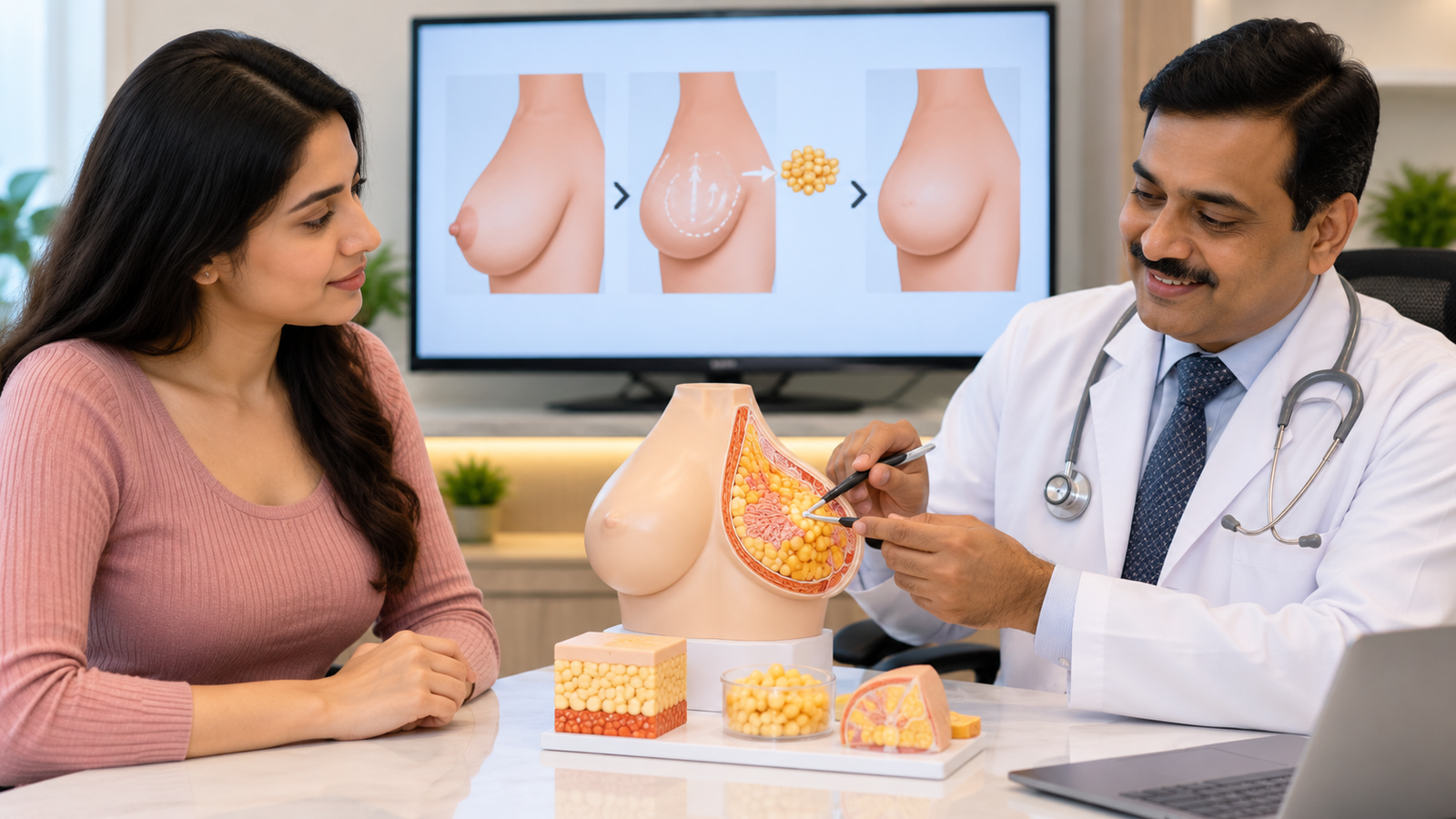
A breast lift with fat transfer combines breast reshaping with the injection of fat taken from another part of your body. The lift raises and reshapes sagging breasts, while fat transfer adds modest fullness. However, not all transferred fat survives, and the procedure cannot guarantee an exact cup-size increase or permanent volume.
Breasts can lose firmness and fullness after pregnancy, breastfeeding, weight loss, or ageing. As a result, some women notice loose skin and less volume in the upper breast.
A breast lift can improve breast position. However, it does not significantly increase breast size.
Fat transfer offers another option for patients who want a modest increase without breast implants.
Still, the procedure has limits. Your surgeon must consider skin quality, existing breast tissue, and the amount of fat available for transfer.
This guide explains how the procedure works, how much volume it may add, and what you should know before surgery.
What Is a Breast Lift with Fat Transfer?
A breast lift with fat transfer combines two procedures.
First, the surgeon lifts and reshapes the breasts. Next, they transfer carefully prepared fat into selected areas to improve fullness.
The two procedures have different purposes.
What Does a Breast Lift Do?
A breast lift, also called mastopexy, improves breast position.
During surgery, the surgeon may:
- Remove loose skin
- Reshape existing breast tissue
- Raise the nipple position
- Improve breast contour
- Correct selected differences in breast position
However, a breast lift does not create a large increase in breast volume.
You can read more about breast sagging correction at Elegance Clinic.
What Does Fat Transfer Do?
Fat transfer uses your own body fat to add volume.
The surgeon removes fat through liposuction, processes it, and places small amounts into the breast tissue.
Common donor areas may include the abdomen, thighs, or waist.
As a result, fat grafting may improve selected areas of breast fullness.
However, the amount of lasting volume varies between patients.
Can Fat Transfer Add Volume During a Breast Lift?
Yes. Fat transfer can add volume during a breast lift in selected patients.
For example, someone may have sagging breasts with reduced fullness in the upper portion.
A lift can improve breast position, while fat grafting may add some fullness.
However, fat transfer is not suitable for every patient.
What Changes Can Fat Transfer Make?
Fat grafting may help:
- Add modest breast volume
- Improve upper-breast fullness
- Soften selected contour differences
- Improve minor breast asymmetry
- Add volume using the patient’s own fat
Additionally, the surgeon may use fat to refine the breast shape.
Still, the procedure cannot guarantee a particular cup size.
Can Fat Transfer Replace Breast Implants?
Sometimes, fat transfer may suit patients who want a smaller increase in volume.
However, breast implants generally provide a more predictable increase in volume.
Therefore, the right choice depends on how much enlargement you want.
How Much Volume Can a Breast Lift with Fat Transfer Add?
Fat transfer usually provides a modest increase rather than a large enlargement.
The amount depends on several factors.
These include:
- Available donor fat
- Existing breast tissue
- Skin quality
- Breast blood supply
- Amount of fat safely transferred
- Fat survival after surgery
- Surgical technique
Is One Cup Size Possible?
Some patients may notice a change approaching one bra cup size after healing.
However, this is not a reliable prediction for everyone.
Bra cup measurements vary between brands. Also, fat survival differs from person to person.
Therefore, surgeons should not promise a fixed cup-size increase.
Can Fat Transfer Add Two Cup Sizes?
A large increase is generally difficult to achieve with one fat-transfer session.
Some patients may need more than one procedure.
Even then, the result depends on tissue capacity and fat survival.
If you want a larger or more predictable increase, your surgeon may discuss breast implants.
Why Can’t Surgeons Transfer Unlimited Fat?
Transferred fat needs a healthy blood supply to survive.
If the surgeon places too much fat into a limited area, some fat may not receive enough blood flow.
As a result, fat cells may die and form lumps, oil cysts, or areas of firm tissue.
Therefore, safe fat placement matters more than injecting the largest possible volume.
Breast Fat Transfer Volume: What Do the Numbers Mean?
Surgeons measure transferred fat in millilitres (mL).
However, the amount injected is not the same as the final amount retained.
For example, transferring 200 mL does not mean the breast will permanently gain 200 mL.
Some fat may be reabsorbed during healing.
Illustrative Fat Transfer Volume Table
| Fat Injected Per Breast | What It Means | Important Limitation |
|---|---|---|
| 100 mL | A relatively small transfer volume | Final retained volume may be lower |
| 150 mL | May provide modest fullness | Results depend on tissue capacity |
| 200 mL | May be considered in selected patients | Not all transferred fat survives |
| 250 mL | Requires suitable tissue and blood supply | Higher volume does not guarantee a larger result |
| 300 mL or more | May be possible in carefully selected cases | Not suitable or safe for everyone |
Important: These numbers are examples, not recommended injection amounts or predicted results. The surgeon must decide how much fat can be transferred safely.
How Does Fat Grafting to the Breast Work?
Fat grafting involves several stages.
Each step affects the safety and final result.
Step 1: Consultation and Examination
First, the surgeon checks breast size, shape, skin quality, and degree of sagging.
They also assess whether you have enough donor fat.
Additionally, your surgeon reviews your medical history and expectations.
Step 2: Choosing the Donor Area
Next, the surgeon identifies suitable areas for fat removal.
Common options include:
- Abdomen
- Waist
- Flanks
- Thighs
- Hips
However, the surgeon must avoid removing excessive fat.
The goal is to collect suitable fat while maintaining a balanced donor-area contour.
Step 3: Fat Removal Through Liposuction
During surgery, the surgeon removes fat through small incisions.
A thin tube helps collect the fat.
The amount removed depends on your anatomy and treatment plan.
Step 4: Fat Preparation
After collection, the surgical team prepares the fat for transfer.
This process separates usable fat from excess fluid and other material.
Different surgeons may use different preparation methods.
Step 5: Breast Lifting and Reshaping
The surgeon performs the planned breast lift.
This may involve removing extra skin and adjusting nipple position.
The exact sequence of lifting and fat placement depends on the surgical plan.
Step 6: Fat Injection
Next, the surgeon places small amounts of fat into suitable breast tissue layers.
Careful placement helps the fat receive blood flow.
However, the surgeon must avoid unsafe injection locations and excessive pressure within the tissue.
Step 7: Recovery and Follow-Up
Finally, the patient receives wound-care and recovery instructions.
Follow-up appointments help the surgeon assess healing and breast shape.
How Much Transferred Fat Survives?
Not every transferred fat cell survives.
After surgery, some fat establishes a new blood supply. Meanwhile, the body gradually absorbs fat that does not survive.
As a result, the breasts may lose some early fullness during healing.
What Affects Fat Survival?
Several factors may influence the result:
- Blood supply in the receiving tissue
- Fat collection and preparation methods
- Injection technique
- Amount of fat placed in each area
- Smoking or nicotine exposure
- General health
- Healing response
However, no surgeon can guarantee an exact fat-survival percentage.
When Does the Volume Become More Stable?
Early swelling usually decreases during the first several weeks.
Meanwhile, fat reabsorption and tissue healing continue.
The breast volume often becomes more stable over the following three to six months.
However, individual healing varies.
Therefore, your surgeon may wait several months before judging whether another session would be useful.
Breast Lift with Fat Transfer vs Breast Implants
Both procedures can improve breast appearance. However, they offer different benefits and limitations.
Breast Lift with Fat Transfer
This option uses your own fat.
It may suit patients who want modest fullness and prefer not to use implants.
However, the volume increase is less predictable because some fat is reabsorbed.
Breast Lift with Implants
Implants can provide a larger and more predictable increase in volume.
They also offer a range of widths, shapes, and projections.
However, implants introduce device-related risks and may require future surgery.
Comparison Table
| Feature | Breast Lift with Fat Transfer | Breast Lift with Implants |
|---|---|---|
| Main goal | Lift and add modest fullness | Lift and add implant-based volume |
| Volume source | Patient’s own fat | Breast implant |
| Large volume increase | Usually limited | More achievable |
| Volume predictability | Varies with fat survival | More predictable initially |
| Donor-area liposuction | Required | Not required |
| Implant-related risks | No | Yes |
| Fat necrosis or oil cysts | Possible | Not caused by implant placement itself |
| Future procedures | Additional fat transfer may be needed | Implant replacement or removal may be needed |
| Scars | Breast lift scars plus small liposuction scars | Breast lift scars plus implant-related incisions as applicable |
Neither procedure is automatically better.
Instead, your surgeon should recommend an option based on your anatomy and goals.
For more information, explore breast treatment options at Elegance Clinic.
Who Is a Suitable Candidate for Breast Lift with Fat Transfer?
A combined procedure may suit selected patients who want improved breast position and modest fullness.
You May Be a Candidate If:
- You have sagging breasts
- You want a modest volume increase
- You have enough donor fat
- Your general health supports surgery
- You understand that some fat may be reabsorbed
- You accept permanent breast lift scars
- Your expectations are realistic
Additionally, patients should understand that further fat transfer may be necessary.
Who May Not Be a Suitable Candidate?
The procedure may be less suitable if:
- You want a large increase in breast size
- You have very little donor fat
- You have an untreated breast concern
- Your medical condition increases surgical risk
- You smoke and cannot follow the surgeon’s nicotine-cessation plan
- You expect a guaranteed cup-size increase
Your surgeon may also recommend delaying surgery if you are planning major weight loss.
Can Fat Transfer Improve Upper-Breast Fullness?
Yes. Fat transfer may add fullness to selected areas of the breast.
For example, some women lose upper-breast volume after pregnancy or weight loss.
The surgeon may use fat grafting to improve the contour.
However, the amount of improvement depends on the tissue’s ability to support transferred fat.
Will the Upper Breast Stay Full Permanently?
Fat that survives and establishes a blood supply can remain for years.
However, breast shape can still change.
For example, weight loss may reduce the size of surviving fat cells.
Similarly, ageing and pregnancy can affect breast tissue and skin.
Therefore, long-term results are not completely fixed.
Can Fat Transfer Correct Uneven Breasts?
Fat transfer may help improve selected breast size or shape differences.
For example, the surgeon may place more fat into the smaller breast.
However, major asymmetry may require another approach.
Some patients benefit from breast reduction, lifting, or implants.
What if One Breast Sags More?
A breast lift can help improve differences in nipple position and sagging.
Meanwhile, fat transfer may add volume where needed.
Combining these techniques may improve overall balance.
However, perfect symmetry is not guaranteed.
What Are the Benefits of Using Natural Breast Volume?
Fat transfer uses tissue from your own body.
As a result, it avoids some risks associated with breast implants.
Potential Benefits
- Uses the patient’s own fat
- May add modest fullness
- Can refine selected breast contours
- May improve minor size differences
- Avoids implant rupture and implant-related capsular contracture
- Can combine breast reshaping with donor-area liposuction
However, natural tissue does not mean the procedure is risk-free.
Fat grafting still involves surgery, anaesthesia, and healing.
What Are the Risks of Breast Lift with Fat Transfer?
Every surgical procedure carries risks.
A combined breast lift and fat-transfer operation includes risks from both procedures.
1. Fat Reabsorption
Some transferred fat may not survive.
As a result, the final volume may be smaller than expected.
2. Fat Necrosis
Fat necrosis occurs when transferred fat cells die.
It may cause firm areas or lumps within the breast.
Although many cases are harmless, new lumps need medical assessment.
3. Oil Cysts
Fat that does not survive may form oil-filled cysts.
These may sometimes require further assessment or treatment.
4. Calcifications
Fat grafting can produce changes that appear on breast imaging.
For example, some patients develop calcifications.
Therefore, tell your breast imaging team about any previous fat-transfer procedure.
5. Infection and Bleeding
Infection or bleeding may occur after surgery.
6. Uneven Fat Survival
The breasts may retain different amounts of fat.
As a result, some asymmetry may remain or develop.
7. Donor-Area Changes
Liposuction can cause swelling, bruising, or uneven contours.
8. Permanent Scars
Breast lift surgery leaves permanent scars.
However, their appearance often improves over time.
9. Changes in Nipple Sensation
Breast lift surgery may affect nipple sensation.
Some changes improve, while others may last.
10. Additional Surgery
Some patients need another procedure because of complications, limited fat survival, or remaining shape concerns.
Therefore, discuss the possible risks before deciding.
Does Fat Transfer Affect Breast Cancer Screening?
Fat transfer can create changes within breast tissue.
These may include fat necrosis, oil cysts, or calcifications.
Such changes can sometimes appear on mammograms or ultrasound scans.
However, experienced breast imaging specialists can often identify common post-grafting changes.
Should You Tell Your Radiologist?
Yes. Always tell the imaging team if you have undergone breast fat transfer.
Additionally, follow age-appropriate breast screening recommendations.
Fat transfer does not replace regular breast health checks.
If you develop a new lump, unusual discharge, or other concerning symptoms, seek medical assessment.
How Long Does Recovery Take?
Recovery depends on the breast lift technique, amount of liposuction, and individual healing.
Because the operation involves both the breasts and donor areas, you may experience soreness in more than one location.
General Recovery Timeline
| Recovery Period | What You May Experience |
|---|---|
| First few days | Swelling, soreness, and bruising |
| Week 1–2 | Gradual improvement in comfort |
| Weeks 3–4 | Continued healing and reduced swelling |
| Weeks 4–6 | Possible return to more demanding activities with medical clearance |
| Months 3–6 | More stable breast volume and shape |
| Following months | Scars continue to mature |
These are general estimates.
Your surgeon will provide instructions based on your procedure.
Recovery Tips
Follow your wound-care instructions.
Also, wear the recommended support garments.
Avoid smoking or nicotine because it can affect healing.
Additionally, avoid pressure on grafted areas when instructed.
Attend follow-up visits so your surgeon can assess breast and donor-area healing.
Will You Need More Than One Fat Transfer Session?
Some patients achieve their goals after one procedure.
However, others may want additional fullness after the first session heals.
The need for another session depends on:
- Initial breast volume
- Amount of fat transferred
- Fat survival
- Desired final size
- Available donor fat
- Tissue condition after healing
Therefore, your surgeon may recommend waiting until the breast shape becomes more stable before considering another session.
How Does the Surgeon Plan a Breast Lift with Fat Transfer?
A consultation helps determine whether the combined procedure is suitable.
Step 1: Assess Breast Sagging
First, the surgeon examines nipple position, skin quality, and breast shape.
Step 2: Discuss Desired Fullness
Next, you explain whether you want subtle volume improvement or a larger increase.
The surgeon can then discuss realistic limits.
Step 3: Check Donor Fat
The surgeon assesses whether enough fat is available for safe collection.
Step 4: Review Breast Health
Previous breast reports and medical history help guide planning.
Breast imaging may be recommended when appropriate.
Step 5: Explain Surgical Options
Finally, the surgeon compares a lift alone, a lift with fat transfer, and a lift with implants.
At Elegance Clinic, Dr. Ashutosh Shah, a plastic surgeon, can assess breast sagging, existing tissue volume, and donor-fat availability during a consultation. He can explain whether fat transfer may provide the desired fullness or whether another approach would better match your goals. The discussion should also cover scars, recovery, fat survival, and possible risks.
You can review Dr. Ashutosh Shah’s professional profile before arranging an appointment.
Frequently Asked Questions
1. Can fat transfer be combined with a breast lift?
Yes. Fat transfer can be combined with breast lift surgery in selected patients. The lift improves breast position, while fat grafting adds modest fullness. However, suitability depends on breast tissue, skin quality and donor-fat availability.
2. How much breast volume can fat transfer add?
Fat transfer usually provides a modest increase. The final amount depends on how much fat the surgeon can safely place and how much survives. Therefore, an exact cup-size increase cannot be guaranteed.
3. Is breast fat transfer permanent?
Fat cells that survive and establish a blood supply can remain long term. However, some transferred fat is reabsorbed during healing. Additionally, weight changes, pregnancy and ageing may affect future breast volume.
4. Does fat grafting to the breast leave scars?
Fat grafting usually involves small liposuction and injection entry points. However, a combined breast lift also requires larger incisions to remove extra skin and reshape the breast. Therefore, permanent breast lift scars remain part of the procedure.
5. Can a breast lift with fat transfer replace implants?
It may suit patients who want modest fullness without implants. However, fat transfer usually cannot provide the same predictable volume increase as implants. Your surgeon should compare both options based on your anatomy and goals.
6. When can I see the final results of breast fat transfer?
Early swelling decreases over several weeks. Meanwhile, some transferred fat may be reabsorbed. Breast volume often becomes more stable over three to six months, although healing varies. Therefore, your surgeon will assess the result during follow-up visits.
Key Takeaways
- A breast lift improves breast position and shape.
- Fat transfer can add modest volume using your own body fat.
- The combined procedure may improve upper-breast fullness.
- Not all transferred fat survives.
- An exact cup-size increase cannot be guaranteed.
- Large volume increases may require implants or more than one fat-transfer session.
- Fat transfer requires suitable donor fat and healthy receiving tissue.
- Possible risks include fat necrosis, oil cysts, infection, and uneven results.
- Breast lift surgery leaves permanent scars.
- Breast imaging teams should know about previous fat grafting.
- Recovery involves both the breasts and liposuction donor areas.
- A consultation helps determine which option suits your goals.
Conclusion
A breast lift with fat transfer can improve breast position while adding modest fullness using your own fat.
However, the procedure has limits. Some transferred fat is reabsorbed, and the final volume depends on your anatomy and healing.
For patients who want a subtle increase, fat grafting may be worth considering. Meanwhile, breast implants may offer a more predictable option for larger volume changes.
At Elegance Clinic, Dr. Ashutosh Shah can assess your breast shape, skin quality, and donor-fat availability before discussing suitable treatment options.
To explore your options, book a consultation at Elegance Clinic or contact the clinic for appointment details.
