

|
Getting your Trinity Audio player ready...
|
✓ Medically reviewed by Dr. Ashutosh Shah, Plastic, Reconstructive & Cosmetic Surgeon (M.Ch., DNB)
After major weight loss, body contouring can remove loose skin that no longer retracts on its own, but it cannot replace healthy weight management or guarantee a particular body shape. Different operations address different areas, and several procedures may need to be staged rather than performed together. Stable weight, recovery time and the amount of excess skin all influence the surgical plan and the scars that remain.
Why Does Skin Not Retract After Major Weight Loss?
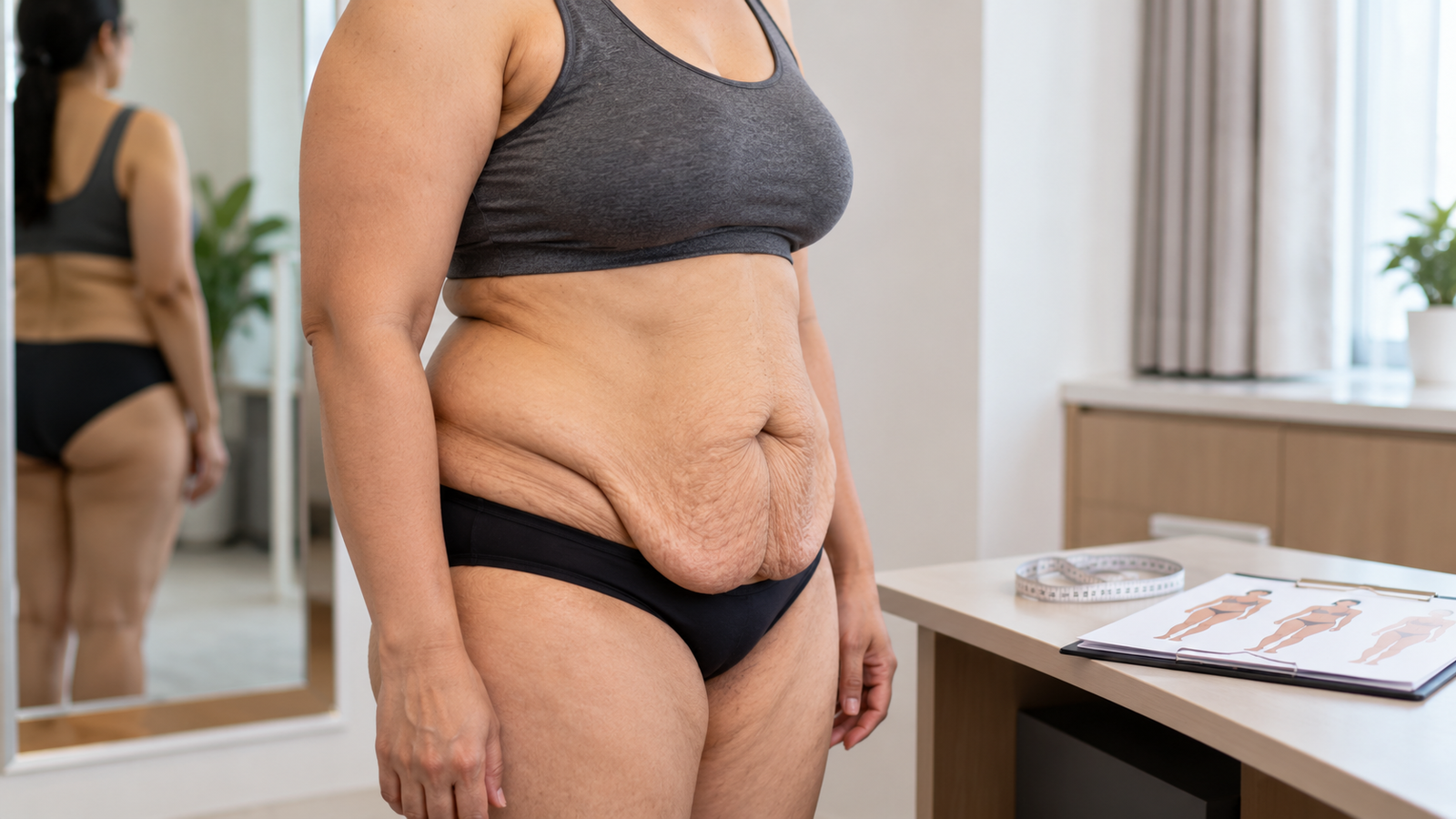
Skin stretches gradually as body weight increases. When a person subsequently loses a substantial amount of weight, the skin may not return completely to its previous size.
This happens because prolonged stretching can affect the skin’s elasticity and supporting tissues. Age, genetics, the amount of weight lost and how long the skin remained stretched can all influence how much loose skin remains.
After major weight loss, excess skin may appear around the:
- Abdomen
- Waist and lower back
- Upper arms
- Thighs
- Breasts or chest
- Upper back
- Buttocks
Exercise can strengthen the muscles underneath the skin, but it cannot remove a large fold of excess skin.
Post-weight-loss body contouring is designed to remove or reposition selected excess tissue. It is therefore different from another weight-loss treatment. The objective is to improve the contour created after the weight has already been lost.
Patients considering treatment can review information about post bariatric surgery in Surat to understand how body-contouring procedures fit into the broader post-weight-loss treatment pathway.
What Can Post-Bariatric Body Contouring Fix?
The operation selected depends on where the excess skin is located.
Belt Lipectomy
A belt lipectomy addresses excess tissue around the waist and lower trunk. The incision follows the body in a belt-like pattern and can remove loose skin from the abdomen, sides, lower back and related areas.
It may be considered when loose skin extends around the entire lower torso rather than being limited to the front of the abdomen.
Tummy Tuck
A tummy tuck, or abdominoplasty, primarily addresses excess abdominal skin and can also address separation or weakness of the abdominal wall when appropriate.
It does not remove loose skin from the arms, thighs or back.
Brachioplasty
A brachioplasty, or arm lift, removes excess skin from the upper arms.
After major weight loss, the upper-arm skin may hang significantly even when the person has little remaining excess fat.
The incision and resulting scar depend on how much skin needs to be removed and where it is located.
Thigh Lift
A thigh lift addresses loose skin around the thighs. The exact approach depends on whether the excess tissue is mainly on the inner thigh, outer thigh or extends more extensively around the leg.
Upper Back Lift
An upper back lift removes excess skin and tissue from the upper back area.
This can be particularly relevant when folds remain across the back after substantial weight loss.
Breast Lift or Reconstruction
Weight loss can change breast volume and leave loose skin or a deflated appearance.
A breast lift can reposition and reshape the remaining breast tissue. In selected situations, reconstruction or volume restoration may also be considered.
The appropriate operation depends on the amount of remaining breast tissue and the patient’s individual anatomy.
Buttock Lift
A buttock lift addresses loose skin and tissue around the buttocks after substantial weight loss.
The goal is to remove excess skin and improve the contour rather than simply add volume.
Chest Wall Reconstruction
For some patients, major weight loss leaves substantial excess tissue across the chest wall.
Chest wall reconstruction may be considered when the amount or distribution of tissue requires a more extensive reconstructive approach.
Why Must Your Weight Be Stable First?
Stable weight is an important part of planning post-weight-loss body contouring.
If a person is still losing a substantial amount of weight, additional weight loss after surgery can create new loose skin or change the contour that was created.
Similarly, significant weight regain can stretch the remaining skin and alter the surgical result.
The goal is therefore to perform contouring after the major phase of weight loss has been completed and the patient’s weight has reached a stable level.
The exact definition of stable weight varies between patients and should be assessed during consultation.
Which Operation Addresses Which Area?
There is no single procedure that removes all loose skin after major weight loss.
A person with abdominal excess may need an abdominoplasty, while someone with circumferential lower-body excess may be considered for a belt lipectomy.
Likewise, loose upper-arm skin is addressed differently from loose thigh or upper-back skin.
This is why the treatment plan should begin with an assessment of the entire body rather than choosing an operation based only on one area.
Can Multiple Procedures Be Performed?
Sometimes more than one area can be addressed during the overall treatment journey, but performing every procedure at once is not automatically appropriate.
The decision depends on:
- The number of areas requiring surgery
- The amount of tissue being removed
- Overall operative time
- Medical factors
- Expected blood loss
- Recovery requirements
- Ability to move safely after surgery
- The patient’s individual anatomy
For extensive post-weight-loss contouring, procedures are commonly planned in stages.
Staging allows one part of the body to recover before another major operation is performed.
Post-Weight-Loss Body Contouring Sequencing Table
The exact order and interval must be individualised. The table below provides a planning framework rather than a fixed surgical schedule.
| Procedure | Order | Minimum gap in months | Reason | Typical hospital stay |
|---|---|---|---|---|
| Belt lipectomy | 1 | — | Can address extensive lower-trunk excess and establish the main lower-body contour | Depends on extent of surgery and recovery |
| Tummy tuck | 1–2 | Usually several months if staged | Targets abdominal skin and abdominal contour | Depends on procedure and patient factors |
| Brachioplasty | 2–3 | Usually several months | Allows recovery from major torso surgery before arm contouring | Usually short stay or day-case depending on case |
| Thigh lift | 2–3 | Usually several months | Allows safe staging when lower-body areas require separate operations | Depends on extent and technique |
| Upper back lift | 2–3 | Usually several months | Addresses remaining upper-back skin after major weight-loss contouring | Depends on extent of tissue removal |
| Breast lift or reconstruction | 1–3 | Usually several months if staged | Addresses breast skin and shape according to remaining tissue | Depends on procedure |
| Buttock lift | 2–3 | Usually several months | Improves loose skin around the buttocks after other major contouring | Depends on extent and technique |
| Chest wall reconstruction | Individualised | Usually several months if staged | Used when substantial chest-wall excess requires reconstruction | Depends on complexity |
There is no universal minimum interval that applies to every patient. The surgeon may recommend a longer gap when healing is incomplete or when another operation would place excessive physical demands on the recovering body.
What Scars Will You Keep Permanently?
Body-contouring surgery requires incisions, so scars are an unavoidable part of removing substantial excess skin.
The location and length depend on the operation.
A belt lipectomy can leave a scar extending around much of the lower torso. A tummy tuck generally leaves a lower abdominal scar. A brachioplasty creates a scar along the upper arm, while a thigh lift creates scars according to the selected technique.
Breast, buttock, back and chest-wall procedures each have their own incision patterns.
Scars usually change with time. They may become flatter, softer and less noticeable as they mature, but they do not completely disappear.
The final appearance of a scar varies between individuals and depends on healing, skin characteristics, genetics and postoperative care.
How Does Body Contouring Differ From Further Weight Loss?
Body contouring is not a substitute for losing additional weight.
Its purpose is to remove excess skin and reshape selected areas after major weight reduction.
If a person still needs significant weight loss, it may be preferable to complete that process first. Otherwise, further weight loss after contouring may create additional loose skin.
This is one reason weight stability is considered during the consultation.
What Happens If Weight Is Regained Later?
Significant weight regain can change the result of body-contouring surgery.
Remaining skin can stretch, and additional fat accumulation can alter the body’s contour.
This does not mean that any weight fluctuation will automatically undo the result. The concern is substantial or sustained weight regain after surgery.
Maintaining a stable weight after contouring therefore remains important for preserving the changes created by surgery.
How Long Should You Wait After Weight-Loss Surgery?
The timing depends on whether the phrase “weight-loss surgery” refers to bariatric surgery or the completion of a major weight-loss period.
After bariatric surgery, patients often continue losing weight for a period of time. Body contouring is generally planned once weight has stabilised and nutritional status is appropriate for elective surgery.
The exact waiting period should be determined individually.
Nutritional deficiencies are also relevant after major weight loss because adequate nutrition supports wound healing and recovery.
Can Everything Be Done in One Operation?
Not necessarily.
Some patients may have more than one procedure combined, but extensive post-weight-loss surgery can involve significant operative time and a substantial recovery.
When multiple large areas require correction, staging may be safer and more practical.
The final sequence should be based on the patient’s anatomy, health, amount of excess skin and recovery capacity.
Will the Scars Fade?
Scars normally mature gradually.
A new scar may initially appear darker, redder, firmer or more noticeable. Over time it generally becomes softer and less prominent.
However, a surgical scar remains permanent even when it becomes much less visible.
Scar placement is therefore an important part of the discussion before surgery.
Is Any of This Covered by Insurance?
Insurance coverage depends on the specific procedure, medical indication, insurance policy and applicable requirements.
Some body-contouring operations may be considered reconstructive when excess skin causes documented functional problems, while procedures performed primarily for cosmetic contouring may not be covered.
Patients should check directly with their insurance provider and ask what documentation, medical criteria or prior authorisation may be required.
Coverage should not be assumed simply because surgery follows major weight loss.
Will I Lose More Weight After the Surgery?
Body-contouring surgery itself is not intended to produce major weight loss.
The amount of tissue removed can contribute to a change on the scale, but the primary objective is removal of excess skin and improvement of body contour.
Patients should therefore approach surgery after completing the major phase of weight loss rather than treating body contouring as another weight-loss method.
What Areas Are Usually Planned Together?
The final combination depends on the patient’s anatomy and the amount of loose skin.
For example, lower-body procedures may be planned as part of one stage, while arms or thighs are addressed during another stage.
Breast and chest procedures may be planned separately or combined with other operations when appropriate.
The purpose of staging is not simply to spread the procedures out. It allows the surgeon to manage the extent of each operation while giving the body sufficient time to recover.
For patients considering an arm procedure, information about brachioplasty (arm lift) explains the specific approach used for excess upper-arm skin.
What Does the Final Result Depend On?
The result depends on several factors, including:
- Amount of weight lost
- Stability of weight
- Skin elasticity
- Distribution of excess skin
- Previous operations
- Overall health
- Nutritional status
- Procedure selected
- Healing and scar formation
- Future weight changes
Two people can lose the same amount of weight and still have very different patterns of loose skin.
That is why before-and-after photographs should be viewed as examples rather than guarantees.
A post bariatric surgery gallery can demonstrate the types of changes that body contouring may create, but photographs cannot show every aspect of recovery, scar maturation or individual anatomy.
The Bottom Line
Post-weight-loss body contouring can remove substantial loose skin and reshape areas that do not retract adequately after major weight loss. However, each operation has a specific purpose and cannot correct every area at once.
A stable weight, appropriate nutritional status and realistic expectations are important before surgery. When several areas need treatment, procedures may be staged with recovery intervals between them.
The scars created by these operations are permanent, although they generally mature and become less noticeable over time. The most appropriate sequence depends on the individual patient’s body, health, amount of excess skin and surgical goals.
Frequently Asked Questions
How long should I wait after weight-loss surgery?
Usually until major weight loss has stabilised and the patient is nutritionally ready for elective surgery. The timing is individual.
Can everything be done in one operation?
Not always. Extensive procedures are often staged according to operative extent and recovery requirements.
Will the scars fade?
They usually become less noticeable as they mature, but surgical scars remain permanent.
Is body contouring covered by insurance?
Coverage varies. Some medically necessary reconstructive procedures may meet policy criteria, while cosmetic procedures may not.
Will I lose more weight after the surgery?
Body contouring is not a weight-loss procedure. Its main purpose is removing excess skin and improving contour.
What happens if I regain weight later?
Significant weight regain can stretch the skin and change the contour achieved through surgery.

