

|
Getting your Trinity Audio player ready...
|
✓ Medically reviewed by Dr. Ashutosh Shah, Plastic, Reconstructive & Cosmetic Surgeon (M.Ch., DNB)
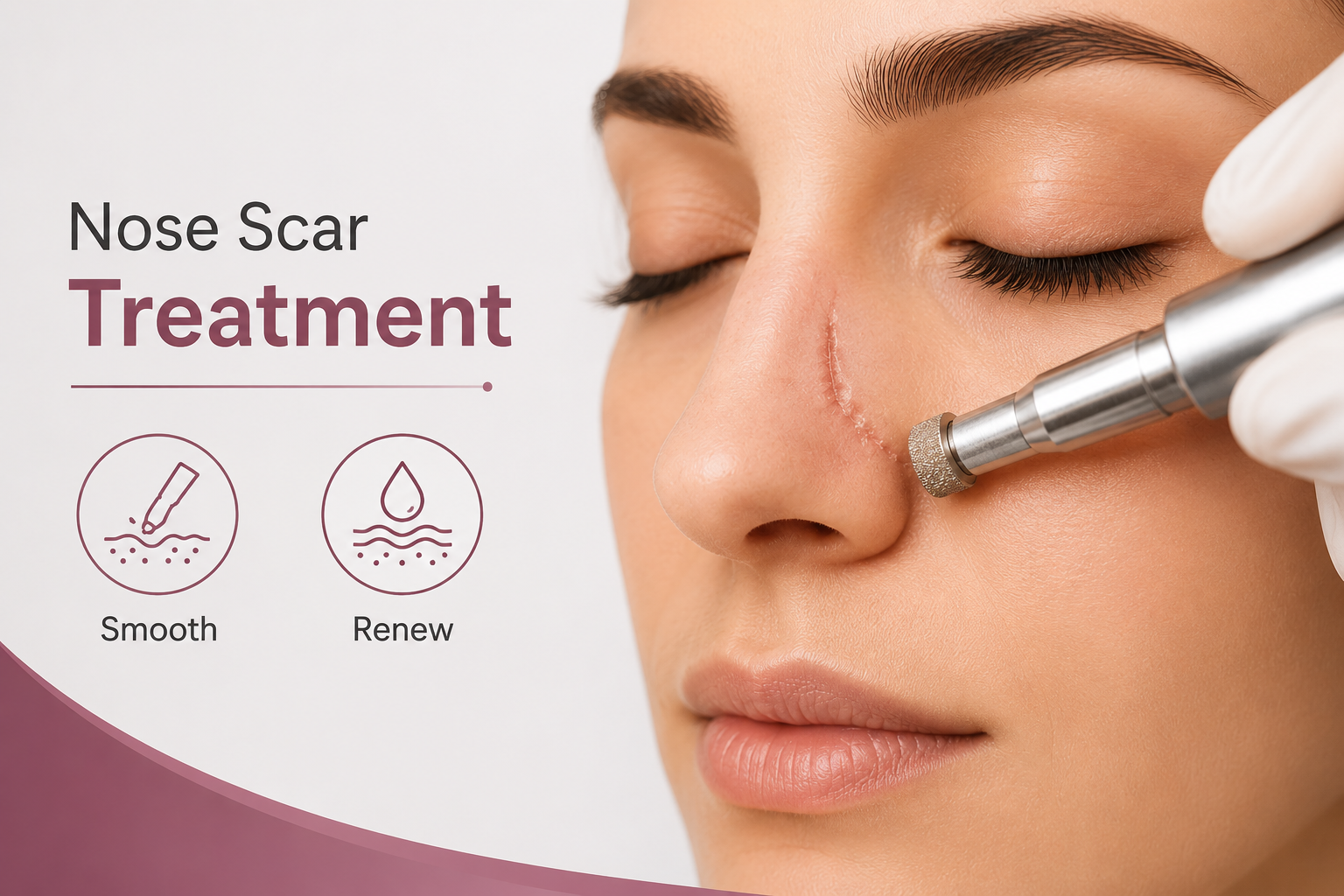
Nose scar dermabrasion with collagen treatment combines mechanical skin resurfacing with collagen induction to smooth textured, uneven scars on the nose and encourage the skin to rebuild healthier tissue underneath. It’s commonly used for scars left behind by rhinoplasty, injury, acne, or previous surgery, where the goal is refining texture rather than removing the scar entirely.
Scars on the nose are particularly noticeable, since the skin here is thin, tightly stretched over cartilage, and sits at the centre of the face. A combined approach — dermabrasion to physically resurface the irregular scar surface, followed by collagen induction to stimulate fresh, organised collagen underneath — is one of the more effective ways to soften texture without more invasive scar revision surgery.
What Is Nose Scar Dermabrasion with Collagen Treatment?
This is a two-part approach to scar refinement. Dermabrasion mechanically removes the outer, irregular layer of scarred skin using a rotating abrasive instrument, smoothing the surface level with surrounding skin. Collagen induction — typically through microneedling — then creates controlled micro-injuries in the dermis, prompting the body to lay down new, better-organised collagen as it heals. Together, they address both the surface texture and the deeper structural quality of the scar.
What Kinds of Nose Scars Respond Well to This Treatment?
- Post-rhinoplasty scars — textured or slightly raised scarring from previous nose surgery
- Post-traumatic scars — irregular texture left after an injury to the nose
- Post-acne scars — shallow, uneven pitting on the nasal skin from previous acne
- Post-surgical scars — following skin cancer removal or reconstructive procedures on the nose
Very deep, tethered, or keloid-type scars often need a different primary approach, such as total excision or CO2 laser resurfacing — your surgeon can advise which category your scar falls into during an in-person assessment.
Dermabrasion vs Collagen Induction: What’s the Difference?
| Dermabrasion | Collagen Induction (Microneedling) | |
|---|---|---|
| How it works | Mechanically resurfaces the outer scarred skin layer | Creates fine micro-channels to trigger new collagen formation |
| Best for | Surface-level texture irregularities | Improving skin quality and depth of the scar over time |
| Downtime | Redness and peeling for 5–10 days | Mild redness for 1–3 days |
| Number of sessions | Usually one main session, occasionally touch-ups | Typically a series of 3–6 sessions spaced weeks apart |
How Is the Combined Treatment Performed?
- Assessment: The surgeon examines the scar’s depth, age, and texture to confirm this combined approach is appropriate.
- Numbing: A topical or local anaesthetic is applied to keep the area comfortable during treatment.
- Dermabrasion: The irregular outer scar surface is mechanically resurfaced to bring it closer to the level of surrounding skin.
- Healing interval: The skin is allowed to heal from dermabrasion before starting collagen induction sessions.
- Collagen induction series: Microneedling sessions are carried out over subsequent weeks to build new collagen and further refine texture.
What Does Research Say About Dermabrasion and Collagen Induction for Scars?
Clinical studies support both techniques as genuinely effective for scar texture, with some evidence favouring collagen induction for ease of use and side-effect profile. A comparative Indian study of dermabrasion versus percutaneous collagen induction (microneedling) for scars found that both techniques produced meaningful improvement, though microneedling was associated with fewer adverse effects such as post-inflammatory pigmentation and was noted to be simpler to perform (Indian Journal of Clinical and Experimental Dermatology, 2017). This is exactly why combining the two — dermabrasion for the surface irregularity, collagen induction for the ongoing quality of the healed skin — is often more effective than relying on just one technique alone.
Recovery After Nose Scar Dermabrasion with Collagen Treatment
- Days 1–5: Redness, mild swelling, and pinpoint scabbing from dermabrasion; sun protection is essential during this phase.
- Days 6–10: New skin surfaces as the treated area heals; makeup can typically be resumed once fully healed.
- Collagen induction sessions: Each session that follows causes only mild, short-lived redness lasting a day or two.
- Months 2–6: Skin texture continues to improve gradually as new collagen forms and remodels beneath the surface.
How Many Sessions Are Needed?
Dermabrasion is usually performed once, with an occasional touch-up if needed for stubborn areas. Collagen induction, by contrast, works cumulatively, so most treatment plans include a series of three to six microneedling sessions spaced about four weeks apart to build progressively better skin quality.
What Does Nose Scar Dermabrasion with Collagen Treatment Cost in Surat?
Cost depends on the scar’s size and depth, whether dermabrasion, collagen induction, or both are needed, and how many collagen induction sessions your treatment plan requires. A written estimate is only meaningful after your surgeon examines the specific scar in person.
Nose Scar Treatment at Elegance Clinic, Surat
At Elegance Clinic, nose scar dermabrasion with collagen treatment is performed by Dr. Ashutosh Shah, a board-certified plastic and cosmetic surgeon with more than two decades of experience in scar revision and facial reconstruction in Surat, Gujarat. As an expert doctor treating both cosmetic and post-surgical scars, Dr. Shah tailors the sequence and number of sessions to your specific scar rather than applying a one-size-fits-all protocol, so the result matches your skin’s actual healing pattern. This kind of texture refinement often complements broader nasal work, including our post-burn nose reconstruction and post-traumatic nose services.
Book a Scar Assessment
Every scar heals differently, so the right combination of dermabrasion and collagen induction is best decided after an in-person look at your specific scar. Book a consultation with Elegance Clinic in Surat, or reach out directly on WhatsApp to discuss your scar treatment options.
Disclaimer: This article is for general educational purposes only and is not a substitute for professional medical advice. Please consult Dr. Ashutosh Shah or a qualified plastic surgeon for an individual assessment of your scar.

