

|
Getting your Trinity Audio player ready...
|
✓ Medically reviewed by Dr. Ashutosh Shah, Plastic, Reconstructive & Cosmetic Surgeon (M.Ch., DNB)
Vitiligo surgery may be considered when medical treatment has not produced satisfactory repigmentation and the disease has remained stable. Vitiligo surgery Surat options can include melanocyte transfer, punch grafting and other tissue- or cell-based techniques. The important first step is confirming that the vitiligo is stable and that the affected patches are suitable for surgical repigmentation. Surgery is not normally performed on actively spreading vitiligo because ongoing disease activity can make repigmentation less predictable.
For patients researching vitiligo skin grafting Gujarat, the decision is therefore not simply about choosing a grafting method. Patch stability, location, size, previous treatment, donor skin and realistic expectations all need to be considered.
What Does Stable Vitiligo Mean?
Stable vitiligo means that there has been no meaningful recent progression of the disease. The assessment looks at whether new patches have appeared, whether existing patches have enlarged and whether signs such as a recent Koebner response are present.
A commonly used benchmark before surgical repigmentation is around 12 months without progression, although the appropriate observation period and assessment can vary according to the individual case and type of vitiligo.
A doctor may compare current findings with previous photographs and treatment records rather than relying on one examination. Stability is important because the purpose of surgery is to restore pigment to an area that has already stopped changing.
Stability-Assessment Table
| Stability factor | What is assessed | What it means | Verdict |
|---|---|---|---|
| Months without a new patch | Whether any new vitiligo lesion has appeared during the observation period | New lesions can indicate continuing activity | Stable if no new lesions are documented; Not stable if new lesions continue |
| Months without an existing patch enlarging | Whether established patches have changed in size or border | Enlargement suggests ongoing progression | Stable if unchanged; Not stable if enlargement continues |
| Koebner response | Whether new vitiligo develops after scratching, friction, injury or trauma | A recent response may indicate activity | Stable if absent; Not stable if recent activity is present |
| Recent steroid course | Whether treatment was recently required because of active disease | Recent treatment for active progression may require further observation | Needs assessment before surgery |
| Clinical examination | Current appearance and borders of the patches | Supports the history of stability | Stable only when findings agree with the history |
| Overall assessment | History, examination and previous records together | Determines whether surgery can reasonably be considered | Stable / Not stable |
Stability should therefore be documented rather than assumed simply because a patch looks unchanged at one appointment.
Which Patches Are Suitable for Surgery?
Surgical repigmentation is generally considered for selected stable, localized vitiligo that has not responded adequately to appropriate medical treatment.
The patch itself is important. A clearly defined stable area may be easier to treat than widespread disease with multiple changing areas. Location also matters because healing and repigmentation can vary between body sites.
Before recommending surgery, the doctor may assess:
- Size of the vitiligo patch
- Location and anatomical characteristics
- Duration of stability
- Previous medical treatment
- Skin colour and surrounding pigmentation
- Donor-site availability
- Previous surgery or scarring
- History of keloids or abnormal scars
- Patient expectations
The same surgical method is not automatically appropriate for every patch.
Why Is Unstable Vitiligo Not Operated On?
When vitiligo is actively spreading, new patches may continue to develop or existing lesions may enlarge. Surgical repigmentation cannot guarantee that newly transferred pigment-producing cells will remain unaffected by continuing disease activity.
This is why active vitiligo is generally treated with disease-control strategies rather than immediately proceeding to surgery.
Waiting does not mean that surgery has been ruled out permanently. It means that stability needs to be established first. Once the disease has remained inactive for an appropriate period, the suitability of surgical repigmentation can be reassessed.
For patients considering stable vitiligo treatment, this distinction is important: the goal is to treat the disease appropriately first and then consider surgery for suitable residual patches.
How Do the Grafting Methods Compare?
There are several surgical approaches to repigmentation. They differ in how pigment-producing cells or pigmented tissue are transferred and in the type and size of patch they can address.
Method-Comparison Table
| Method | Patch size suited | Sittings needed | Expected colour match | Healing time |
|---|---|---|---|---|
| Melanocyte transfer | Selected stable localized patches; suitability depends on technique and site | Depends on area and treatment plan | Gradual repigmentation; blending varies by patient and site | Donor and recipient areas require healing and follow-up |
| Melanocyte culture | Selected cases where cultured pigment cells are appropriate | Usually planned as a staged treatment pathway | Repigmentation can be useful, but exact colour matching varies | Requires specialised processing and recipient-site healing |
| Punch grafting | Small, localized stable patches | May require multiple grafts or sessions | Can provide repigmentation in suitable patches | Small donor and recipient sites heal over time |
| Ultrathin skin graft | Selected stable areas requiring broader coverage | Depends on patch size | Gradual blending with surrounding skin | Both donor and recipient areas require wound care |
| Pulverised skin graft | Selected stable patches | Depends on area and response | Colour develops gradually | Healing is assessed during follow-up |
| Blister therapy | Selected localized stable patches | May require more than one sitting | Response varies according to site and patient | Donor and recipient areas require monitoring |
These techniques should not be treated as interchangeable. The choice depends on the clinical situation, affected area, donor skin and treatment objectives.
What Is Melanocyte Transfer?
Melanocytes are the pigment-producing cells responsible for normal skin colour.
In melanocyte-transfer procedures, pigment-producing cells are obtained from normally pigmented skin and transferred to a prepared vitiligo area. Depending on the specific technique, the cells may be transferred as part of a tissue preparation or cellular suspension.
The purpose is to repopulate the depigmented area with functioning pigment-producing cells. Repigmentation develops progressively rather than immediately.
Patients looking specifically for melanocyte transfer Surat should discuss whether their patch is stable and technically suitable before focusing on the procedure itself.
What Does Repigmentation Really Look Like?
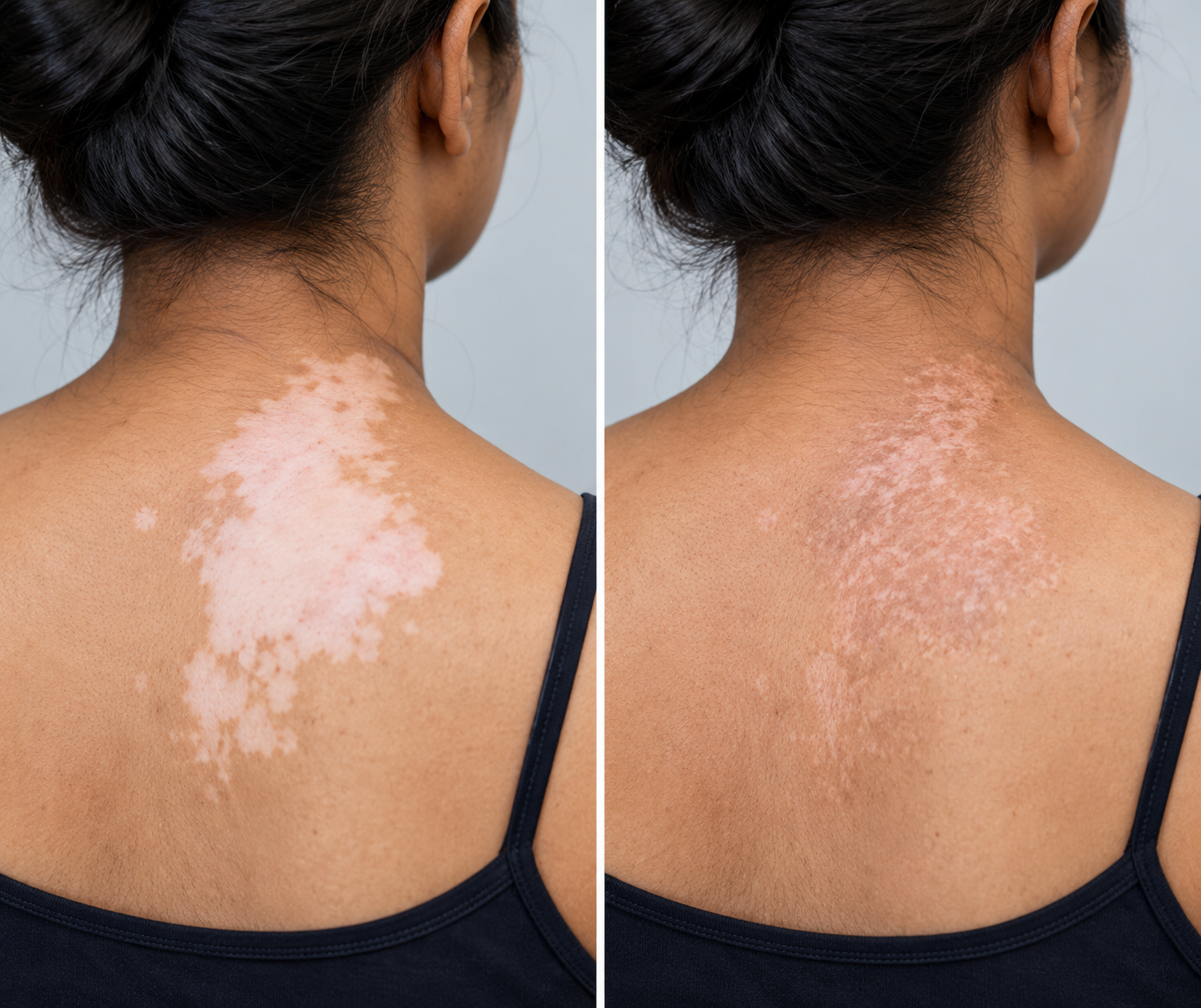
Repigmentation is a gradual process.
After treatment, the area may initially show small areas of returning pigment. These areas can enlarge and blend over time. The final appearance depends on the treatment method, body site, skin colour, healing and individual response.
A realistic treatment goal is improvement in colour and blending. An exact colour match with the surrounding skin cannot be guaranteed.
Patients should also understand that early postoperative appearance is not necessarily the final result. Follow-up is needed to assess how pigmentation develops.
Can Vitiligo Spread After Surgery?
Yes. Surgical repigmentation treats selected areas of pigment loss, but it does not guarantee that vitiligo will never become active elsewhere.
This is why disease stability is assessed before surgery. If new patches continue to appear, the treatment plan may need to focus on controlling activity before surgical repigmentation is considered.
Long-term follow-up may therefore remain relevant even after a successful surgical procedure.
Does Surgery Work on the Hands, Lips and Eyelids?
Surgery can be considered for selected stable patches on these areas, but expectations need to be discussed carefully.
Hands can be more challenging because of their anatomical characteristics and repeated friction or mechanical stress. Lips and eyelids require precise assessment because of their delicate anatomy.
The result obtained on one body site cannot automatically be expected on another. The doctor should explain the likely response for the specific location being treated.
How Many Sittings Will I Need?
There is no universal number of sittings.
The number depends on:
- Number of patches
- Total affected area
- Patch location
- Surgical technique
- Donor-site availability
- Healing
- Repigmentation response
- Whether several areas are being treated
A small localized patch may be treated in a single planned session, while larger or multiple areas may require staged procedures.
If the response is incomplete, the area can be reassessed after adequate healing before another sitting is considered.
What Happens If the Graft Does Not Take?
Not every graft or transferred cell population produces the same degree of repigmentation.
The outcome can be affected by recipient-site characteristics, healing, technique and disease activity. If the initial result is incomplete, the doctor can determine whether additional observation, medical treatment or another procedure is appropriate.
An early incomplete result should not automatically be judged as the final outcome because pigmentation can continue developing during follow-up.
What Happens Before Surgery?
A preoperative assessment should establish whether the disease is stable and whether both the donor and recipient areas are suitable.
The assessment may include:
- Detailed vitiligo history
- Previous treatment history
- Examination of affected patches
- Review of previous photographs
- Assessment for Koebner activity
- Donor-site examination
- Patch size and location
- Discussion of the selected method
- Expected repigmentation
- Healing and aftercare
- Possibility of additional sittings
A history of keloids, abnormal scarring or other healing problems should also be disclosed.
Patients can review vitiligo treatment in Surat before the consultation and then discuss which treatment pathway is appropriate for their individual condition.
What Happens After Vitiligo Surgery?
Aftercare depends on the procedure performed.
The recipient area may require protection and dressing while the graft or transferred cells establish themselves. The donor area also needs appropriate wound care.
Follow-up allows the doctor to assess:
- Healing
- Graft or cell take
- Early repigmentation
- Colour development
- Any complications
- Whether additional treatment is required
Pigmentation should be evaluated over an appropriate period rather than judged immediately after surgery.
When Does Medical Treatment Stop Being Enough?
The decision to consider surgery is not based only on how many medicines or creams have been tried.
Surgical repigmentation may be considered when:
- The vitiligo is stable.
- The affected patch is suitable for surgery.
- Appropriate medical treatment has not produced satisfactory repigmentation.
- The donor area is suitable.
- The patient understands the expected outcome and limitations.
- The surgical method is appropriate for the specific patch.
The objective is to select the right patient and the right patch rather than simply move to surgery because medical treatment has been disappointing.
Understanding Punch Grafting
Punch grafting is one option for selected stable, localized vitiligo.
Small pieces of normally pigmented skin are transferred into prepared recipient areas. It may be appropriate for certain small patches, but the suitability depends on location, size, disease stability and the patient’s skin characteristics.
Patients interested in this method can read about punch grafting for vitiligo before discussing whether it is suitable for their particular patch.
Understanding the Expected Result
The outcome of vitiligo surgery should be considered over time.
The important questions are not simply whether pigment appears immediately, but whether the transferred cells or graft establish successfully, whether pigmentation spreads across the treated area and how closely it blends with surrounding skin.
Factors such as disease stability, anatomical location, surgical method and healing all influence the result.
Patients should therefore avoid comparing their early healing appearance with another person’s final result.
Frequently Asked Questions
How do I know if my vitiligo is stable?
Your doctor looks for no new patches, no enlargement of existing patches and no recent Koebner activity, supported by your history and previous records.
Will the new colour match my skin?
It can blend well, but an exact colour match cannot be guaranteed.
Can vitiligo spread after surgery?
Yes. Surgery treats selected depigmented areas but does not guarantee that future vitiligo activity will never occur.
How many sittings will I need?
It depends on the number, size and location of the patches and the selected technique.
Does it work on the hands, lips and eyelids?
It can be considered in selected stable cases, but results and suitability vary by anatomical site.
What happens if the graft does not take?
The area is reassessed after healing. Further observation, medical treatment or another procedure may be considered depending on the result.
Final Takeaway
Vitiligo surgery in Surat is considered for selected patients whose disease is stable and whose localized patches have not responded sufficiently to appropriate medical treatment.
The first step is therefore not choosing a grafting method. It is establishing stability and determining whether the patch is suitable for surgical repigmentation.
Depending on the individual case, options may include melanocyte transfer, melanocyte culture, punch grafting, ultrathin skin grafting, pulverised skin grafting or blister therapy. Each method has different requirements and expected outcomes.
Repigmentation develops gradually, and the objective is realistic improvement and blending rather than a guaranteed perfect colour match. Careful patient selection, appropriate technique and follow-up are all important parts of the treatment process.
Patients can also review the vitiligo surgery before and after gallery to understand how surgical repigmentation results may appear, while remembering that another patient’s result cannot predict an individual outcome.

