

|
Getting your Trinity Audio player ready...
|
✓ Medically reviewed by Dr. Ashutosh Shah, Plastic, Reconstructive & Cosmetic Surgeon (M.Ch., DNB)
Medical guidance reviewed by
Dr. Ashutosh Shah, M.Ch., DNB (Plastic Surgery)
Founder & Director, Elegance Clinic
Board-Certified Plastic, Reconstructive & Cosmetic Surgeon
22+ Years of Surgical Experience
Updated: September 2026
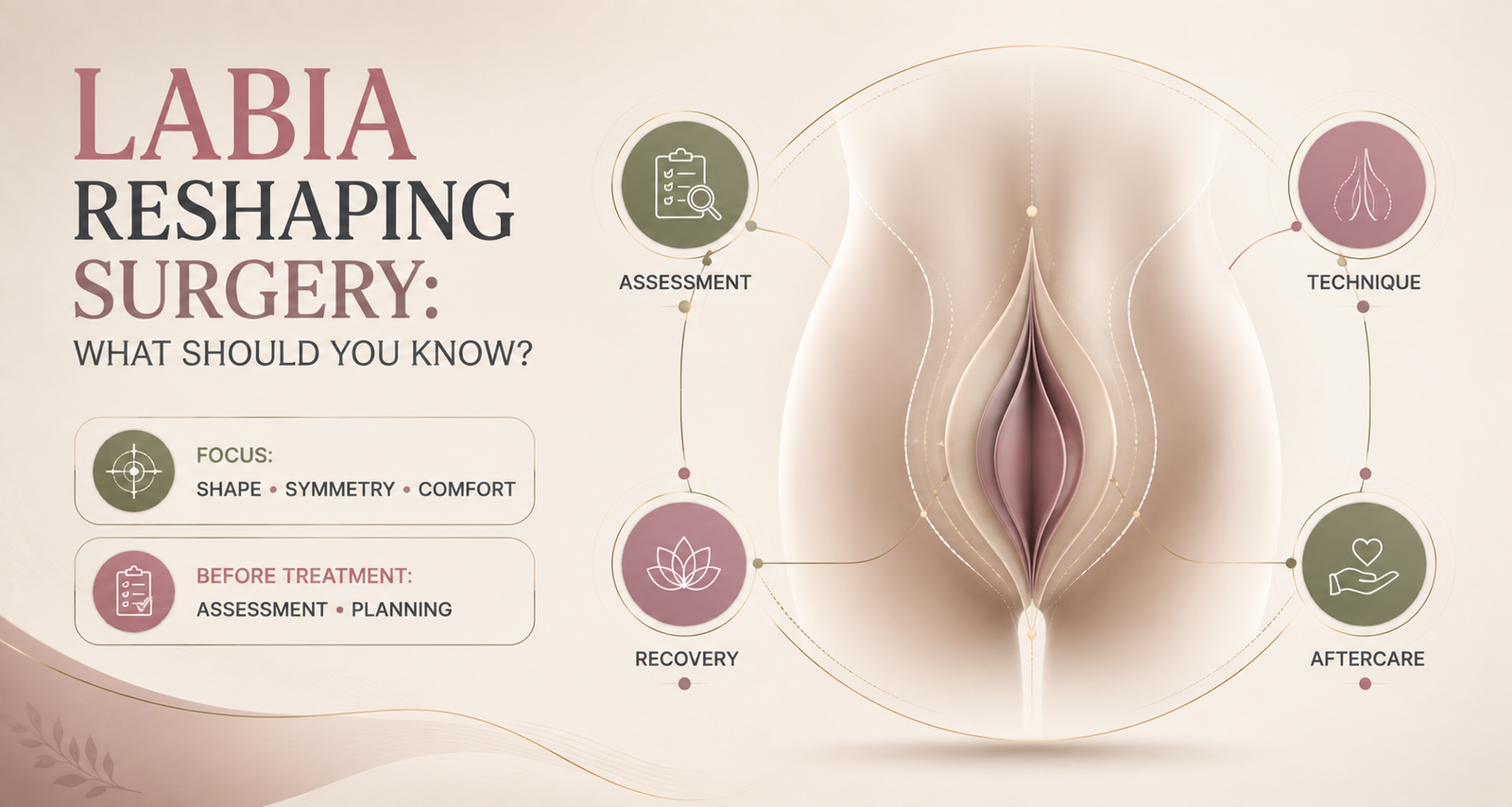
Labia reshaping surgery is an intimate surgical procedure that may be considered when the size, shape, asymmetry or excess tissue of the labia causes physical discomfort or a personal aesthetic concern. The procedure is commonly discussed under the term labiaplasty, although the exact surgical plan depends on which tissue requires correction and what the patient hopes to improve.
Some women consider surgery because enlarged or uneven labial tissue causes rubbing during exercise, discomfort in fitted clothing or irritation during certain activities. Others are primarily concerned about appearance.
Neither situation automatically means surgery is necessary. A wide range of labial shapes and sizes is normal. The decision should be based on an individual assessment, realistic expectations and a clear understanding of possible benefits, limitations, recovery and risks.
Before Surgery: What Is Actually Being Reshaped?
The term “labia” can refer to different structures.
The labia minora are the inner folds, while the labia majora are the outer folds. Their size, shape, pigmentation and symmetry naturally vary significantly between individuals.
Labiaplasty most commonly involves reshaping the labia minora, although other concerns may require a different approach.
This is why an intimate cosmetic concern should first be translated into a specific anatomical goal rather than simply requesting “smaller labia.”
Why Do Some Women Consider Labia Reshaping?
There is no single reason.
Physical discomfort
Prominent tissue may contribute to rubbing, pulling or irritation during activities such as cycling, exercise or wearing certain clothing.
Asymmetry
One side may naturally be longer or shaped differently from the other.
Changes over time
Pregnancy, childbirth, ageing and other individual factors can alter intimate tissues.
Appearance concerns
Some patients simply want a change in shape or proportion.
However, natural variation is extensive. Surgery should never be presented as necessary simply because the labia do not match a particular appearance seen online.
What Happens During Labiaplasty?
The procedure removes or reshapes selected tissue according to the patient’s anatomy and surgical plan.
There is more than one surgical approach. The choice depends on factors such as:
Tissue distribution → Desired correction → Natural edge → Symmetry → Scarring considerations
The objective is generally to reduce or reshape selected tissue while preserving appropriate function and avoiding unnecessary removal.
Patients researching the procedure can learn more through labiaplasty services at Elegance Clinic.
The Most Important Principle: More Reduction Is Not Always Better
This is particularly important in intimate surgery.
Removing excessive tissue does not necessarily create a better outcome. Overcorrection can potentially create functional, aesthetic or healing concerns.
Surgical planning therefore considers how much tissue can appropriately be reshaped while preserving natural anatomy.
The aim should be appropriate reshaping, not maximum tissue removal.
Will Both Sides Become Perfectly Symmetrical?
Perfect symmetry should not be promised.
Human anatomy naturally contains small differences between the two sides. Surgery can aim to improve a noticeable imbalance, but minor differences may remain after healing.
Swelling can also temporarily make one side look different during early recovery.
For this reason, the appearance immediately after surgery should not be treated as the final result.
What Is Recovery Like?
Recovery occurs progressively.
During the early period, patients can experience swelling, tenderness, bruising and sensitivity. These symptoms usually change as tissue healing progresses.
Postoperative instructions may include guidance about:
- wound hygiene,
- clothing,
- physical activity,
- exercise,
- friction,
- and follow-up.
The exact timeline depends on the surgery performed and individual healing.
Why Does Swelling Matter So Much After Labiaplasty?
The labial tissues can swell following surgery.
This may temporarily make the operated area look larger or more asymmetric than expected.
Patients should therefore avoid judging the final shape too early.
As swelling decreases and tissues settle, the appearance can continue changing.
What Activities May Need to Be Restricted?
Anything that creates significant friction, pressure or tension around healing tissue may need temporary restriction.
This can include strenuous exercise and activities such as cycling. Sexual activity also requires appropriate healing before it is resumed.
The treating surgeon should provide an individualized timeline because the extent of surgery and healing rate differ between patients.
What Are the Risks of Labia Reshaping Surgery?
As with any operation, complications are possible.
Potential concerns can include:
- bleeding,
- infection,
- swelling,
- wound separation,
- delayed healing,
- scarring,
- persistent asymmetry,
- contour irregularity,
- altered sensation,
- discomfort,
- and dissatisfaction with appearance.
Over-resection is another important concern, which reinforces why conservative and anatomically appropriate planning matters.
What Is Normal Healing and What Is a Warning Sign?
Swelling, bruising and tenderness can occur during early recovery.
However, progressively worsening symptoms deserve attention.
Contact the treating surgical team if there is increasing rather than improving pain, heavy bleeding, fever, spreading redness, unusual discharge, wound opening or another unexpected postoperative change.
Is Labia Reshaping the Same as Vaginal Tightening?
No.
These procedures address different anatomy and concerns.
Labiaplasty generally focuses on reshaping external labial tissue. Procedures described as vaginal tightening involve different anatomical structures and treatment goals.
Patients considering female intimate procedures should therefore avoid treating these terms as interchangeable.
Who May Not Be Ready for Surgery?
Surgery may need to be postponed or reconsidered when there is an active infection, unresolved medical issue, unrealistic expectation or another factor that could interfere with safe healing.
The decision should also be voluntary and based on the patient’s own concern.
A consultation should help answer whether surgery is appropriate, not persuade every patient to undergo it.
Five Questions Worth Asking Before Labiaplasty
What exactly is bothering me?
Appearance, asymmetry and physical irritation can require different discussions.
Is my anatomy within normal variation?
Many differences are completely normal.
What amount of reshaping is appropriate?
Maximum reduction should not be the automatic goal.
What will recovery involve?
Understand activity restrictions before scheduling surgery.
What result is realistically achievable?
Improvement can be discussed, but perfection should not be promised.
Choosing Reshaping for the Right Reason
Labia reshaping surgery should not be about making normal anatomy conform to one supposed ideal.
For patients with persistent physical discomfort or a personal concern about labial shape, surgery may be considered after an appropriate examination and discussion of alternatives, limitations and risks.
The surgical philosophy at Elegance Clinic emphasizes individualized treatment planning and realistic expectations. You can also review Dr. Ashutosh Shah’s professional profile.
For a confidential individual assessment, contact Elegance Clinic.
FAQs
Is labia reshaping surgery the same as labiaplasty?
Labiaplasty is one of the main procedures used to surgically reshape labial tissue.
Can labiaplasty correct asymmetry?
It may improve noticeable asymmetry in appropriately selected patients, although perfect symmetry cannot be guaranteed.
Is swelling normal after labiaplasty?
Temporary swelling is expected after surgery and can initially affect appearance.
Does labiaplasty leave scars?
Any surgical incision creates a scar. Its eventual appearance varies with technique and individual healing.
Can labiaplasty change sensation?
Temporary sensory changes can occur, and altered sensation is a potential surgical risk that should be discussed beforehand.
When can exercise be resumed?
The timeline depends on healing and the procedure performed. Follow the operating surgeon’s instructions.
Is labiaplasty necessary for large labia?
No. Labial size varies naturally. Surgery is elective and should be considered only after individual evaluation.
