

|
Getting your Trinity Audio player ready...
|
✓ Medically reviewed by Dr. Ashutosh Shah, Plastic, Reconstructive & Cosmetic Surgeon (M.Ch., DNB)
Recovery after an intimate aesthetic procedure needs to be considered in the context of the exact treatment performed, rather than assuming that all laser procedures affect tissue in the same way.
At Elegance Clinic, Surat, Dr. Ashutosh Shah, M.Ch., DNB (Plastic Surgery) brings more than 22 years of surgical experience in plastic, cosmetic and reconstructive care. His experience is relevant when assessing intimate aesthetic concerns, treatment suitability, tissue response, and post-procedure symptoms that may require examination.
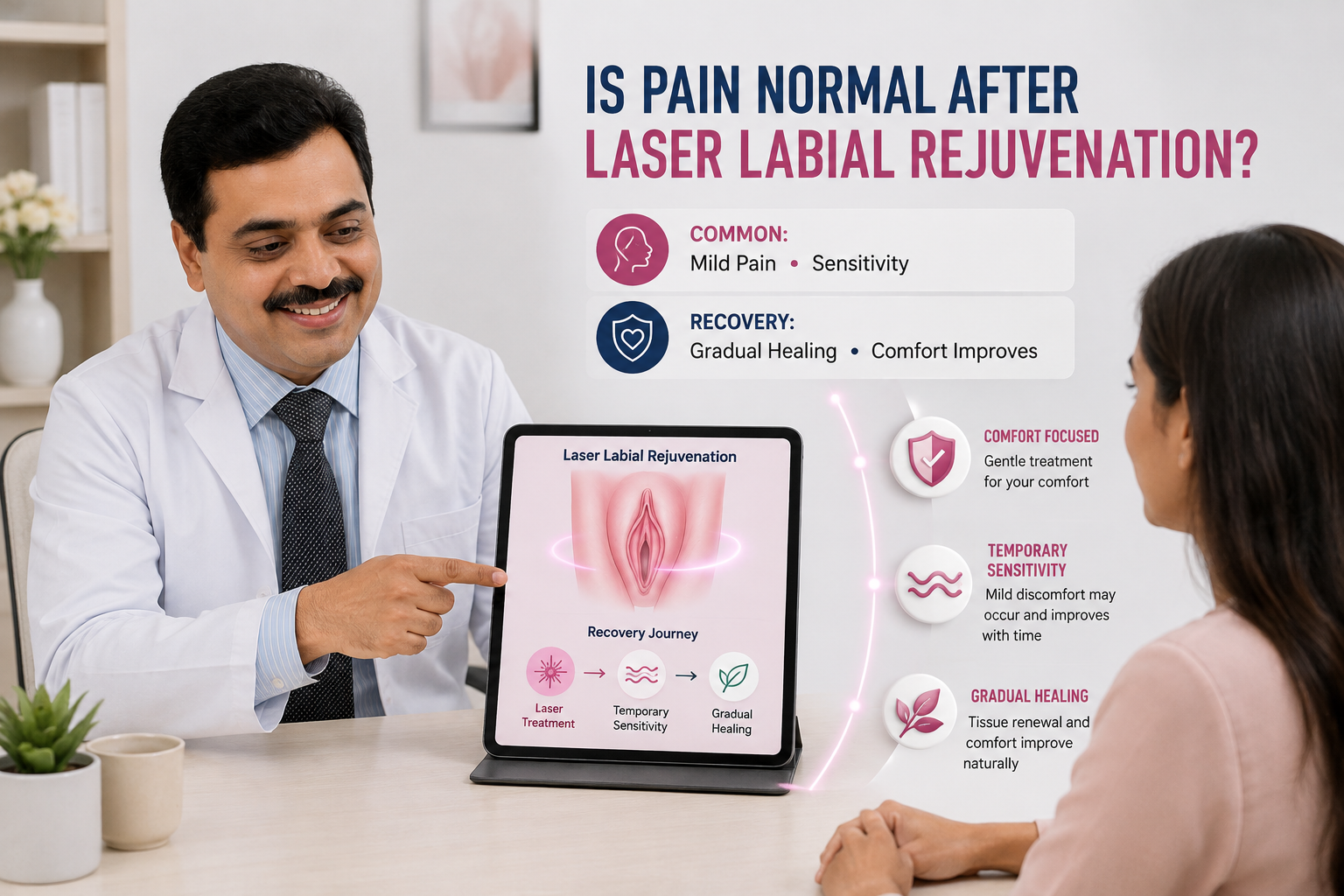
Some pain after laser labial rejuvenation may occur, depending on the type of laser treatment performed, treatment intensity, and individual tissue response. Temporary tenderness, warmth, sensitivity, or mild swelling may be experienced after some procedures. However, severe, increasing, or persistent pain should not automatically be considered a normal part of recovery.
“Laser labial rejuvenation” is a broad term. Different laser technologies and treatment protocols may target different tissues and concerns. Because of this, recovery cannot be described with one fixed timeline that applies to every patient.
The intimate area contains sensitive skin and soft tissue. After energy-based treatment, a temporary inflammatory response may contribute to discomfort. The way a patient feels afterward can also depend on treatment extent, previous procedures, individual sensitivity, and how the tissues respond during healing.
Patients in Surat who are considering laser-based intimate rejuvenation should discuss expected discomfort and aftercare before treatment. Patients who have already undergone treatment should follow the specific instructions provided by their treating clinician rather than relying on a general online recovery schedule.
Most importantly, symptoms that are unexpectedly severe or becoming worse deserve professional assessment. Significant swelling, blistering or visible skin injury, unusual discharge, fever, bleeding, or increasing redness should not simply be managed at home without contacting the treating medical professional.
Key Takeaways
- Some temporary tenderness or sensitivity may occur after certain laser labial treatments.
- Severe or progressively worsening pain should not automatically be labelled normal.
- Recovery varies according to the laser technology, treatment settings, treated area, and individual tissue response.
- Temporary swelling, redness, warmth, or sensitivity may occur after some treatments.
- Post-treatment instructions should come from the clinician who performed the procedure.
- Fever, significant bleeding, worsening swelling, unusual discharge, blistering, or increasing pain require medical attention.
- Laser rejuvenation is not suitable for every intimate concern, so assessment before treatment matters.
Why Can Pain Occur After Laser Labial Rejuvenation?
Discomfort can occur because laser energy produces a controlled effect in the treated tissue. Depending on the device and technique, the body’s short-term response may include local sensitivity, warmth, tenderness, redness, or swelling while the treated area begins recovering.
The intensity of these symptoms is not identical for every patient.
Inflammatory Response: The body’s natural short-term reaction to tissue treatment or injury, which can include warmth, swelling, redness, and tenderness.
A more extensive or higher-intensity procedure may have a different recovery pattern from a limited treatment. This is why patients should receive procedure-specific expectations rather than assuming that someone else’s recovery experience will match their own.
What Can Early Recovery Feel Like?
Early recovery may involve temporary tenderness, sensitivity, warmth, mild swelling, or local discomfort in some patients. The exact symptoms and their duration depend on the treatment performed and individual healing response. Symptoms should generally be monitored for improvement rather than progressive deterioration.
Some patients may feel more sensitive during normal movement, sitting, or contact with clothing.
The important point is the direction of recovery.
Symptoms that gradually settle are different from pain that becomes significantly stronger, swelling that continues to increase, or new symptoms developing after the procedure.
Avoid using an online article to decide whether a particular symptom is normal if it feels unusual or concerning. The clinician who performed the treatment knows the device, settings, treatment area, and immediate response.
What Can Affect Pain After Treatment?
Post-treatment discomfort can be influenced by the laser technology used, energy settings, number of treatment passes, size and location of the treated area, individual sensitivity, previous procedures, and how the tissue responds during healing.
This also explains why a universal statement such as “the pain will disappear in exactly two days” is not medically responsible.
Different procedures marketed under terms such as labial rejuvenation or intimate laser treatment may not be technically identical.
A consultation should therefore clarify what the treatment actually involves, what it is intended to improve, and what recovery is realistically expected.
Patients considering the procedure can learn more about Laser Intimate Rejuvenation before discussing individual suitability and recovery expectations.
How Should Recovery Be Managed?
Patients should follow the aftercare instructions provided by their treating clinician because recommendations can vary according to the device, treatment intensity, and tissues treated. General online advice should not replace procedure-specific instructions or an examination when symptoms are concerning.
Aftercare may include instructions about hygiene, clothing, physical activity, sexual activity, topical products, and when normal routines can resume. The treating clinician should determine what applies to the individual procedure.
Patients should also avoid applying unprescribed products simply because they are marketed as soothing or suitable for intimate skin.
If medication has been prescribed, it should be used according to the treating clinician’s directions.
How Long Should Discomfort Last?
There is no single recovery timeline for every laser labial rejuvenation procedure.
Minor sensitivity after a limited treatment may settle relatively quickly, while another treatment protocol may produce a different recovery experience.
Instead of focusing only on a fixed number of days, consider whether symptoms are improving.
Pain that persists longer than the treating clinician expected, becomes progressively stronger, or develops alongside other concerning symptoms should be assessed.
When Is Pain After Laser Labial Rejuvenation Concerning?
Pain deserves medical review when it is severe, unexpectedly increasing, persistent beyond the expected recovery pattern, or associated with significant swelling, blistering, visible tissue injury, unusual discharge, fever, bleeding, worsening redness, or other concerning changes.
Pain is useful information. It should not automatically be dismissed because a cosmetic treatment was recently performed.
A patient experiencing significant symptoms should contact the treating clinic promptly. Severe or rapidly worsening symptoms may require urgent medical evaluation.
Can Laser Labial Rejuvenation Cause Side Effects?
Yes. Energy-based intimate treatments can cause adverse effects, and the type of risk depends on the device, settings, treatment area, and patient factors. Temporary discomfort and local irritation can occur, while burns, scarring, infection, altered sensation, or other tissue injury are potential concerns with inappropriate or complicated treatment.
The U.S. FDA has previously raised safety concerns about energy-based devices marketed for certain “vaginal rejuvenation” uses and has warned about possible serious adverse events. This does not mean every laser procedure produces complications, but it reinforces the importance of understanding the specific device, indication, evidence, and risks before treatment.
FDA – Medical Device Safety Communications
Does More Pain Mean the Treatment Is Working Better?
No.
Pain intensity should not be used as a measure of treatment effectiveness.
A more painful procedure does not automatically produce a better cosmetic outcome. Appropriate treatment involves balancing the intended tissue effect with patient safety.
Similarly, patients should not feel that they need to tolerate severe symptoms because discomfort supposedly proves that the laser is “working.”
Unexpected pain should be discussed with the treating medical professional.
When Should You Contact Your Doctor?
Contact the treating clinician when symptoms do not follow the recovery pattern explained before the procedure or when you are uncertain about a new symptom.
Prompt assessment is particularly important for increasing pain, significant swelling, fever, unusual discharge or odour, blistering, skin colour changes, persistent bleeding, visible tissue injury, or worsening redness.
Patients in Surat who develop concerns after intimate laser treatment should seek appropriate medical assessment rather than trying to diagnose the cause from photographs or online descriptions.
Understanding Recovery at Elegance Clinic
Intimate aesthetic treatment requires a balance between the patient’s goals, the characteristics of the tissue, and the limitations and risks of the chosen technology.
At Elegance Clinic in Surat, assessment can help determine whether an energy-based treatment is appropriate for the concern in the first place. Dr. Ashutosh Shah’s background in plastic and cosmetic surgery provides relevant clinical perspective when evaluating intimate aesthetic concerns and unexpected post-treatment symptoms.
Patients should understand the expected recovery before undergoing treatment and know whom to contact if their recovery differs from what was discussed.
Conclusion
Some pain after laser labial rejuvenation can occur as temporary tenderness, warmth, sensitivity, or discomfort following certain treatments. However, there is no universal level or duration of pain that should be considered normal for every patient.
Recovery depends on the specific laser technology, treatment settings, area treated, tissue response, and individual health factors. More importantly, pain should generally move toward improvement rather than becoming progressively worse.
Patients experiencing severe pain, increasing swelling, fever, blistering, unusual discharge, bleeding, visible tissue changes, or other unexpected symptoms should seek professional medical assessment.
At Elegance Clinic, Surat, consultation with Dr. Ashutosh Shah can help patients understand whether intimate rejuvenation is appropriate, what recovery may involve, and whether post-treatment symptoms require examination.
Experiencing unexpected discomfort after an intimate laser procedure?
Consult Dr. Ashutosh Shah at Elegance Clinic, Surat, for an individual assessment rather than relying on general recovery timelines online.
Frequently Asked Questions
Q: Is pain normal after laser labial rejuvenation?
Some temporary discomfort or tenderness may occur after certain treatments. Severe, worsening, or persistent pain should be discussed with the treating clinician.
Q: How painful is laser labial rejuvenation afterward?
Discomfort varies according to the treatment technique, settings, treated tissues, and individual sensitivity. There is no single experience that applies to everyone.
Q: Can swelling occur after intimate laser treatment?
Temporary local swelling may occur with some procedures. Significant or increasing swelling should be medically assessed.
Q: How long does laser labial rejuvenation recovery take?
Recovery varies between devices, treatment protocols, and patients. Follow the timeline and aftercare instructions provided for the specific procedure performed.
Q: Can I use creams for discomfort after treatment?
Do not apply unprescribed products to the treated area without checking with the treating clinician, as some products may irritate sensitive tissue.
Q: When should post-laser pain worry me?
Seek medical advice for severe or increasing pain, particularly when accompanied by fever, significant swelling, blistering, bleeding, discharge, or visible tissue changes.

